
First quarter check in at the movies, 2026
In many respects, the first quarter of 2026 has demonstarted itself to be a relatively strong start to the year. As per usual, made stronger by the usual slate of awards contenders finally seeing wide release over the course of January. I am thinking of the likes of Vallade and Han’s Little Amelie, Park Chan-wook’s No Other Choice, or my personal favorite of the bunch, Mona Fastvold’s The Testament of Ann Lee. All of which would be topping my 2026 list had I included them (as it is, I added them to my 2025 list).
Alongside this though, is a year that started with the follow up to last year’s exceptional 28 Years Later (Bone Temple) . While I was a bit less high on it than many others, finding some narrative weakness in the overall story conception, there is no denying the strength of the trilogy, and having this leading the way definitely elevates the slate.
Surrounding that was the dependable if predictable Statham led action flick Shelter, which I found to be refreshingly understated as a straightforward, no frills, thriller with a satisying script and a solid young star complimenting the weathered action hero (here less hero than weathered and aging soul), the underseen but surprisingly solid Austrlian apocalyptic zombie drama We Bury the Dead, which makes the most out of a creative premise and its alluring lead in Daisy Ridley, and lastly the by the numbers January filler in Primate, which is a short but competent formulaic suspense movie where a Primate kills everyone on screen.
Leaving aside Timur Bekmambetov’s slightly misguided Mercy, which despite not being as bad as the critics made it out to be, and even making it’s “made for IMAX 3D” format worth the investment, does fail to read the room regarding the temperament around AI in the present moment. The absolute highlight of January for me was the wide release of Bi Gan’s Resurrection, a film that plays with matters of perspective as it explores those liminal spaces between illusion and reality, standing as a thematic and cinematic celebration of the form itself. That and the experimental film The Mother and the Bear by Johnny Ma, a film about Winnipeg made by a local filmmaker, telling a story that is in many ways a love letter to the city, and which I got to see with a local crowd. This led the way in what has been a really good year thus far for Canadian film.
Not wanting to be left out, February came out swinging with the much anticipated and highly successful new film by Sam Raimi, Send Help, which for my money stood out most for McAdam’s go for broke performance. I never knew she had that in her.
Inbetween that buzzy release and later in the month the much talked about Wuthering Heights, a film that I didn’t care for but which definitely captured the moment on a cultural level, was a mix of VOD and smaller theatrical releases. On the VOD side, Pike River was definitely one of the standouts, a New Zealand project about a real life story involving a mining accident and the politics that surround it, and the women who fought back against the powers trying to silence it. A strong, quiet, emotionally laden effort with a real eye for it’s characters.
Batting straight down the middle were a handful of fine but forgettable films, including the latest Dave Bautista film, The Wrecking Crew (which had it’s moments for a bigger, surface level action film), and two rom-com’s in F Valentines Day and Kissing is the Easy Part (I liked the former more than the latter).
Topping that list of VOD films however was without question La Crazia, the latest from Paolo Sorrentino (The Hand of God). A timely political movie that is less about the politics and far more about those universal questions regarding what it means to be human and what it means to wrestle with ones legacy as a human. And more so, how this seeking after legacy can enslave our sense of personhood or identity to it’s narrative in ways that often run larglely external to our own sense of control. It’s a character study, but it’s also a philosophical exercise to this end, and one that I resonated with in a big way.
Back on the big screen was the next Canadian effort in line, Nirvanna, the Band the Show the Movie, which for someone like me going in blind with zero awareness of the show definitely cemented itself as likely the funniest film I will see all year (and one of the most enjoyable theater experiences). And finally got to see the new Luc Besson film as well, which was his take on the Dracula story. It took that story in certain directions I did not expect on a visual and thematic level, and it really won me over to it’s mix of serious and camp, giving me lots to think about and sit with regarding larger themes of life and death and what redemption means in light of those tensions.
Say what you will about the Angel Studios release Solo Mio (and trust me, I have a lot of my own words about the studio), but my wife Jen and I have a ton of great memories of routinely watching King of Queens before Letterman (or Conan), and equally from our time in Rome. Setting the quality of the movie aside, checking those two boxes were enough to get us out to watch it, and sure enough we got some version of “King of Queens goes to Rome.”
Quietly taking over the box office in the midst of this was the little animated movie that could in GOAT, which earned it’s way into the conversation with a good script and that off the radar appeal.
A film that actually did pretty good for it’s genre, but neverthless deserved more eyeballs on the big screen was Crime 101, a throwback to those old school car chase thrillers that, if a bit too long in runtime, gives us a little bit of everything. That and the follow up to the really solid Emily the Criminal in How To Make a Killing. While not as good, it was still the sort of film that we need, in a healthy theater landscape, to support. The mid-budget, smaller scale originals made by boots on the ground creatives (in this case John Patton Ford). The uniquly ambitious and bombastic Good Luck, Have Fun, Don’t Die by Gore Verbinksi would also fit this bill.
March really became known for three things- the success of Hopper, the advertised failure of The Bride, set alongside the complete takeover of Project Hail Mary. In my opinion, Hoppers hits all the marks it needeed to in order to justify it’s rise to prominance, even while, for me, still sitting behind films like Elio and Elemental in terms of it’s creative vision. The Bride is where I would want to go to bat the most however, as it’s one of my favorites of the year thus far, messy but creative, and never less than interesting as it balances fun and serious in a visionary fashion. Whatever expired milk some of the critical voices were drinking, unfortunately it controlled the narrative surrounding this film, seeeping intto the cultural ethos and announcing it dead upon arrival before it even had a chance. There’s still hope however that the film could somehow gain some kind of cult status down the road, as I do know those who are on it’s side really liked it a lot, to the point where it has a passionate defence.
Not much more needs to be said about Project Hail Mary- big movie that’s hitting the marks people want in dire times. Much more does need to be said though about EPIC: Elvis Presley in Concert, one of the definite films of the year made by the same director who gave us the recent biopic (one of my favourites of that year). It’s not just an excellently crafted and edited concert film, which weaves far more into the territory of narratively driven documentary, it’s a suprisingly satisfying viewing experience, in that the footage manages to somehow give fresh insight, or at least shed a fresh light on, the enigmantic figure. That alone is impressive, but it’s the spell the film casts, inviting us into his charismatic and complicated (and tortured) allure, that was most memorable.
Some other films to note from March, which I did seperate thoughts on recently (so brief mentions here)- an experimental Canadian film, Alberta Number One, the always compelling Jim Jarmusch in his latest effort Father Mother Sister Brother, the Ukrainian sci-fi film getting swalloed up by Project Hail Mary, U Are the Universe, the decent follow up to Ready or Not (Ready or Not 2: Here I Come), the unsettling horror film The Plague and the Canadian film Undertone.
As well, there was Winnipeg Directors McLellan and Trudeau in the northern thriller Hair of the Bear, Canadian Director Anita Doron in the compelling and quite explicit Maya and Samar, and my two top releases of the month, the haunting The Voice of Hind Rajab and the emotionally captivating All That’s Left of You.
Still needing to catch up with three anticipated films I missed- They Will Kill You and Forbidden Fruits, both of which still have at least another week in their theatrical runs, and Kristen Stewart’s The Chronology of Water, which unfortunatley finished it’s run.
In terms of larger narratives, the dominant storyline of course has been the up again, down again dramatics of the WB merger, which remains in disarray and will likely be mired in all sorts of complications over the coming months- don’t be surprised to see it challenged. An unfortunate distraction as things go, given that the real issues this whole thing has been bringing to the surface regarding the present state of the industry would be far better served by addressing actual regulation and vision.
As things go, there’s been a notable trend towards the different ways in which the artists are beginning to speak up about the present state of the industry as of late. And it should be noted, I am noticing a willingness to speak more bluntly and unfiltered. What comes from the select few whom find success these days (leaving the discussion of measure to the side) tends to be different than the creatives, established or not, whom find thsemselves fighting against the system just to stay alive. Listen to the differences between voices like Emerald Fennell, Daniel Chong, and Lord and Miller, and conversations with those like Maggie Gyllenhaal and John Patton Ford, films that were labeled failures. One can hope this serves to tease out the nuances of the discussion over the next while, as playing the success of something like Project Hail Mary, as great as that is, as a catch all for “there is not a problem” continues to miss the forest for the trees (sorry Gosling, I don’t think your speech really gets it).
And yes, if because I keep banging this drum precisely because I think speaking about it is necessary, one of the biggest things people can do is keep watching how a giant like Netflix continues to take advantaage of a landscape weak in regulated terms and caught in continued chaos. That’s the thread with the most relevance and the most power.
To note some positives of the last whle:
– the discussion the merger helped bring to the forefront still feels like it’s somehwat in play, save for getting caught in the political war
– there seems to be some genuine interest in challenging the Canadian film culture to step up to the plate when it comes to defining it’s shape and it’s presence (see the platform the Directors for “Nirvana…” have been utilizing over these last few months), especially where it comes to actually looking at what Canad’s Online Streaming Act is meant to defend (once a product of 20th century anxieties about American cultural influence, it is now grappling with the present global realities- see OPEN CANADA article, “Preserving Canadian Culture in the Platform Era from March 18th). To cite that article, ”
If Canadian cultural policy was built on the assumption that supporting domestic production would shape what audiences see, that link is now mediated by platforms that Canada does not control
That is the conversation at the forefront right now over these last few months- how to connect powers and agencies outside of our culture to a systsem that continues to feed our cultural values, including indigenous and french, independent and canadian theater chains, production, education, ceativity, even as the powers keep pushing back (which of course they will)
– a move like Universal (see: Universal expands their theatrical window) and Amazon (recommitting to more investment in theaters- see Project Hail Mary) is good news
– Voices like Ted Hope, whom has been in the spotlight speaking to A24’s continued value for investment and their call for advocating for regulation is good news
– European regulations being brought into play alongside Canada, arguably where regulations and systems are much stronger than ours, is good news (see the article by Leslie Griffin, Trade Barriers Evolve With Movie Streaming Trends, from Hinrich Foundation). Back in the 1920’s, European coutnries offered subsidies to combat the Hollywood system encouraching on the “keepers of culture” in foreign locations, subsidies that “imposed screen quotas and (windows).” Eleven countries still have this in place. These are the things that now global entities have been challenging and that discussions must address. An interesting note here that breathes some nuance into the ongoing discussions, which is assessing how regulations to protect against Hollywood have also in some ways hindered local film cultures in that it makes it more difficult to find their own global presence.
In any case, some thoughts that have been with me over the past three months. Been also watching the continued redevelopment of The Garry Theater, of which I became a friend (donor) in its preservation. Attended a session at Winnipeg Public Library on the history of Canadian and Winnipeg theaters. I continue to support my local arthouse as a member, which is deeply embedded in fostering and growing Winnipeg film and its filmmakers.
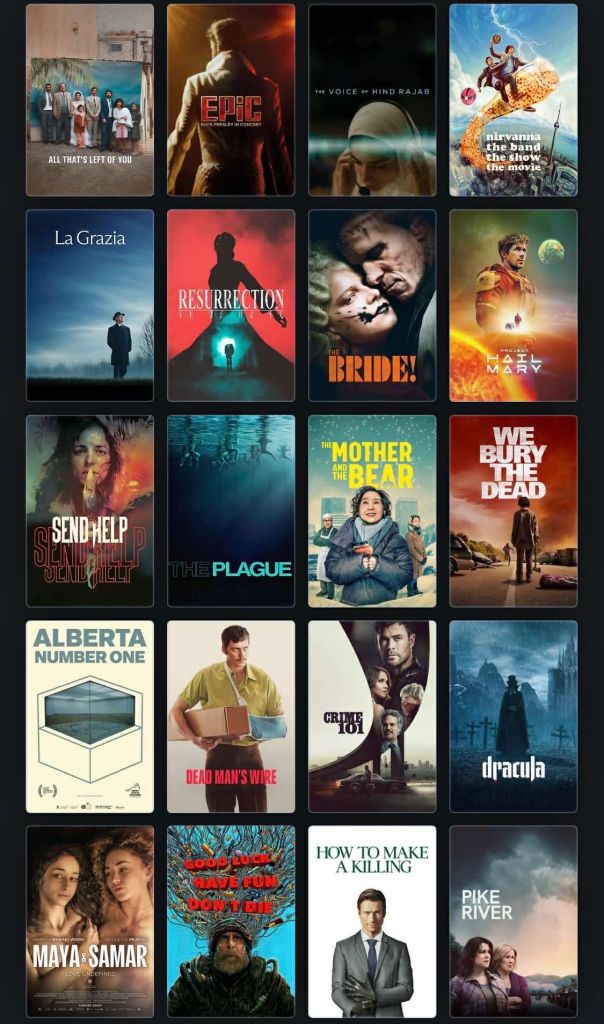
Lastly, here’s where my top 12 of 2026 stands as of the end of March (with the picture rounding out the top 20):
- All That’s Left of You
- Epic: Elvis Presley in Concert
- The Voice of Hind Rajab
- Nirvanna the Band the Show the Movie
- La Grazia
- Resurrection
- The Bride
- Project Hail Mary
- Send Help
- The Plague
- The Mother and the Bear
- We Bury the Dead
 The Stories of my Life