
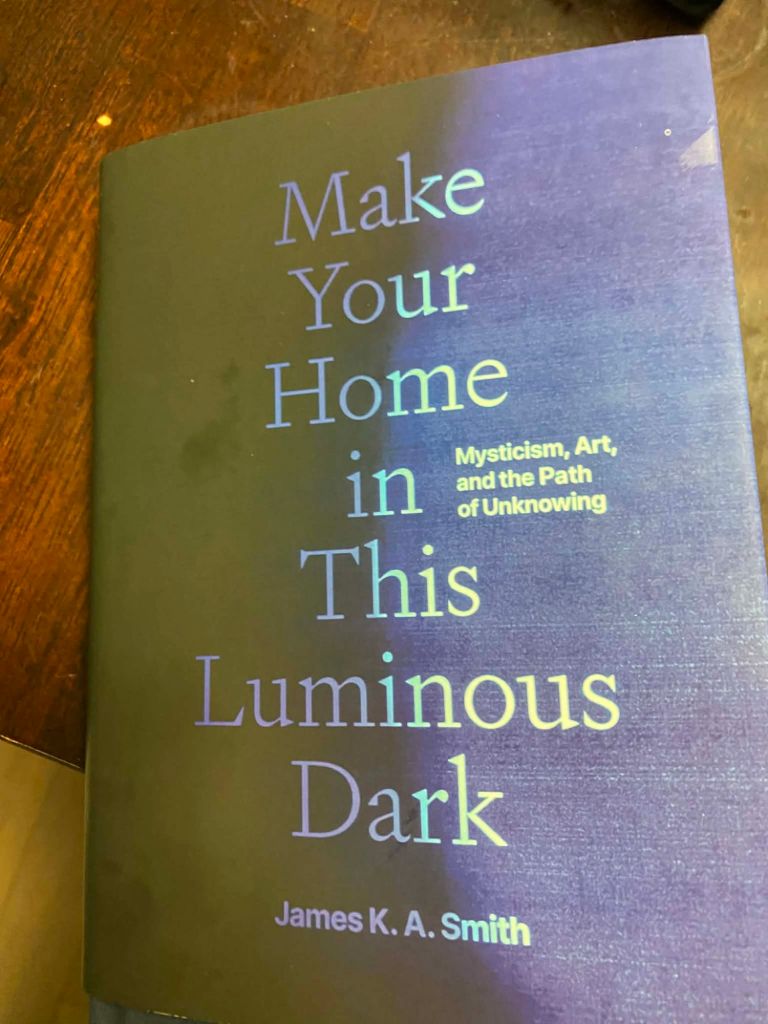
“This is a book aboute how to be when you don’t know.”
Or, as James K. Smith puts it in his latest book, Make Your Home In This Luminous Dark, a book about “how to live when you don’t know what to believe or who to believe, or how you could possibly know.”
The liberation of what he refers to as “profound uncertainty.”
Here he makes an important distinction- it is not about “not knowing,” rather it is about the process of “unknowing.” A word he borrows from the anonymous fourteenth century author of The Cloud of Unknowing.
What distinguishes the act of unknowing from not knowing? One word- conviction. Or better put, uncertain conviction that the mystery worth knowing does in fact exist and can be known.
This is difficult for those of us (or at least all of us in the western hemisphere) whom live in what Smith calls a “knowledge economy.” Knowledge=value and worth, and such knowledge is defined as the aquisition of certain right information regarding what this world is and how it can be controlled. This is what hands us our identity, is whether we know or not. This is what ultimately matters to the human enterprise.
What we ignore is the simple notion that, in our need to control such a conception of knowledge becomes a defense mechanism against the idea that “mystery” means we are not in control. Thus philosophy, Smith’s profession, has become an endless stream of necessary justifications regarding what we know and what this knowledge enables us to control.
As Smith puts it,
“It might be that our uncertainty is not a problem to be eradicated but a country to inhabit, a place to wait for some other way of being to come over the horizon- not certainty or clarity or comprehension, but an awareness…”
An awarness of (and for) the mystery, someting that Smith imagines being caught up in Meister Eckhart’s well known prayer, “God, rid me of God,” a prayer designed to find a God (Truth) beyond “God” (our certain constructions).
In his introduction, Smith talks about being a young man navigating the two worlds of his present aspirations, that of an itinerant preacher speaking to farming communities in rural Ontario, and working his way through school to become a professional philosopher.
Both things he describes as being fundamentally about a need to “get it right.” Both things feeding eachother in one of the book’s first observations of an exercise in later humilty- that he ever imagined his didactic sermons based on delineating a certain conception of knowledge having “anything to do with their lives.”
“Here was a twenty-two-year-old-kid who’d read a lot of books, standing in front of them trying to parse Trinitarian personhood through mineteenth-century scholasticism as if it mattered.”
A second point of later humility emerges here- recognizing that this approach to knowledge was, at it’s heart about “winning.” Win the argument (even with the argument itself) and you have the Truth. Here Smith imagines this as offering a security that became quietly aware as a prison. A prison that the entire enterprise of western philosophy has created for itself, from Aristotle’s “All men by nature desire to know,” (and Plato’s formative foundations standing behind him) to Alexander the Great, cementing this relationship between the development of western philosophy and conquest. There is a constant found embedded within this historical reality- that of the excluded middle. The construction of binaries to encase and protect what we call truth. And this exclusionary practice is what leads to the “profession” itself.
“Philosophers love to know more than anyone- which is to say, we philsophers love thinking about knowing, trying to understand knowledge… (as outposts of metaphsics and epistemology) Questions about the nature of being are reduced to questions about the nature of mind, which, whatever it might be, is the “it” that knows and understands and conceptualizes. But precisely because the philosopher knows- knows how knowing works and is able to pierce through to the essence of things- the philosopher is a cultural arbiter of meaning and truth… They would become kings- emperors.”
And, not inconsequentional, that exclusionary practice hands one a road paved with polemic, one where Smith “imagined the world’s problems ammounted to a failure of analysis.” Good arguments will save us.
That is, until you are forced to attend for the lived life.
Smith has this great confession,
“As a young Christian philosopher, I wanted to be the confident, heresy-hunting Augustine, vanquishing the pagans with brilliance, fending off the Manicheans and Pelagians with iron-clad arguments. As a middle-aged man, I dream of being Mr. Rogers… I used to imagine that my calling was to defend The Truth. Now I’m just trying to figure out how to love.”
Having recently finished the great book Augustine the African, I’m compelled towards the ways that book illuminated those taught tenants (within Protestantism) as part of a more nuanced picture of Augustine wrestling with his own sense of this luminous dark.
Here Smith turns to something more revelatory than observed. He speaks about how that observation, that such efforts are about winning, is actually a facade for the real desire that this “knowledge will save” mindset obscures- that need to belong. Smith doesn’t say this, but my own interaction here wonders about the ways in which those with knowledge about how knowledge works become experts in isolating themselves from a world where what really matters to people is their constructs. Where philosophy’s aim is to break the apparent illusions that hold our lives intact, it also means breaking from the connections those illusions create and sustain. Thus why philosophy (or the well read thinker) turns inwards towards it’s own sense of itself, convincing itself that what set one on this path to begin with is what truly matters- seeking the Truth of things. As Smith puts it, “Mabye philosophy begins in wonder, but a doctorate in philsophy is where wonder goes to die,” bent on the conquering the niche territories we have reduced knowledge to in order to control it.
But Smith pushes this notion further. It is not simply about the one with the truth learning how to belong in the world of the living, where the truth matters less than the illusion; it is about learning how that way of thinking is in tself symptomatic of the larger problem. Here he comes back to that cloud of unknowing, A cloud that cannot be dispersed and conquered by our “winning” the argument. What happens when the same knowledge that hands us progress and technology cannot prevent “the deep rifts in our social fabric.”
Here that observation about belonging resurfaces. I’ve been thinking about this idea over the course of this morning. That exclusionary practice might appear like we are rightly pushing untruths into the distance in order to help ourselves and others see more clearly, but where it applies to the lived life, such actions take the shape of pushing away those whom we come to say in the process- “we no longer know.” Precisely because, that we now know what its true and they do not, the one whom is still in the darkness cannot see us, even as we endeavor to place them out of sight and mind. It’s an irony that underlies this approach to knowledge. What is revealed through this act is the fact that in doing so we come to accept that “they no longer know you either.”
The sort of knowledge we have mastered “in modernity” cannot “solve” this problem. In fact, it would appear, as Smith points out, that the more knowledge we accumulate and thus control in the language and form of modernity, the more anxiety and unahappiness “besets us.” If Smith is right, this is because of the distance it creates, between one another, and likewise us and the mystery, ” leaving our lives to be “shadowed by alienatation and distrust” of anything and anyone we deem not to be the truth.
Smith goes on to describe a life changing moment for him, where he faced something out of his control (or the control of his philosophical weapons), and eventually found something that reached beyond “an exchange of ideas,” which he calls an act of “re-narration.” Learning, as an act of imagination, to embody a different story.
Holding “swirls of contradiction…” This is what allows us to truly enter into the logical implications of whatever story/narrative is actually governing our lived lives. This is the real interest of the logical argument. At the end of the day, story, not philosophy, is the universal language. If philosophy is to have real and true formative power when it comes to awakening us to knoweldge of what is true, and Smith believes it does and it can, it needs to begin with desire. Our desire to know Truth. And subsequently, it needs to end with msytery. Apart from that there is nothing to draw us towards Truth in a way that can preserve it and allow it to be known.
Smith brings in a different question then- why do we want to know? What do we (actually) want when we want to know? Both questions that lead to the central observation that holds it altogether- the recognition that I (we) want to be known. There is a word for this- phenomenology. Rather than a dusty, intellectualized conception, this word, if properly recaptured and reconstituted in practice, has the power to reawaken the wonder behind this desire for knowledge. More importantly, it places us directly back into the realm of the living, where knowing comes through necessary participation in the spaces we occupy.
I’ve been thinking (and praying) this morning about how this intersects with my own story and life. What, as someone who very much resonates with this interest in philosophy and who spends a lot of time reading a whole lot of books, does this speak into my own tendencies and prisons? One thing I can say for sure- I know this luminous dark.
I wonder where and how I am caught up in this polemic. Perhaps there is a fine line that is easy to step over in any given moment between engaging this modern philosophical landscape on its own terms and the desire to speak to the issues and frustrations Smith is tabling (is it a polemic to go after the penchant for polemic?). A greater awareness of this line I think can be a good thing.
I know the isolation he describes. When so much of the necessary work seems to require the dismantling of the world’s constructs (including within Christianity), it hands you a mix of disinterest, anger, rejection, puzzlement, and distance from others. Where this desire for knowledge means you exist everywhere but seemingly belong nowhere. There are two things Smith references that I think are helpful here- offering a reminder that forming convictions is necessary for any pursuit of knowledge. Which is more a recognition that we all have them in the form of a guiding narrative. This matters if we are to reclaim a proper redefining of knowledge as more (or something other) than our modernist terms of true information. It exposes not just our interpretation , but the interpreter. It’s a reminder of the persons, and indeed the whole of creation, occupying the mix of this shared experience.
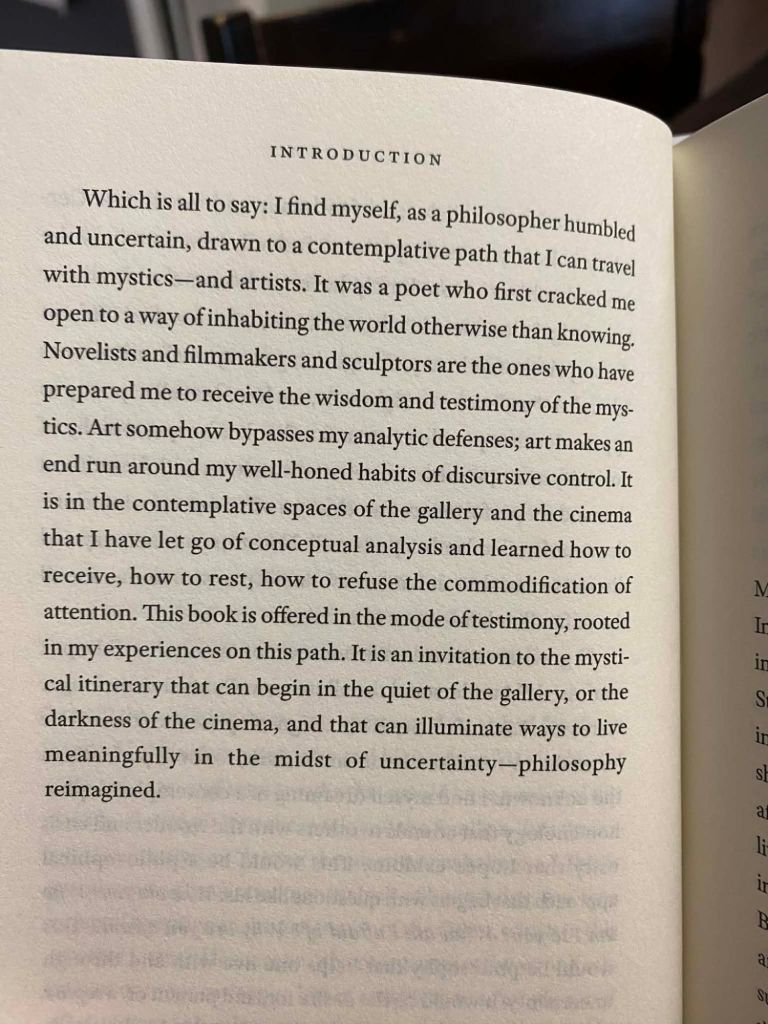
Lastly, and I’ve included a screenshot here of the fuller discourse, I resonated deeply with Smith’s descriptive of how he has learned to move from from the intellect of the head to true knowledge of the lived in spaces of this world. He speaks of needing the artists and the mystics. to act as a brdige. I have often spoken about how for me the cinema is like a sanctuary, a way of moving from where I am (often in my head) towards an encounter with the transcendent. With God. With the mystery. To me it is a sacred space. Reading also occupies this space, more so these days with the continued disenchantment of cinema as a space once meant to evoke wonder. Here Smith legitimizes this practice as an essential part of knowing. Of seeing it as a way to expose the limits of logic (our our logical arguments), and challenge our methodologies of control. It’s a reminder of why these sacred spaces matter both to our convictions and our desire to know, and above all to our ability to belong.
 The Stories of my Life