Reading Journal 2024: Matter and Memory

Reading Journal 2024: Matter and Memory
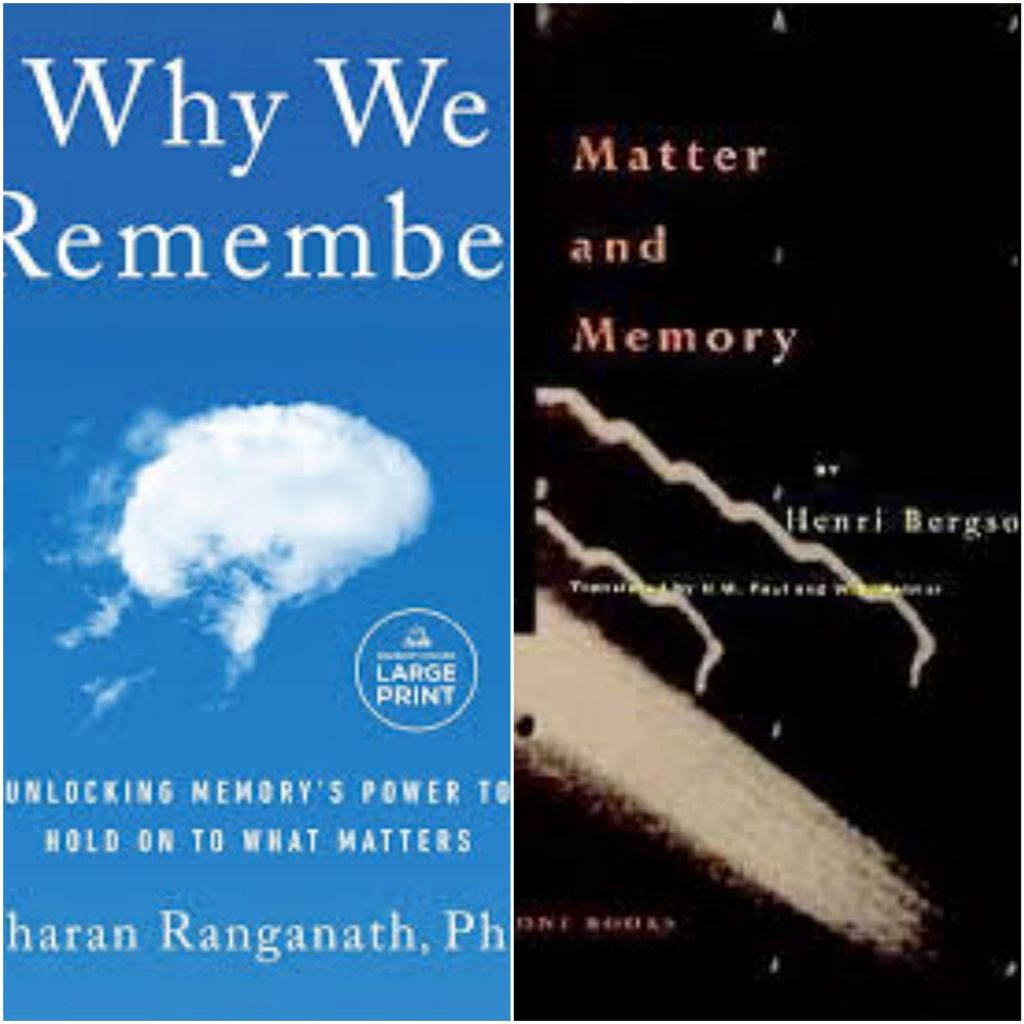
Author: Henri Bergson

A tough read, although altogether fascinating and challenging. The toughness comes in wading through the thought process. The ideas are poignant and profound, but also at times frustratingly allusive in both their nature and their argumentation.

The purpose however is clear- “This book affirms the reality of spirit and the reality of matter and tries to determine the relationship of one to the other by the study of a definite example, that of memory.” This attempt to reconcile platonic ideals with aristotelian realism becomes the essential pattern, and it depends on both distinguishing each idea while at the same time seeing them as operating in relationship to each other. Here he puts forth a mutually existing pure perception and pure memory.

This is where I think it gets difficult to fully grasp. The author is clearly critiquing modernism and its hard and fast allegiance to enlightenment thought. However, this critique comes through acknowledging that the existence of pure perception actually roots memory in realism, while pure memory roots perception in idealism. Perception emerges from the flow of memory, thus being made of a composite of progressive actions as we exist in relarionshop to the world around us.

It becomes a fallacy to say that memory is a materialist function, and equally a fallacy to say that perception is not a spiritual function, precisely because these two ideas are interrelated and dependent on the other. The more we see them operating together the greater our perception of reality becomes.

I am deeply interested in the subject of memory, so I really appreciated how he approaches this subject as a blend of science and philosophy. He doubles down on perception as an active word, meaning it is formed as we act in the world, or through necessary movement. Without movement there would be no perception precisely because there would be no memory. It is on this basis that he looks to establish that memory is not simply something that is trapped in a brain, as though it is a series of snapshots being stored until they are accessed. Memory perception exists as a summation of movement/activity, and thus as reality. Perception pulls memory down into the functional reality of Aristotle’s concern while memory pulls perception upwards into the Platonic ideals, ultimately giving us what we call reality, something that is neither realism or idealism, both pure ideas in their own right, but something truer to itself when it is opposing such dualism.

I’m butchering the brevity of the books lengthy passages and exposition, but from what I gathered these were some of its more essential conclusions. Because movement and image are not opposed but mutually dependent, this must change our perception of reality, or our perception of perception to put it more aptly. Living, or true reality is what he calls a “continuity of becoming”. Perception can only ever be a distinguishing of the beginning to the end, a movement. And in the center of this movement is a body. A body situated between the matter that influenced it and that which it is has influence on. It is human interaction with these two competing forces, which is responsive in its nature, that holds consciousness in its grip as the characteristic note of the present, pulling realism and idealism together as it acts/functions.

To cease to act would be to cease to be conscience, and to cease to be conscience would be to cease to exist. It is this flow of  conscious action that we can call spirit. Consciousness illuminates the past in relationship to the future, proving that the past must exist/survive for the present to exist. We, by nature of conscious awareness, are interested in the unfolding of time precisely in this manner, not necessarily the whole, but the unfolding depends on the existence of the whole.

If it hasn’t been made aware yet, this is why this is a tough read. I would wager even my understandings here, for as much as I am trying to articulate it with integrity, is not yet quite grasping the ideas. But that’s the beauty of such a process- it ruminates, and as it does I trust it continues to bring clarity, because I do think this is important stuff.

Reading Journal 2024: Brewtown Tales: More Stories from Milwaukee and Beyond

Reading Journal 2024: Brewtown Tales: More Stories from Milwaukee and Beyond
Author: John Gurda

Bought this on my visit to Milwauke this past summer, and it didn’t disappoint. I was interested in learning about the character of the city as I was fascinated by its story and its uniqueness as a midsize city center existing in the shadow of its much more prominent southern neighbor (Chicago). It is designed so that you can start anywhere and pick up anywhere, serving as  collection of essays that travel through the different parts of the city and through his own personal family history. But it is also able to be read as a cohesive story that moves through time and development.

Given that I had visited many of the neighborhoods and got a decent sense of its city structure and geographical shape, it was both helpful and fun to be able to read and imagine those spaces’ development. I’m a sucker for a good story, and the author is a good storyteller, helping the different quirks and flavors come alive.

You not only get to see its innovations, but you also get to hear about the would have/could have/should have beens on the historical stage. Loved the transformation of the waterfront, its storied relationship with the railroad, its history with bikes and bike infrastructure, and its fascination with drama and its dark history. The city that it has become seems to see itself formed from the early divide that the river and its central bridge created, choosing to lean into that ethos of being a mix of dark and lawless underbelly and smart, innovative culture.

Looking forward to returning for another visit with greater awareness in tow.

Film Journal 2024: The Coffee Table

Film Journal 2024: The Coffee Table
Directed by Caye Casas

A tight, taught horror indie that uses a simple premise (a couple with a new baby purchases a new coffee table that becomes the center piece of their home) to depict a gradual but persistent unraveling of their once mundane lives.

The Director uses a mix of visual filmmaking and character work to achieve a real sense of dread, and features some genuinely memorable sequences. It struggles a bit to land some of its metaphorical or allegorical possibilities, and it could have been better served by trading some of the less fleshed out plot pieces (there is one particular thread that ultimately proves to contribute little to the overall end effect) for a stronger thematic focus, but what it does well it does very well.

Film Journal 2024: The King Tide

Film Journal 2024: The King Tide
Directed by Christian Sparkles

I tried hard to catch this in theaters but couldn’t make it work. Was happy to catch up with it now that it’s on VOD and Hoopla, as it felt like it would be my kind of movie. It has elements of horror, drama, spiritual and philosphical reflection, thriller, and has a strong sense of place and setting.

There is a moral dilemma at play that is fascinating to watch play out, and I love how it uses this to then flesh out the community dynamic of this small, isolated village. It really does feel like there is a lot more hanging in the balance than the initial optimism and excitement this community initially exhibits and expresses understands and recognizes. It is these untold and somewhat hidden tensions that guide the story forward through the unusual nature of its present circumstances. A seemingly good and positive turn of events feels like it is stirring what are some deeply rooted primal instincts. Which makes this an equally interesting study of human nature.
An under the radar gem that has much to offer both on the cinematic and thematic front.

Film Journal 2024: Lost in Tomorrow

Film Journal 2024: Lost in Tomorrow
Directed by Kellen Gibbs

A quaint and lovely hidden gem. It feels a bit uncertain in the early going, but once the premise kicks in, following a young girl struggling to fit in at school and at home as she finds herself lost in tomorrow, it is quite affecting.

What’s interesting about the film is that you could essentially break it up into different parts, as the cast is always changing even as we follow a singular character. And that easily could have been a weakness here, as without a visible lead it could feel like it might be hard to locate the character development. The Director does a really nice job however of tying each sequence together narratively and thematically, and each new person that we meet (or that she wakes up in) does a great job of embodying her growth and transformation. Part of the journey here is, every time she wakes up she gets further away from herself. Thus there is a natural flow to the concept of learning to find herself by discovering the story of others. Our main character is always part of the story even when her face is out of view.

Works really well as a low budget, indie family film with lots of heart and a good message that traverses subjects like family, identity, growing up, discovery, and being present.

Film Journal 2024: Footnotes

Film Journal 2024: Footnotes
Directed by Chris Leary

Low budget indie that makes decent use of its script and its performances. You can tell the film wants to dig deep, to explore the nuances behind the standard romantic drama beats. It doesn’t fully realize its potential on that front, trading a drive for clarity and real thematic punch for getting lost in some of that nuance instead. But what makes the film worthwhile is that desire not to simply stay on the surface.

There are certain subtleties to the way the central relationship develops, following two single neighbors struggling with the recent lockdown during the pandemic as they randomly choose to become each others safe person, bridging the functional distance and creating a cohabiting space. These subtleties ebb and flow through a relationship that is largely undefined. The more time goes on the more you can feel that inevitable emerging crisis that demands some sort of defintion. The question hanging in the balance is, can they find a shared defintion.

It’s a very conversational film that leans into the chemistry of its leads, which is definitely there. The film is at it’s best when it’s just sitting with them in these moments, allowing us to search for those subtleties and nuances that naturally emerge from the conversational flow. When it does need to move the story forward on its own, using a mix of editing choices and visual moments, it feels slightly less confident. However, the groundwork it lays allows it to stay afloat and to utilize its final concluding moments in service of that developing tension.

Not bad for a small and unassuming debut.

The Fracking of the Mind, The Problem of the Self, and the War For Our Attention: The Ezra Klein Show In Review

I was sent this Episode recently of the Exra Klein Show titled Your Mind Is Being Fracked, along with a strong recommendation to give it a listen.
Great episode. Highly worth a listen for anyone interested in the subject of attention, particularly as it relates to our present social media age.

There’s a natural progression to the conversation that brings up many worthwhile points to think about and ponder. Some of my own reflections:

They bring up the question of defining what attention is, nong a lack of clear defintion, especially when we look at the differences between functional attention (such as the idea of attention being the absence of distraction that allows us to do our jobs well) and emotional attention (such as relational engagement that requires being immersed, or attentive, in a given experience).

The question of a working defintion is attached to the question of when and why the notion of attention came into being as a recognizable, and therefore necessary idea and concept. One could argue that attention emerges as an idea because it became necessary in response to human (evolutionary), societal and cultural changes. Here then we get caught in another tension- is the interest in attention based on a positive (we need to understand and hone the concept of attention for the sake of a, b, and c. And further, does a, b and c reflect our central value system, and if so what is that value system).

Or is the interest rooted in the negative (a, b, and c robbed us of our attention, therefore we need to understand it and hone it for the sake of gaining back that which was lost for the sake of human flourishing).

What was interesting to me was the way the first part of the episode begins to root our interest in the concept of attention in the question of human flourishing. On some level, and it articulates this later on, understanding typically follows feeling. Meaning, we feel this or that to be true, and thus the need for understanding emerges when this feeling reflects a point of crisis. Understanding is never, however, purely functional. It is simultaneously revealing a value system. And this is crucial to our ability to say something about why education, or education about attention, matters.

What is interesting was the tension I then felt listening to the first part of this episode, as I found myself noting how much of the why of the matter (or why it matters) persistently kept coming back to this notion of human flourishing, and how human flourishing kept coming back to this notion of the self as the ultimate end. A self that even they note is an illusory idea at best, if a false one.

Further yet, I found it fascinating to consider that all of the ideas about attention it was fleshing out on an academic level were ideas that I had learned a long time ago through my years as a practicing Christian in the church. Here the host makes an interesting distinction between two prominent but arguably co-existing definitions of attention within academia- attention as action (bringing about or acting on known/revealed desire), and attention as waiting (allowing that unknown desire to emerge). This echos the very defintion of Hebrew and Greek faith or faithfulness as an embodied term rooted in spiritual practice.

Things get even more interesting when the host notes a world where religion has lost its narrative presence and force of influence and has been traded for market values. In some sense what is being reflected on here is a trading of the emotional or immersive form of attention for the functional. And what is expressed is a dissatisfaction with the value system (market) this binds us to. Not only do we seem to feel a loss of attention (or our ability to be attentive), our attention has been commodified and reapplied to modernitys obsession with a form of progress.

The guest inserts the possibility then of two other avenues that can do what religion does- education and the arts. But here is the issue. What religion does is it allows us to direct our attention to something other than ourselves, precisely because something other exists. Education doesn’t have the power to either be a transcendent value or an end (it is in fact a subservient activity), but in a world absent of religion it plays that role superficially and falsely. The arts on the other hand can only be an expression of our values. It points to that which drives our attention/convictions and which gives it value. What happens then when those values are inevitably held captive to the self? No matter how education and the arts attempt to replace religion, they inevitably come back to that same fundamental place- human flourishing. Or the capacity of the self to point to the will (or choice, or liberty). To point to desire. This is why attention is seen to be a concern. But these are all, by defintion, functional constructs. They are things that don’t actually have transcendent qualities, no matter how much our art attempts to treat them as such. This leaves this train of thought grappling with the notion of the world we are being attentive to being a necessarily false one.

Things get more complex when they begin to consider how it is we solve the question of the cycles or progression of history. As people we inevitably compare our present to the past, and we are prone to seeing either our present as superior in its progression or as futile in its descent (the world is getting worse). In some sense it appears to be a both-and, but that requires a measure and it also is held captive to how we tend to need to think in more hard and fast terms if we are to give our present interests/concerns validation, motivation and meaning (progress requires this). The present is always left thinking in terms of its particular concerns and vantage points. Complexities emerge when we bring in things like history and progress as reasoned faculties. The challenge here is that simple observation tells us we are still here, therefore the concerns of the previous generation didn’t lead to the worlds end, but in reality we can equally observe that the problems also didn’t go away, they simply changed and morphed according to the same cycles and patterns inherent in the whole of human progression. So, tackling the problem of attention might be relevant to the here and now in context, but the minute we step outside of ourselves it becomes apparent that we have little to no basis to think and believe that this will and does lead to a positive progression.

Which is perhaps what attention is really about. We can see the world as it is and feel that things are not right, especially as we experience change. But we also intuitively need to be attentive to what we call the unknown in order to function in this world. The question is, can we say that the unknown is true or false. Is it conception/construct or is it reality. Is it functional or transcendent? These things have massive implication for how it is we attend to the present and whether we can actually get past the self on our way to a defining value system that justifies our need to be attentive. To me, the podcast conversation tables this tension, but then kind of walks around it. It is nevertheless interesting though and thought provoking and highly worth a listen.

Reading Journal 2024: Winesburg, Ohio

Reading Journal 2024: Winesburg, Ohio
Author: Sherwood Anderson

Winesburg, Ohio could be described as; chronically melancholic, cynical, depressing. Those descriptives might be true, or at least partly true, but I think it would be a mistake to suggest that this is all the book is. As a collection of short stories that are bound together by the arc of a singular, reoccurring character (George Willard, a young journalist who works and writes for the local newspaper), Winesburg is a deeply immersive and honest portrait of the life of different people living in a small, unassuming, isolated, mundane, non-descript town.

The book is marked on the front end by a chapter titled Book of the Grotesque’, and ends with what I might suggest is one of the best final lines of a book I have ever encountered, if for the pure simplicity of its presence, bringing Willard’s particular part of the storyline to a fitting and poetic conclusion.

Speaking of the prose, while the nature of a short story collection is that some will inevitably be stronger and more interesting than others, which is true in this case, rarely did a page go by where I wasn’t highlighting memorable and quotable phrases, lines and sentences. It is described in the introduction as a “fetish for simplicity”, but that simplicity is profound, “seeking always to penetrate to thoughts uttermost end.”

Which makes his first chapter that much more fitting when he surmises, “in the beginning when the world was young there were a great many thoughts but no such thing as a truth. Man made the truths himself and each truth was a composite of a great many vague thoughts. All about in the world were the truths and they were all beautiful.”

Beautiful even where it finds things like depression, loneliness, boredom, death, addiction, and unrealized longings. This is a book that doesn’t feel the need to mask over the truth of these realities, instead embracing them as part of what binds us together.
I’ve been accused of being melancholic, depressed, cynical myself, so I’m not surprised I found myself connecting with this, and even more so appreciating it. As one character proclaims in the chapter called Mother, “it seemed like a rehearsal of her own life, terrible in its vividness.” Or as it described of Willard, “He is groping about trying to find himself. He is not a dull clod, all words and smartness. Within him there is a secret something that is striving to grow.”

Don’t be surprised if this becomes your own response as well should you give this book a try. I couldn’t have put it better than what I found in this sentiment:
“I don’t know what I shall do. I just want to go away and look at people and think.”

I’ll leave it with this exceprt from the forward,
“It is essentially a literature of revolt against the great illusion of American civilization, the illusion of optimism, with all its childish evasion of harsh facts, its puerile cheerfulness, whose inevitable culmination is the school of “glad” books, which have reduced American literature to the lowest terms of sentimentality.”

Conversations About the Western Self: Common Themes in Will Storrs Selfie and Mann’s Inside Out 2

Reading Journal 2024: Selfie: How The West Became Self-Obsessed
Author: Will Storr
“All we ever wanted was the illusion of control. But we have none, not really. Neither do the people around us who seem so intimidating in all their radiant perfection. Ultimately we can all take comfort in the understanding that they aren’t actually perfect, and that none of us ever will be. We’re not, as we’ve been promised, “as gods”. On the contrary, we’re animals but we think we aren’t animals. We are products of the mud.”

“If the self is a story, then the story the Western self wants to tell is one of progress. Reality is chaos, chance and injustice, our future is illness, bereavement and death. All about us there is terrifying change and there is little we can do to manage it. But our sense of self hides this disturbing fact from us.”

“We’re not all constructed from the same precision-tooled machine parts. We havent all been equally perfectly designed to face the challenges of our environment. We’re lumps of biology, mashed and pounded into shape by mostly chance events. Our human potential is limited.”

“By the time we’re old enough to really understand what our personality is, and begin wondering if there’s anything we can do to change it, most of the work has been done.”

The best treaties and arguments are the ones that are able to be truly honest and upfront about their assumptions and their worldview. This is unfortunately rare in much of liberal, secularized academia. Emphasizing claims to true empiricism and focusing on the functional is often used as a means of sneaking in value claims through the backdoor where they don’t have to be submitted to reason. To challenge those value systems as being irrational typically leads to charges that one is placing too great a burden on reason, formulating this deep inconsistency of logic and argumentation that becomes impenetrable to critique.

Will Storr is nothing if not brutally honest about his working assumptions and the implications of his reasoning. In his worldview the self is a fabricaton, reality is nihilistic in and of itself, meaning is the stories we tell about ourselves which are constructions of our illusions, and there is no such thing as the will or actualized control over our circumstances.

We are, by nature of being naturally born creatures, tribal.

We are, in fact, products of our culture, which means slaves to our nature and formed by our influences.

But this book isn’t according to its author, “a message of hopelessness”. It is in fact a response to the hopelessness that emerges from failing confront the basic truth of our reality and our existence. It is about recognizing that happiness is a purely functional reality, and by recognizing that notions of perfection are in fact a fallacy and that we are ultimately products of chance in a world that is neither equal or fair in its biological function, we can allow our natural tendencies, dependent as they are on our illusions, on our stories, to shift us into environments better suited to enabling feelings of happiness, defined as it is as human flourishing.

And why be concerned with happiness? Because suicide is an epidemic in the modern world. It shouldn’t be given our nature is wired for self preservation and survival. But, as the author submits, it is, leading him to set out and answer the question why. This leads him to a singular observation- it is rooted in the art and function of social perfectionism. If “one of the most critical functions of the human self”, that illusionary construct comprised of story, or the stories we tell ourselves, is “control”, then feelings of failure leave us out of control and thus prone to self destruction. In truth, the idea that we are in control is fact an illusion based on greater illusions of the self.

While this is a modern evolutionary trait of humanity, it can be made sense of by understanding empirical observations about nature, biology, and human evolution. Suicide might seem counterintuitive to our nature, but in reality it is rooted in observable truths about ourselves as creatures existing within the natural world and the natural order. Knowing the patterns can help us parse out where suicide fits in what are inherited self obsessed genes and traits.

And yes, everything, even altruism and self giving practices and concern for the other are inherently selfish activities.

So why does this ultimately matter? Here in lies the conundrum. Suicide is a natural outcome of our natural selves living in a natural order. Once we understand what it is we can see that it is not an abnormality. And yet, so is survival. Thus to understand and to respond to suicide as a “problem” is part of our natural drive towards self preservation, in this case being locating ourslevses in the western concept of human flourishing defined as happiness.

And the best way to be happy? Recognize that perfection doesn’t exist, that progress is a fallacy, thus stripping away the comparative measures that lead to feelings of failure.  Here the author distinguishes between depression and failure, suggesting that if we commonly associate depression with suicide, depression is in fact more acutely connected with confronting reality, not suicide. Suicide is nearly entirely connected to feelings of failure.

The author spends each chapter deconstructing the different historical movements that lead to the modern west, both to show how the west is no different in its nature and function than the ages that preceded it and to show how it is equally distinctive in its context, and thus it’s questions and concerns. Nature stays the same, culture changes. And we are products of our culture. Whether we are talking about Greco-Roman culture, Christianity, the enlightenment, neo-liberalism, industrialism, the digital and technological ages, they are all constructs out of which we locate and find our cultural norm, and thus the integral self that frames our cultural obsessions. These things matter because it is the self and the world that we know, and we need these constructs, and even to believe in their realness despite what we know empirically,  in order to survive. Thus these things are formed into value systems, value systems that don’t correlate to realty but rather function as part of it, as illusions. To change our cultural realities, to change ourselves, is simply about changing our position, as to occupy different spaces is to gain different influences that then drive us in particular directions. More importantly, those with chance capacities, wired biologically, can change others by changing cultural influences. However, the key here, if we are to tackle suicidal tendencies, is to recognize that cultural changes are differentiated from the natural order. When culture, which reflects value systems, is made synonymous with the natural order, it likes to pretend that it can supersede it, which is precisely what makes the west distinct in its history. It turns illusions into reality, creating false standards of perfection that reality ultimately unmasks as failure. It takes the truth of a nihilistic reality and reframes it as a functional nihilism in practice, both binding us to the illusions and fallacies that allow us to live while convincing us they are untrustworthy.

I’ve got two essential responses to this book. First, I greatly appreciate its honesty and transparency. This is the implication of the worldview and assumptions it is building from, even if it is difficult for us to accept,

On the other hand, I think I would hold the authors convictions more directly accountable to those implications. I’m not convinced that the author has grounds to say that suicide is wrong or bad in his view. He is bound to the ultimate aim- happiness, and in truth happiness is free to express itself in a myriad of ways that dispel what feels to be encroachment of concrete claims of good or bad. Human flourishing is far more malleable as an aim than I think he wants to admit, and I think there is good reason for most of humanity to see the reality he observes and argues for as nihilistic in nature and function. It is thus possible, and indeed most likely, for happiness to function apart from any fundamental concern for the given value of human persons, let alone the world.

Nevertheless, I think this would be a book I would cite and reference in any conversation that wants to suggest empiricism and reason are value systems in and 0f themsleves, and even for that matter reliable or relevant apart from the value systems we are assuming to be true when we engage such things. We are all naturally bred master storytellers. If Storr is right about realty, we just don’t like to be confronted with the fact that the stories we tell to give life meaning are inherently false when measured by the same terms we use to govern reality (empiricism and reason). I don’t happen to agree with Storr’s observations about reality, but i do agree with the implications of his view and appreciate his willingness to deal with that head on. I don’t buy his appeal to hope, but if I had to locate his hopefulness I think I would point to thus summarizing quote:

“I thought once again about how counterintuitive it all was; about no matter how convincing it might seem that our perspectives and beliefs come from a personal place of freely willed wisdom, my investigation hinted at the extraordinary extent to which we are, in fact, our culture. Which is not to say we’re all clones, of course. We have different personalities, different in-group identities, different political biases, and so on. But all of that still sits within this dense web of stories, heroes, dreams and dreads that makes us all, no matter how far apart we might sometimes feel, a family.”

Film Journal 2024: Inside Out 2
Directed by Kelsey Mann

I’m glad I did a recent rewatch of the first film, and that I watched both films in essential succession this morning. I hadn’t actually revisited the first film since seeing it once in theaters back when it released, so I knew that a rewatch might bring some interesting and maybe suprising results. More importantly, it gave me a better gauge for which to make sense of my experience with both films as a seperate but also singular story.

Just to clear the air right up front, if you are stuck on begrudging this as a sequel, seeing it as emblematic of the larger problem plaguing both studios and theaters as they continue to doible down on familiar IP, that will likely define your experience of Inside Out 2. The simple fact that it is operating without the novelty of experiencing its inner world brought to life for the first time I think could feel like justification for resisting its existence.

In truth, I do think this fact forms what might be my biggest critique of the film, which is, by nature of contextualizing both stories into a narrow framework based on age and formation the sequel naturally condenses the reach of its message, both in its present context (puberty) and retrospectively (childhood). Of the two films the sequel suffers more, as I think the original has an already established legacy that applies its message and themes more universally as a concept. Similarly, the first film has the advantage of doing the leg work, which means it does the heavy lifting of parsing out the complexities of its vision and concept in ways the sequel doesn’t need to, leaving a fair portion of the sequel feeling a bit episodic in nature and even a little too on the nose.

It should also be noted though that the first film anticipates the sequel. It sets the stage for it, so to speak, and upon rewatch I think really does operate in faith of its eventual existence. This should help dispel some of those feelings about it being either unnecessary or simply a cash grab. And true to form, if  much of the film feels episodic, the recognizable and familiar Pixar “magic” shows up for the final act.

Thematically speaking the film continues where it left off, bringing in the new emotions that come along with puberty and, as the film posits it, the subsequent formation of the self. What’s interesting about the way the film navigates this is, the whole puberty aspect does tend to get left in the shadows the further the film gets into exploring its conception of the self. This is at least in part because the story is so contained and narrowed to its particular situation. I feel like it wanted the simplicity of its scenario driven plot (young girl going through puberty has a chance to discover her dream to be a hockey player at a time of personal transition) to afford it the freedom to then dig deeper into the bigger ideas it is exploring about the self, but there is a bit of a push and pull within the story between these two parallel lines that does end up feeling disjointed. To be fair, the plot of the first film is also far simpler than I remembered, but it had the freedom to commit more wholly and completely to the conceptualized inner workings of the emotional world precisely because it didn’t need to worry as much about the functional self. The natural progression of the sequel is towards bringing in that added dynamic of identity.

I remember when the first film came out that there was a plethora of think pieces dissecting the science of its premise, some supporting it and some criticizing it for pushing the science too far into the realm of ideology and transcendence. I also heard critiques about how it depicted emotions as seperate entities functioning in isolation. The sequel sort of addresses this in a round about way. It assumes the same fundamental end- happiness, or as some define it, happiness as the grounds of human flourishing, but it adds in a new emotion (anxiety) which has the power to bind all the others together. If happiness is the end, anxiety is the means that ensures it is attained. In the first film the story is about embracing sadness as a key to joy rather than its antithesis. In the sequel it is about embracing the whole as the true expression of the self.

Here is where things get really interesting however. The film roots the self in the notion of core beliefs. In theory, it is bringing together beliefs about the world and beliefs about the self, rooting in the natural outworking of puberty as the point in which we begin to build and formulate our identities in the face of these two interrelated realities. Not against our formative years, but in light of it. Beliefs here are seen to represent agency, toying with the question of whether our biology makes us who we are or if we (an operative self) determine our biological function. There is plenty there to parse out as far as reading between the lines in one direction or another, but suffice to say what it is teasing out along the way is the concept of a functional will.

I feel like the contained nature of the film does get tripped up here a bit, because it fails to leave room for wrestling with how past and future connect to the present. It seems to give in to the danger of allowing a point in time when the self generally sees itself as both conceptually autonomous and as the center of the world (puberty) to define the reality of the self in a more empirical and universal way. Its not difficult to look at the way the film conceptualizes beliefs and see that these beliefs are essentially constructs based on perceptual and conceptualized realities. This leaves the self as entity on shaky ground. And not only that, but these are constructs that are determined by external forces.

This left me thinking; why and how should we trust these core beliefs, especially when they appear to be operating in the form of concrete perceptions (I am a good person, for example). The film tries to weave into this a sentiment that sees us as the sum of both our good and bad parts, successes and failures, but this only works on a philopshical level if we make the necessary assumptions about the self that can and will allow us to function freely in the realm of perceptions.

That’s where the conception finds some challenges, most notably when it comes to bringing in a future perspective. If anxiety is about control of the future (or self control), then the future is about contending with life’s impact on our conception of the self. This seemed to me to be a missing piece of the puzzle for anyone trying to apply its concepts beyond puberty. The real question is, can the films construction of the self make sense of reality looking backwards, a notion that gets teased through a reoccurring gag throughout the film. Sure, it can speak to the perception that puberty affords it, but what happens when it is forced to contend for a different reality than our core beliefs assumed? What happens when reality threatens the legitimacy and trustworthiness of our perceptions?

I suppose one of the ways this film addresses this problem is by attempting to say that joy is not constrained to, confined to, or defined by our circumstance. It exists apart from it as a governing force over our lives, holding within it both our meaning and our purpose. There is, i think, fair and good truth here. But what is clear is that puberty perceives life according to its potential. It can feel what it does in the present because it believes there is a certain kind of future to be obtained in service of the self. It functions according to the belief that life has an aim, that progress has a shape, and that human flourishing is bound up in our happiness, or our experience of happiness.

Further, this is tied to our fundamental beliefs, structures that are built through our experiencing of the world. One of the lingering images in Inside Out 2 is of shattered beliefs being reconstructed in a way that pushes further and further out towards something transcendent. At the same time though its philosophy bleeds this transcendence back into its essential construct- the self. Even those things that see beyond ourselves are demonstrated to be part of our personhood, our identity.  So what would happen if a third film was made looking back at this person from the perspective of times passage? Would a meaningful life and true identity rest in proving this conception of personhood to be true? In experiences justifying our commitment to joy/happiness as worthwhile? Would our understanding of reality overturn our core beliefs once again, and if so in which direction and to what end? These are of course the sorts of existential questions that recast those fundamental constructs which hold together our sense of meaning and purpose and existence in a different light. I do wonder how the missing component of this story might or could work itself into the story’s we tell to this films target generation, a generation that finds its meaning in a given cultural expectation and norm.

If nothing else, this is the sort of conversation the film opens the door to, and that’s a testament to its strength. Its willingness to go big with its ideas is an admirable thing. And all the storytelling elements that made the first one a beloved classic- humor, character, emotion- are here, just in a slightly more streamlined and compartmentalized fashion. And as I mentioned, the third act finds a way to break the door wide open in this regard, so even if the bulk of this film isn’t operating quite on the same level as its predecessor, it’s defintiely worth the investment as a whole.

A Thought Revisted: Students, buses, religion and philosophy: Finding Fresh Context to Consider Finiteness and the InfiniteStudents, buses, religion and philosophy: Finding Fresh Context to Consider Finiteness and the Infinite

I penned this a while back. A pair of sermon series podcasts brought it back to mind- The Crystal Sea by Greg Boyd, in which he talks about all of life, and indeed all of creation, in its finite perspective catching up to what God says is already true of it, and Darrell Johnson’s Having the Mind of the Master and All I Finally want, in which he describes the infinite Truths that define our longings, such as joy, not as something we attain through the exercise of our temporality, but as something that attains us through its infinitude.

With my recent shift in jobs, I’m still driving a school bus, and still driving for a private school (which, for my American friends, means religious/faith based schools here in Manitoba). These things are the same.

I have seen a very real shifts though in location and the students. I have shifted from a rural setting to the city, and from most to not all Christian kids from a uniform background to driving a busload consisting of no less than 10 different ethnic backgrounds and 7 different religious expressions.

Which has been really interesting for me. Given that it is a private school, there is a certain degree of freedom I have in discussing matters of religion and faith that I wouldn’t have elswhere, only in this case I find myself engaging with a very real diversity of opinions and convictions and perspectives. I’ve been really appreciating learning from them while also challenging myself to think about the universality of such discussions and concerns. I’ve also been struck by how the students are not afraid to talk about religion at all. In fact, they seem genuinely interested in it.

This past week one such subject was the idea of heaven, or eternity. Strictly speaking, it’s a topic that requires some imagination, as we don’t really have good language for it. I was curious to see how this subject might translate in the midst of the diversity of those imaginations that make up my busload. Here there is both overlap and specific departures, but all pointing in a similar way to the problem we all wrestle with from our different vamtage points- the reality of death. Defined more broadly than mere non-existence, rather to speak to the basic function of reality, or life, in a finite existence ruled by the law of entropy and decay.

Usng my own imagination, I might begin with this simple observation: I thought about how we experience time from a finite perspective. So much so that it is common to think in terms of borrowed time, or the concept of making the best of the little time we have. This is the language that we have. Time begins. Time ends. And we experience this in the space between birth and death. To begin to imagine a universe with no beginning or no end, scientifically, philosophically or religiously, is a bit of an impossibility, because we don’t have language for it. It’s not something our brains can comprehend. This is why, as the book The Soverignty of Good, a philopshical treatment of transcendence and sovereignty in a purely material world, finds itself needing to collapse notions of the transcendent back into the functional, binding this common struggle and definition of reality to the language of functionality. In doing so such arguments turn finitieness into a transcendent virtue in and of itself.

And yet, at the same time, on a purely functional level, if we compare an era when life expectancy was 40 with an era when life expectancy is 80, we can see how easily we shift our value systems accordingly to fit the potentiality that this given life span represents. We don’t decry that added 40 years, we shift our expectations of what a good life is. We see anything less than that expectant life span as lost potential and, on some level, a tragedy. Thus, it would seem natural to at least consider that our tendency to make finiteness a value in and of itself perhaps should be given pause. If 80 years is our present reality, it seems reasonable to conclude that it’s, at the very most, a contextualized reality and contingent value.

This is one part of the equation. The other part of the equation relates to the quality of a life as it is experienced in time. It’s one thing to talk about length of years, It’s another thing to talk about the quality of those years. In truth, the reason we know the language of finiteness is because we experience decay, suffering and death. This is, then, the measure of a life according to our potential. The potential becomes the value. But what happens when we shift this measure from matters of quantity to the question of quality. What kind of life do we experience in the in-between space, and how does this become a measure of our value. Here things become far more complex and often muddied on the level of morality.

In some sense, it is the collison point between expected life span and the quality of our experience that informs the push and pull of these values. This is how we arrive at the concept of constructed potentiality as the driving value system that governs existence. Potentiality is driven by norms, and norms require context. Context is shaped by the experiences of the present. Thus, if experiencing finiteness on a human and cognisent level as a measure of 80 years with a plethora of medicines, practices and tools that can alleviate sickness and suffering is our context, and this context has been normalized by our culture, then potentiality becomes an incredibly fluid and malleable notion that is held captive to our present reality. Especially when you begin to apply these norms to contexts that are not our own as a comparative exercise. The conundrum exists when we begin to parse out the relationship between longevity and quality as part of a shared value. Two different trajectories and progressions each dependent on the other and interested in the same undefinable aims when considered against the idea of human progress.

This brngs up numerous questions:
1. At what point do we deem the notion of our potential to have been exhausted?

2. How do we measure what we might call unrealized or unreached potential? Do we imagine this potential to have limits?

3. Is something like suffering deemed to be an enemy of potential only within the parameters of our constructed norms, or is it deemed simply to be an enemy of potential and thus something that needs to be done away with by way of our constructed norms? The same question could apply to death. When we think of unrealized potential, do we imagine this only reaching so far when it comes to the evolving nature of length and quality of life? What is the aim of progress in this regard?

4. Can our concern for the present ever be detached from our assumptions about this unrealized potential which we can ultimately only imagine?

Here is the thing. The language of finiteness depends on our experience of suffering, decay and death. This is what defines our reality as a “kind” of reality (one which experiences suffering, decay and death). All discussions of potential are held captive not onjy to this reality, but our context. Time as we know it exists only because of the existence of suffering, death and decay. At the same time, life is defined by its potential. This potential exists in opposition to suffering, decay and death, even as it is also held captive by it. This becomes the working tension that we carry forward into discussions of the eternal or the infinite.

In truth, and this is something that philosophical systems of thought can help demonstrate, for as long as our reality is defined by suffering, decay and death it cannot speak the language of eternal or infinite. It can only broaden the parameters as a matter of function, and as I reasoned above, there is no reason to believe that such broadening has a limit. Hence the philosophical problem, because to speak of unlimited potential, or to speak in terms of the eternal and the infinite, requires one to imagine a different kind of reality altogether, one that requires a different language in order to be expressed. And this is key- it requires us to imagine a reality that is defined by tne defined by the absence of death in its broadest sense.

If this is all true, then I think we can see how the language of finitensss tells us two essential things; First, death, suffering, and decay is in fact an enemy of life, not its defining mark. Second, the fact that we think in terms of potential tells us that in some way, shape or form, we understand that finiteness is not our primary language. We may have lost our mother tongue, but it nevertheless is still present in the ways that life continues to exist in opposition to death. Finiteness is not a value, it is a problem that needs a solution. The real awareness emerges when we consider that finiteness is not a problem that can ever be solved by simply broadening our parameters. We need a different reality to break in and not only transform our thinking and our language, but to redefine and change our experience. To give us a different context through which to measure the notion of potential.

From here I could go on to explain why the Christian narrative is, for me, the thing that helps me to make the best sense of the truth of this reality as we know and observe and experience it. But as a foundation for even beginning to think about this realty, I think this, for me anyways  helps to make sense of our common longings and experiences.