Film Journal 2024: Monkey-Man Directed by Dev Patel
The comparisons to John Wick are warranted. So much so that we get a couple of direct nods in the film itself. Those comparisons are simply a jumping off point for something that is in fact a fusion of different ideas and influences. It functions almost as an intentional homage on this front, giving it a level of authenticity befitting a passion project.
On the John Wick front, any comparisons would postion this well in the vein of the first film. One of the clear differences between the two is, while that franchise is defined by its world building and mythology, using the hyper-violence as a means to explore and push different cinematic boundaries while, above all, entertaining its audience, Monkey-Man takes a more stripped down approach. It is earthy, grounded, and at its heart a more serious film, one that is immersed in some very real cultural notes and thematic interests evoking a legitimate historical backdrop. It is actually these characteristics that offer this film’s greatest sense of intrigue and surprise, taking the story into some unexpected places. Certainly helps that the films sudden release out of nowhere, a big ticket item that I don’t think anyone knew existed until not that long ago, also contributes to that sense of surprise. It is ultimately less interested in entertaining its audience than it is in challenging us to experience the transformation it is exploring on a human and spiritual level. Themes of retribution and justice run through the fabric of its story, grappling with the challenges of personal and social trauma and oppression it goes.
This is, of course, Dev Patel’s film, and as mentioned, I feel like this qualifies as a passion project. A film he felt he needed to make. It is new territory for him, and I think it really does help make him an intriguing voice to watch behind the camera as well as in front of it. A way of establishing his fingerprints and tabling his sensibilities as an artist, avoiding the polish and trappings of being over-produced and leaning into the sort of rough around the edges intimacy that let’s him experiment and take chances. And I’m here for it. I’m excited to see where he goes next.
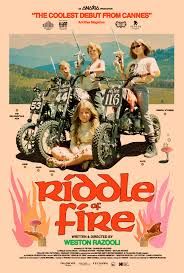
Film Journal 2024: Riddle of Fire Directed by Weston Razooli
The official synopsis describes this as a neo-fairy tale. That’s a decent categorization for a film that manages to defy categorization, albeit while feeling, at the same time, like an impassioned ode to a bygone era of filmmaking. An era where the simple art of imagination and a feeling of adventure are your tools rather than CGI, and where grassroots and no frills storytelling bolstered by natural chemistry between your characters is enough to make a meaningful and memorable film on a very small budget
I almost want to suggest that it has an old school Disney classic feel, but it is more like imagining if a Disney classic was allowed to color outside the lines. There’s a definite charm to the kids pervasive cursing, playing without supervision, and minor disdemenears.
There’s a ton of heart too, evoking the once upon a time familiar joys of a childhood spent outside with your friends and nothing but your imagination ro occupy you. This is the way into the magic of its premise, gently wielding the presence of witches and young girls with powers and ancient myths into the stark realism of their escapades. It’s a grand narrative tied to a simple plotline- at the end of the day the kids really just want that egg so they can make that pie.
That dance scene in particular is pure cinematic perfection, and the ending rises to some sweet and charming emotional heights befitting the films practical, grounded, and personable approach. Most of all though, one of the film’s most defintie delights is simply the banter between this cast of kids. The world is their stage, and the privilege here is the opportunity to follow them on their adventures.
Film Journal 2024: Sting Directed by Kiah Roache-Turner
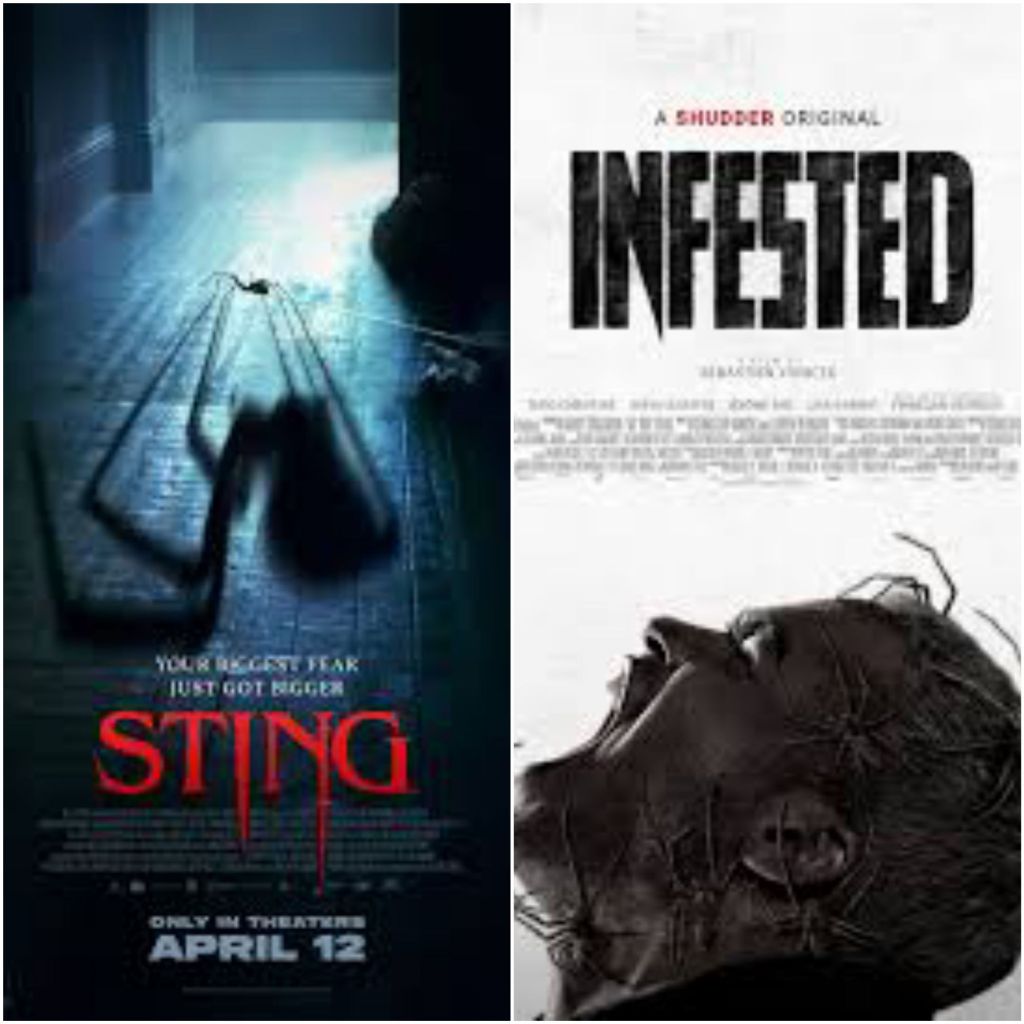
A quiet and unassuming horror that embodies the spirit of the classic creature feature. It is bolstered by a solid script, a tight run time, and solid performances. A quality film that has gotten little to no advertising or press, but is definitely worth your time. Its not on a lot of screens, but if you can track it down, support it.
Reading Journal 2024: Revelation for the Rest of Us: A Prophetic Call to Follow Jesus as a Dissident Disciple Authors: Scot McKnight and Cody Marchett
I am not the target audience for this book, given that I am already well entrenched in the research and approach that this book champions. This book, which is a joint effort by McKnight and Matchett, essentially functions as a stepping stone into the wider conversation regarding the shift from predictive readings to contextualixed ones. On that front it is quite good, although mileage might vary on the practical portions that get quite specific on how the authors see this reading of Revelation applying to the present state of American politics. I confess, even as a Caandian I felt these portions, which are mostly found in the final third, kind of sidelined me as a reader a bit. Which is just another way perhaps in which I wasn’t entirely the target audience for this book.
Even if the material isn’t necessarily new, there were still insights woven into the book that helped me think and rethink certain ideas in fresh ways. I really liked how the authors help us as readers imagine what it looks like to live as peope allegiant to King Jesus in the midst of Empire, using the patterns present in Revelation to note the distinctions and characteristics of both. I thought it did a nice job of demonstrating how the language of Revelation is all hyperlinked back to the OT. I also really enjoyed how the authors looked at the narrative of Revelation, which is retelling the narrative of the OT through the lens of a died, raised and ascended Jesus. In this sense, the predictive notes in Revelation are really all leading up to the death and Resurrection of Jesus, while the singular future hope is centered on one thing- Jesus’ return, or the consummation of what Jesus’ resurrection and ascension inaugurated (the promised new creation realty). One of the biggest points that emerges within this is the notion of Babylon as a cyclical reality- every generation and every age has their Babylon. Thus it has nothing to do with a chronological timeline of events leading up to an end times. For the author and readers of Revelation, their context is Rome and the Temple. Rome was their Babylon. We have our own. And what we can glean from the words of Revelation is not just the patterns of Empire, but how they were called to live in the reality of Empire as a dissident disciple of Jesus and His Kingdom.
Much of this book is interested in deconstructing predictive readings. Even the reconstructing moments can’t help but dwell on the negative, which I suppose could be seen as a critique of the book. It’s understandable though once you consider the books target audience- those for whom predictive readings no longer make sense. Old habits die hard, thus there is a need to keep repeating and calling out those old habits when they stand in danger of creeping back in.
When I first picked up this book I didn’t quite know what to expect, I’ve read quite a bit from McKnight, so I know his voice and his sensibilities, but thus isn’t a traditional commentary, so it was difficult to know what approach it was going to take. Given this, I also decided to take a risk, and reached out to an online friend in a shared group who seemed to be its more direct target audience to see if I could buddy read it from our differing points of perspective. One thing worth noting from that approach is, I do think this works best as a group read or small group study, although it would be important I think to have a group that is interested in the sorts of questions this book is asking and positing potential answers to. The authors aren’t shy about where they stand, and thus make their voices prime targets for unsuspecting readers to be turned off and tuned out before they’ve finished the first couple chapters. This book is an entry point into what is a much larger and broader world of scholarship and discussion, but it also is paradigm shifting if you have never entertained an approach that isn’t predictive.
Jesus and the Powers: Christian Political Witness in an Age of Totalitarian Terror and Dysfunctional Democracies Authors: Michael Bird and N.T. Wright
I’m not sure if the books release was intentionally planned to coincide with America’s upcoming election, but Jesus and the Powers, the newest collaboration and joint effort by Wright and Bird, feels like it’s designed to navigate that rather precarious terrain.
Which bears noting one possible critique of the book. It seems equally obvious to say, given that the book reflects the shared voices of an Aussie and a Brit, that the books emphasis would be on the broad shape of global politics. And I do think it is. Thus the book does feel like it has a bit of an identity crisis to overcome, even if this is at least partly due to what we as readers are bringing to the text. It’s difficult to set aside an American centric focus in favor of a broader reaching viewpoint and discussion, and I’m not convinced, even if it feels a but ironic, that the book does enough to help us get there.
A second critique. While the NT In Its World was Bird working with Wright’s material, this book is a clearer reflection of both voices sharing equal space. Meaning, you can tell that there are two distinct voices attempting to coexist. While there is a degree to which this is a positive, it also has some drawbacks. It is easy to see some of the individual quirks and sensibilities of each author being polished out in favor of a more cohesive flow, and at points this creates frustration, as it left me feeling like the particular authors voices were getting somewhat buried in the mix. Given that I have different relationships to both authors on theological and philosophical grounds, it made it difficult to know how to embrace and push back on different portions effectively.
A third critique, which is more a confession- I am a critic and a cynic when it comes to the idea of democracy. Particularly liberal democracy, which is what this book is ultimately championing and upholding. I fully understand this is not the book’s issue, it is mine. But it did play into how I heard and responded to its essential arguments. I found it difficult, for example, to fully reconcile the fact that it tiptoes into suggestions that democracy is in many ways a corruptible idea both in theory and practice, or that democracy is a bit of a fallacy, meaning it reflects an assumed ideal that can never be actualized or realized in practice, and that it mirrors many of the same issues and problems of the political systems it is meant to buffer and oppose.
It tiptoes into these sentiments, but never in a way that allows it to fully commit to the implications of these statements. If one of its central tenants is a critique of the enlightenment, challenging the assertion that it reflects the pinnacle of humanities social and political evolution and offers the promise of a new world remade in its image (all one needs to do is look at the atrocities it has birthed to know this belief represents a fallacy), it plays both sides of the coin by upholding a firm conviction that the western narrative and its commitment to liberal democracy is the best one, albeit one that they tailor by infusing a necessary commitment to pluralism. In truth, if the book wants to dismantle things like Christian nationalism, the sort of thing that emerges when Christians have a poor understanding of their relationship to politics, the book stands in danger of giving fuel to the fire that is its source- individualism with its commitment to individual freedoms as the highest order.
Similar feelings when it comes to the books chapter on fascism and communism. It makes the strange assertion that the West has tended to note the evils of fascism while ignoring the evils of communism, a fact that it finds emerging from the course of western history. I found this puzzling, and one of the dangers here is that the book is simply going to feed one of the other main components of western exceptionalism, which is demonizing socialism under the guise that the evils of communism are hiding under every rock. It does go on to admit that fascism has been the primary political power portions of Christianity has tended to tie itself to, but it avoids connecting this truth to a clear and concise deconstruction of the tendency towards creating this version of fascisms necessary enemy.
Anyone familiar with Wright will recognize the chapter on the Powers, which draws this concept out as a nuanced portrait that speaks of the spiritual and political powers all at once. These two convictions operate together in the ancient mindset, and thus, to be good readers of scripture and its world we need to understand how these two ideas, earthly Empires and the Powers of Sin and Death, are often used interchangeably, breaking down our modern western penchant of dividing these two things into spirit and flesh, heaven and earth, material and spiritual. This to me was by far the strongest element of the book, as it shows how we need to begin here if we are to see and recognize the reason and the way Christianity’s relationship to politics became so messed up. Both authors argue that we need to push back against the idea that politics is the enemy and/or something we need to oppose or stay away from, and the idea that power in politics is the end goal of Christian participation and commitment. And the main way we can combat this is recovering a theology of God’s good creation, a theology that has been lost in the west’s emphasis on depravity and binaries.
Overall I would recommend this, even with my above critiques. I do fear that this book is going to feed certain tendencies and ideologies that I personally would want to deconstruct, but hopefully the ideas here can at least help tailor and grow a better version of those ideas. I think if it can do this, then perhaps it can help awaken some of the limitations and issues with liberal democracy, particularly the kind that upholds the West as an ideal, even over and against these authors ultimate conclusions and convictions.
Reading Journal 2024: James: A Novel Author: Percival Everett
Definitely a conversation starter. It is a really strong example of how to write a reimagining of a classic with purpose and craft. Not only that, it is an extremely entertaining read, especially where it weaves the old world language of Twain into a modernist vibe. It felt very much like I was in the world I knew, with Tom Sawyer and Huckleberry Finn being significant stories from my childhood, but it also felt entirely unfamiliar and new.
Which I imagine is part of the point of this exercise. There is a whole world, a whole life, that lays buried underneath the language of a time and a place. To tell the same story from the perspective of James, the slave whom accompanies Finn, is to imagine not only how he sees those familiar events once held captive to Finn’s perspective, but to travel with James into a world of his own, a world that is never accounted for in the original book. What makes it so pognant and interesting of course, is the melding of that old story with the new, stories that do in fact stand years apart when it comes to composition. Everett is not revising the old story, rather he uses those untold spaces to write a modern tale informed by our present time, letting it be and become its own natural commentary.
It is as humorous as it is harrowing and insightful. It feels unabashed in its desire to maintain and explore the simple charm of those old river tales, never loosing sight of the childlike whims of Sawyer and Finn’s adolescent escapades. Which is really what impressed me the most. The book pokes, but never condemns. It wants to bring a fervent appreciation and admiration for the classic to the table while evoking the freedom to table one aspect of the conversation. In different hands this could have been an easy swing and a miss, but here Everett has found a way to pen a new classic in its own right, one that belongs alongside Twain’s enduring adventures.
Reading Journal 2024: The Bittlemores Author: Jann Arden
If I can say right at the front, I’m not sure where the “comic” descriptive comes from in the books central synopsis. I didn’t find the humor anywhere. Yes, the book is dark, but darkly comic is a thing, and that’s not how I would describe this in tone or genre.
It does have the welcome touch of a gentle prose however. Given this is Arden’s debut, it has the flavor of a seasoned author, confidently tackling some unconventional elements without losing what is a very clear literary presence and identity. One such unconventional element is her decision to give the creatures thoughts and a voice. It comes out of nowhere, and is never really explained or fleshed out in terms of a larger world building exercise. It is just taken for granted. It works though precisely because of the ways the animal abuse and human abuse function in parallel fashion.
A confession: this book has two of the most unlikable characters I’ve encountered in a long while. It also has a very real personal trigger- animal abuse (yes, I know it says something about me that the animal abuse was a trigger while the human abuse was not). Both things were obstacles for me in really embracing this story. It was in fact Arden’s gentle spirit that helped me to enter in despite those obstacles. The book has a propulsive energy to it, fueled by the mystery. It’s not really a mystery to us as readers, rather it’s a mystery the characters need to solve for themselves. It’s a fun element in an otherwise dark story.
The story is also very much centered on the women in the story, giving the story a clear, feminine voice. Not in the sense of commentary, but simply as a matter of perspective. These are the characters we follow, and it shapes the narrative in a particular way.
In all honesty, even though I despised two of the central characters in the book (let’s call them villains), and even though I personally struggled with the animal abuse portions, there was enough here to demonstrate Arden’s strength as an author, and I would absolutely read more if she decides to write more. I think she especially has a gift for simple characterization, which is something I appreciated.
Reading Journal 2024: The Future Author: Catherine Leroux
I got a bit of whiplash from this one. Starts off simple enough, focused on a singular character, small in scope, and seemingly full of potential. And then it takes an odd shift into a Lord of the Flies kind of premise, with the scope and fhs cast beginning to spiral a bit of control.
And then we get yet another shift in the back half that has even more scope and more characters. It was all just too much.
The potential themes are there from the start. It has an interest in exploring a marginalized people and community with clear emphasis on survival, the nature and defintion of community, and larger discussions about colonization. The french aspect is interesting, especially where it is the reflection of a Canadian author reconstructing a borderland between Canada and the USA. The execution simply isn’t there, leaving me feeling lost and disjointed even before the halfway point.
Film Journal 2024: Abigail Directed by Tyler Gillett and Matt Bettinelli-Olpin
Seemed fitting that I saw this with a crowd of mostly middle grade teens. This is, I believe, the films primary target audience. It’s a YA horror-thriller that effectively pushes some boundaries on that front with its commitment to gore and mature themes (and parents, be aware that this does push some boundaries for that demographic). For me, there is a version of this film where the dialogue and plot are more intricately drawn towards an older demographic (I suppose I got this with Ready or Not), but given what this film is and who it’s made for, it’s a decent amount of fun. The further the film pushes into the chaos of its premise the more fun it gets, which makes for a decent payoff.
I should say, I managed to go into this one knowing nothing about it, not having seen a trailer. That definitely aided my viewing experience, because the first half leans into the most basic of reveals. Given that was a surprise for me I got more mileage from the build up than I think I otherwise would have. Even if you do know what this is about though, the commitment to the second half is more than worth the ride. It makes good use of its mostly single setting, practical set pieces and production design.
Reading Journal 2024: Northwind Author: Gary Paulsen
Northwind gains much of its worth from being Paulsen’s last book he wrote before he died. Without that context it’s hard to know how this book would land. It’s something of an odd duck With it, the unusual story becomes a personal commentary on life and death itself.
There is a poetic undertone to the prose, bringing together his real life experiences with the pacific northwest coast and Nordic mythologies. It doesn’t always makes sense being blended together, but there is a beauty to the madness. Paulsen’s affection for the natural world and its creatures is an expected and important facet of the story, which is part survival, part adventure, part internal process as our main protagonist makes his way across a rugged landscape. From this flows his philopshical ruminations, weavimg in and out of subtle theological touchpoints.
At its heart, the book seems to be about the movement from life to death to life, with the uncertain nature of this journey with its all its questions and doubts and unknowns being caught in the crosses that nature itself exhibits. The struggle begins, and perhaps ends, with the basic observation that beauty clashes with the honest brutality of the nature we observe. It becomes difficult to imagine, then, what is illusion and what is not, especially when it comes to speaking about good and evil. Even more difficult to imagine life and death having meaning that isn’t constructed over and against this confusion of realities. The presence of Nordic myth gives this an added dimension as well, transporting these same qualities to our ruminations about the gods. If we cannot say the gods are good or evil, then god becomes a distant entity that is both the author and result of this confusion. Equally so with life operating distanced from the gods. Which leaves death as the great leveler. In such a world the brutality is the only true measurable reality. Driven by instinct and evolution and survival. It becomes the only true certainty.
And yet, as Paulsen confronted his own experience of brutality, he became equally compelled by something else- an untamed beauty, as irrational as it was. He found this in the most unlikely of places; in nature where one would expect the brutal reality of this existence to loom largest. This contrasted the humanity where he found beauty to be most hidden. One of the most striking things about his life, something I gleaned from his autobiography, is how it is his encounter in nature and survival that helped clear his confusion about humanity. It gave him a fresh lens to see existence through. And in some real sense that’s the undercurrent running through his final book. If the one true measurable reality is in fact death, then reality must become immeasurable for life to make sense. For me, this is an idea that endeared me as a child and continues to captivate me as a now aging man.