End of the Year Reflections: Top Films of 2025

If you had asked me 3 months ago, I would have said this has been an exceptionally bare and down year for film. Thankfully some of the fall titles managed to rise to the top, even giving us some genuine success stories. Leading the way would of course be Paul Thomas Anderson’s One Battle After Another, which is arguably standing heads and shoulders above everything else. But its not without its companion pieces, including Zhao’s Hamnet, Marty Supreme (which has been finding some welcome box office success), the rising star in Sorry, Baby, the release of films like Panahi’s It was Just an Accident and Park’s No Other Choice.

In any case, it’s always fun looking back at what stood out and where things land come the end of December. Here’s my highlights and Top list for 2025 in cinema:

Some Hightlights:

Favorite Debut: Grand Theft Hamnet (Sam Crane, Pinny Grylls)

Honorable Mention: Bob Trevino Likes It (Tracie Laymon)/Exhibiting Forgivness (Titus Kephar)

Favorite Animated Film: Lost in Starlight (Han Ji-won)

Honorable Mention: Predator: Killer of Killers (Dan Trachtenberg)/The Day the Earth Blew Up: A Looney Tunes Movie/Little Amelie (Mailys Vallade, Liane-Cho Han Jin Kuang)

Favorite Blockbuster: Ballerina (Len Wiseman)

Honorable Mention: The Fantastic 4: First Steps/How To Train Your Dragon (Dean DeBlois)/Mission Impossile: Final Reckoning

Biggest Surprise: Predator: Badlands (Dan Trachtenberg)

Honorable Mention: Bridget Jones: Mad About The Boy (Michael Morris)

Favorite Horror: Weapons (Zach Cregger)

Honorable Mention: Dust Bunny (Bryan Fuller)/Bring Her Back (Michael and Denny Philippou)/Frankenstein (Guillermo del Toro)/Presence (Steven Soderberg)

Favorite Comedy: Eternity (David Freyne)

Honorable Mention: Eleanor the Great (Scarlett Johansson)/The Naked Gun (Akiva Schaffer)/Roofman (Derek Clanfrance)

Most Underrated Film: A Big Bold Beautiful Journey (Kogonada)

Honorable Mention: Oh, Canada (Paul Schrader)/The Alto Knights (Barry Levinson)/Eden (Ron Howard)

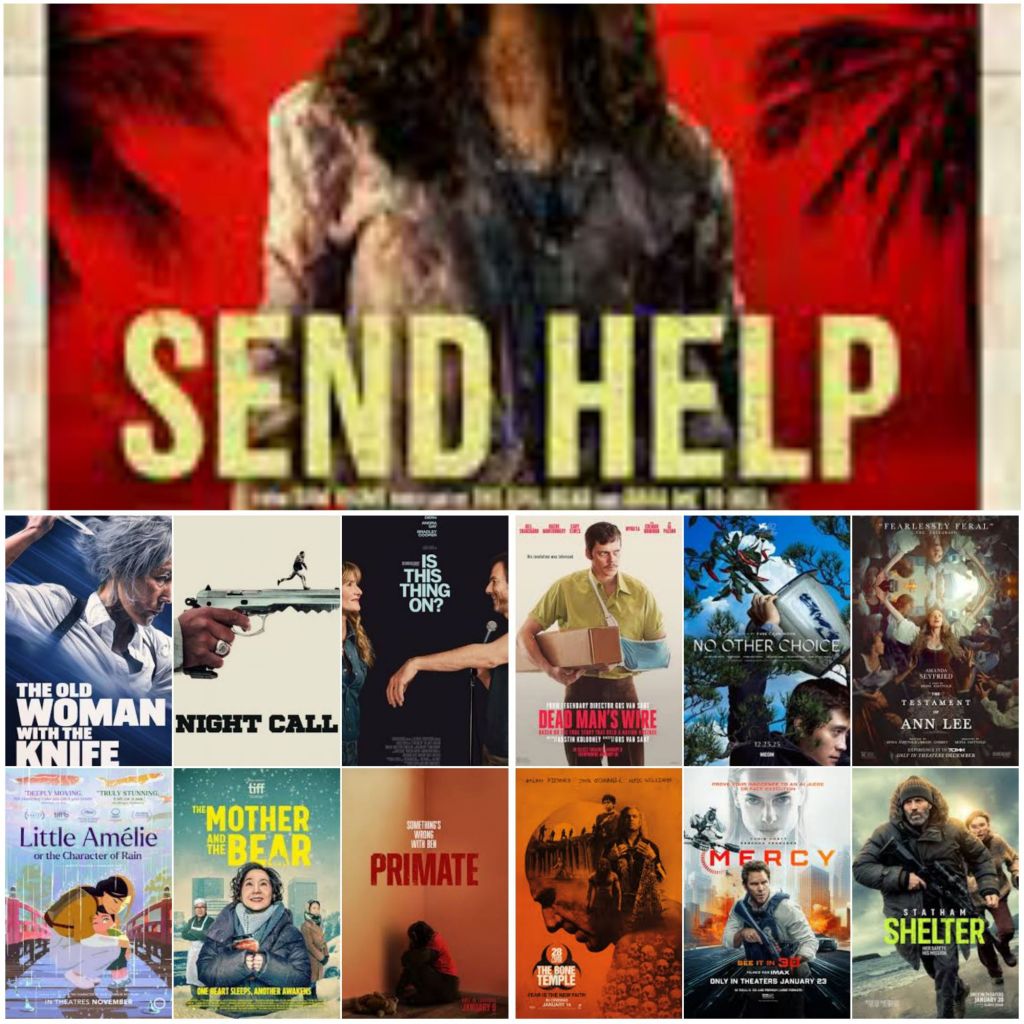
Hidden Gems: Inside (Charles Williams)/Penguin Lessons (Peter Cattaneo)/Vulcanizadora (Joel Potrykus)/The Assessment (Fleur Fortune)/East of Wall (Kate Beecroft)/Xeno (Matthew Loren Oates)/The Old Woman with the Knife (Min Kyu-dong)

Favorite Canadian Film: The Order (Justin Kurzel)

Honorable Mention: Meadowlarks (Tasha Hubbard)

Favorite Documentary: John Candy: I Like Me (Colin Hanks)

Top 12 Movies of 2025

1. One Battle After Another (Paul Thomas Anderson)

In the words of many a pundit: this is peak cinema

2. Hamnet (Chloe Zhao)

Tender, sweeping, poetic, and patient

5. Anemone (Ronan Day Lewis)

Visual, creative, intimate and ambitious debut

4. Sentimental Value (Joachim Trier)

Insightful, full of depth, and highly symbolic

3. The Mastermind (Kelly Reichardt)

A master of the craft and one of the best endings of the year

6. The Ballad of Wallis Island (James Griffiths)

Sweet, lovely, reflective, memorable and meaningful

7. The History of Sound (Oliver Hermanus)

Plays on all the senses

8. Sorry, Baby (Eva Victor)

Subtle and unexpected, it sneaks up on you with its character arc

10. 28 Days Later (Danny Boyle)

Visionary and epic, both in scale and theme

It Was Just An Accident (Jafar Panahi)

His most complete film yet, and layered with tension/moral questions

11. Springsteen: Deliver Me From Nowhere (Scott Cooper)

Immersive performance, engaging and relatable and accessible

12. Materialists (Celine Song)

Smart commentary, superb script

The Outliers

13. F1 (Joseph Kosinkski)- what the movies were made for)

14. Sinners (Ryan Coogler)- messy but transcendent

15. Eddington (Ari Aster)- brave and boundary pushing

16. Black Bag (Steven Soderbergh)- tons of delicious swagger, pitch perfect dialogue and best ensemble casting in recent memory

17. Highest to Lowest (Spike Lee)- a master exploring new metaphorical ground

18. Sore: A Wife From the Future (Yandy Laurens)- a rich and emotional sci-fi indie

19. Jazzy (Morrisa Maltz)- pastoral, contemplative

20. The Legend of Ochi (Isaiah Saxon)- magical, spiritual and enchanting

Top Reads of 2025

The Stats:

Total Books Read: 179

Shortest Book Read: The Grand Miracle (60 Pages)

Longest Book Read: The Path Between The Seas by David McCullough (698 pages)

The Breakdown of How I read:

  • Audiobooks: 42 (3 books per month average)
  • E-Books: 37 (3 books per month average)
  • Physical Books: 100 (8 books per month, or 2 books a week average)

The Ratings (out of 5):

  • One Star: 3 Books
  • Two Stars: 13 Books
  • Three Stars: 68 Books
  • Four Stars: 70 Books
  • Five Stars: 25 Books

Looking at my stats for this year, I feel really good about physical books still  leading the way in terms of how I read. My rhythm is fairly simple. Audiobooks remain a good fit for me in terms of my job (I drive for a living). It is also a part of my regular routine to fit in anywhere between an hour and an hour and a half of listening time on my daily morning walks with the dogs. With the average audiobook being around 8 hours in length, 3 books per month in this format feels about right after I balance that out with my susbscribed podcasts.

I typically have a mix of three books going at once- a fiction book, a non-fiction book, and a theology book. My prime reading times in physical or e-book form- in the morning after I walk the dogs and before I leave for work, usually for about a half hour, in the afternoons between my split shift (a half hour to an hour), and when I go to bed (usually a half hour). It’s not alway all three, but typically I am reading around 100 pages a day, as my rhythm naturally seems to gravitate towards 50 pages of one kind of book and 50 pages of another. If the average physical book is around 300 pages, that translates to 2 books a week, which seems on point with the stats.

For a more indpeth discussion about what these different titles meant for the story of my reading year see my recent blogpost here:

https://thestoriesofmylife.ca/2025/12/30/end-of-the-year-reflections-the-story-of-my-reading-journey-in-2025/

Top Fiction Reads:

  1. Isola by Ellegra Goodman
  2. Phantastes by George MacDonald
  3. Impossible Creatures/The Poisoned King by Katherine Rundell
  4. Sunrise on the Reaping by Suzanne Collins
  5. The Moviegoer by Walker Percy
  6. Our Souls at Night by Kent Haruf
  7. The Boxcar Librarian by Brianna Labuskes
  8. Hamnet by Maggie O’ Farrell
  9. Kings Ransom by Ed McBain
  10. Aurelia by Stephen R. Lawhead
  11. Crow Lake by Mary Lawson
  12. The Wood at Midwinter by Susanna Clarke
  13. Water Moon by Samantha Sotto Yambao
  14. The Story She Left Behind by Patti Callahan Henry
  15. Frankenstein by Mary Shelly/Frankenstein’s Monster by J.S. Barnes
  16. Before Dorothy by Havel Gaynor
  17. Three Days in June by Anne Tyler
  18. The Spirit of Scatarie by Lesley Crewe
  19. Sipsworth by Simon Van Booy
  20. Mirror Lake by Juneau Black
  21. The Great Divide by Christina Henriquez
  22. Tomorrow Is for the Brave by Kelly Bowen
  23. Finding Grace by Mary-Lynn Murphy
  24. How To Train Your Dragon by Cressida Cowell
  25. Worst Case Scenario by T.J. Newman
  26. The Homemade God by Rachel Joyce
  27. Whistle by Linwood Barclay
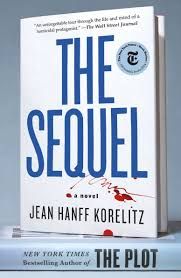
  28. The Plot by Jean Hanff Korelitz
  29. Summer of the Monsters by David Sodergren
  30. Moon Crusted Snow by Waubgeshig Rice

Top Non-Fiction Reads:

  1. The Mythmakers: The Remarkable Fellowship of C.S Lewis and J.R.R. Tolkien by John Hendrix
  2. My Roman History: A Memoir
  3. How To Read a Film: Movies, Media, Multimedia by James Monaco
  4. Signposts in a Strange Land: Essays by Walker Percy
  5. Guillermo del Toro: The Iconic Filmmaker and His Work by Ian Nathan
  6. Is A River Alive by Robert Macfarlane
  7. The Timeless Way of Building by Christopher W. Alexader
  8. The Smiling Land: All Around the Circle in My Newfoundland and Labrador by Alan Doyle
  9. How to Write Your Own Life Story: The Classic Guide for the Nonprofessional Writer by Lois Daniel
  10. Custodians of Wonder: Ancient Customs, Profound Traditions, and the Last People Keeping Them Alive by Eliot Stein
  11. Walking Home by Lynda L Wilson
  12. The Myths We Live By by Mary Midgley
  13. Overnight: Journeys, Conversations and Stories After Dark by Dan Richards
  14. North End Love Songs by Katherena Vermette
  15. I Am Part of Infinity: The Spiritual Journey of Albert Einstein by Kieran Fox
  16. The Revenge of Geography: What the Map Tells Us About Coming Conflicts and the Battle Against Fate by Robert D. Kaplan
  17. The Path Between The Seas: The Creation of the Panama Canal, 1870-1914by David McCullough
  18. Ocean: A History of the Atlantic Before Columbus by John Haywood
  19. The Banquet of Souls: A Mirror to the Universe by Joshua Farris
  20. They Flew: A History of the Impossible by Carlos M.N Eire
  21. The Next Conversation: Argue Less, Talk More by Jefferson Fisher
  22. To the River: A Journey Beneath The Surface by Olivia Laing
  23. Hope: The Autobiography by Pope Francis
  24. Future Boy: Back to the Future and My Journey Through the Space-Time Continuum by Michael J Fox
  25. Against the Machine: On the Unmaking of Humanity by Paul Kingsnorth
  26. The Science of Storytelling by Will Storr
  27. From Eternity to Here: The Quest for the Ultimate Theory of Time by Sean Carroll
  28. The Message by Ta Nehisi Coates
  29. The Science of Revenge: Understanding the World’s Deadliest Addiction- and How to Overcome it by James Kimmel Jr
  30. The First Ghosts: A Rich History of Ancient Ghosts and Ghost Stories by Irving Finkel

Top Theology Reads:

  1. All Things Are Full of Gods: The Mysteries of Mind and Life by David Bentley Hart
  2. Circles and the Cross: Cosmos, Consciousness, Christ, and the Human Place in Creation by Loren Wilkinson
  3. A Light So Lovely: The Spiritual Legacy of Madeleine L’Engle, Author of a Wrinkle in Time by Sarah Arthur
  4. The Medieval Mind of C.S. Lewis: How Great Books Shaped a Great Mind by Jason M. Baxter/The Last Romantic: C.S. Lewis, English Literature, and Modern Theology by Jeffrey W. Barbeau
  5. Theology of Horror: The Hidden Depths of Popular Films by Ryan G Duns
  6. The Sacred and the Profane: The Nature of Religion by Mircea Eliade
  7. The War For Middle Earth: J.R.R. Tolkien and C.S. Lewis Confront the Gathering Storm, 1933-1945 by Joseph Loconte
  8. Judaism is About Love: Recovering the Heart of Jewish Life by Shai Held
  9. Jesus and Divine Christology by Brant Pitre
  10. Understanding Biblical Law: Skills for Thinking With and Through Torah by Dru Johnson
  11. Numbers: An Introduction and Commentary by Peter Altmann
  12. Jesus and the Law of Moses: The Gospels and the Restoration of Israel within First Century Judaism by Paul T. Sloan
  13. Pause: Spending Lent with the Psalms by Elizabeth F. Caldwell
  14. Scripting the Son: Scriptural Exegesis and the Making of Early Christology by Kyle R. Hughes
  15. The Practice of the Presence of God by Brother Lawrence/Soul Feast: An invitation to the Christian Spiritual Life by Marjorie J. Thompson
  16. Light of the Mind, Light of the World: Illuminating Science Through Faith by Spencer Klavan
  17. The Bible: A Global History by Bruce Gordon
  18. Godstruck: Seven Women’s Unexpected Journeys to Religious Conversion by Kelsey Osgood
  19. Come Forth: The Promise of Jesus’ Greatest Miracle by James Martin
  20. Believe: Why Everyone Should Be Religious by Ross Douthat

End of the Year Reflections: The Story of My Reading Journey in 2025

“All stories have a meanwhile- an important thing that’s happening while the rest of the story moves along.” (How To Read a Book, Monica Wood)

“But the rewards of a journey aren’t always immediate and aren’t always manifest. The point is, should we count milestones or miles? And the truth is I learned a lot from my time on the river- learned a lot, that is, about myself.” (Boogie Up The River, Mark Wallington)

The meanwhile of my story, in the plot turn that is my year in 2025, can only be found by looking backwards. Hence why I like to spend time each year engaging this retrospective process, in this case looking back on my reading year in order to try and parse out ideas, narratives, learnings, and themes that have emerged over the course of that journey.

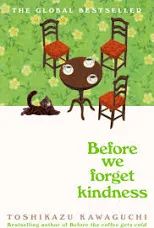
Which also happens to be the reason why I always begin the new year with the next book in Toshikazu Kawaguchi’s Before the Coffee Gets Cold series (sadly I’ll be starting the last and final one this upcoming year, having read Before We Say Goodbye in January, 2025). This series reflects on the ongoing story of this cast of characters constantly engaged in looking back by way of travelling in time (or helping others through this process). As readers will know, these travellers cannot change the past and cannot leave the chair in this particular coffee shop (thus it can only travel back to a circumstance that happened in this space), thus the main question facing their choice of moment to return to is always about what they need to reconile or understand rather than what they can change.

Beyond continuing this tradition, I started the year pulling random books off the remaining weeks of my month of kindle unlimited (activated to obtain some holiday reads) that all had to do with deconstructing Christianity’s allegiance to penal substitution. Not a new topic for me, and I’m not sure where these particular titles came from to be honest (its not like my algorithm was seeking them out), but where my year ended was in a far more intentional and oddly interconnected place, leaning into a handful of recently released books discussing issues revoloving around our understanding of the Jewish Law, especially in relationship to the Gospel and to the way we build our theologies (Jesus and the Law of Moses: The Gospels and the Restoration of Israel Within First-Century Judaism by Paul Sloan, Understanding Biblical Law: Skills for Thinking With and Through Torah by Dru Johnson, Paul and the Resurrection of Israel: Jews, Former Gentiles, Israelities, by Jason Staples).

As Kate Riley fleshes out in her intriguing book Ruth, so often the way into any inneral or internal critique is our ability to critique the critique, which she applies to the story of her main character navigating the thorny ground of religious community. Which simply means, a proper critique must always belongs to that larger conversation in which these different streams can grow and develop. In this case, Sloan, Johnson and Staples are all occupying space within a stream of theological concern that stems back to the original voices of the new perspective. What stood out to me in 2025 was simply the excitment of seeing the fruits of that conversation really beginning to taking shape in what is now a robust and dynamic debate.

If critiquing the common allegiance to penal substition is often a place to start in pushing back on certain western theological tendencies, the natural outflow of this conversation is the recontextualizing of the images and conceptions of Temple, Law and sacrifice within their ANE and second temple context, which is arguably the much harder work of reconstruction. Over the course of this year, these books and others have accentuated the fact that so much bad theology comes from a failure to understand these things (and I would throw in the terms exile and exodus) in their world. And this has massive implications for many areas of our thinking, our beliefs and indeed our living, from how we understand and apply a term like salvation or justice to how we understand larger conceptual frameworks like hope and transformation.

At its heart, the law and the temple, exile, exodus, and the sacrificial rites are narrative constructions that tell a story that, for those of us who hold it to represent a true representation of a God revealed in history, has the power and authority to inform our own. Who I see myself to be, who I see others to be, what I understand the world to be, is intimately tied to who I see God to be, particularly because this becomes the lens through which I understand and thus relate to the world I observe and experience. The story we bind ourselves to matters immensly to the story we tell through our participation in the world. And one of the beautiful things about entering into the story of Israel, which all three of the above books help us to do, is the way it opens up the patterns of life itself. Indeed, the way to understand a story is to understand the patterns contained within, and these patterns are so often attached to this constant movement between spaces and the engagment of cycles.

Perhaps the most ready dynamic of this discussion of ones partticipation in the world applies to my encountering ongoing discussions in the books I was reading about understanding and reconciling the relationship between our constructed world and the greater reality that this belongs to, often given the name “the natural world.” Barbara Brown Taylors An Altar in the World: A Geography of Faith expressley parallels our life in God and Spirit with our connection to the natural world, seeing it through the framework of the movement and within the cycles of its seasons as being accessed through a necessary retreat from the constructed world (society) into nature.

I have often expressed the fact that I am an odd one in this regard, as I am most at home where I find human participation (society and culture) existing in relationship to what we might call the wilderness. I have never been one to find solace in the wilderness, which of course is always an idea worth unpacking, but for this moment, if Taylor’s vision sees the wilderness as a somewhat antithetical space to the societies we inhabit, there were three books in particular that took a different angle. They were expressely about our ability to expand our understanding of nature to include the whole of human participation (Timeless Way of Building by Christopher W. Alexander, The Myths We Live By by Mary Midgley, and perhaps one of the most definitive works I read this year Circles, and the Cross: Cosmos, Consciousness, Christ and the Human Place in Creation by Loren Wilkinson). Each of these books imagines a marriage of wilderness and city as opposed to setting them over and against each other.

In all three books one of the central critiques is the way our modern tendency to replace the old myths with new ones (such as environmentalism and other natural philsophies), myth here being used in the proper sense of a story that anchors us in what is really true about this world and our existence, create this problem of narrowing our conception of nature in ways that cannot speak to the whole. What we need is a myth that can give meaning to both the idea of human particpation as co-creators (or subcreators) as well as to the larger reality of the wild world that this belongs to.

We need to explan our understanding of nature in ways that include the whole.

Unfortunately in a modern world that has sought to distance itself from religion, one of the outcomes is this grabbing at meanings of the word “natural” that distances itself from any inclination of metanarratives, especially concerning the percieved notion of the supernatural but also including the particular human experience. We either find ourselves then swimming in the waters of our necessary but largely irraitonal applications of humanistic concern, which act and function in this sense without approprriate defintion of logic, or we just end up diminishing the natural world altogether. Both Wilkinson and Midgely offer powerful arguments to this end, both seeking better stories through which to make sense of this world by seeing them as parts of the whole. And that begins with broadening our usage, our understanding and our defintion of the word “natural.”

To this end, I’m reminded of this quote from Susanna Clarke’s The Wood at Midwinter, a book I read in the early days of January this year.

“A church is a sort of wood. A wood is a sort of church.”

If this quote evokes this marriage between the wilderness and its human participants and its subcreations, which I think connects back to the prominnance of the parallel images of city and wilderness in the story of Isreal (something Peter Altmann helps bring to life in his commentary on Numbers which I finished this year, a commentary that was initially going to be titled “into the wilderness”), three travelogues also helps accentuate this idea.

Walking Home by Lynda L Wilson is a striking memoir that documents an aging individual whom finds herself randomly setting out to be first to walk this new trail connecting two parts of Southern Ontario. Not only is she not prone to camping or one to really revel in retreating to the wilderness in the traditional sense, but this trail that she embarks on brings her through the different communities that populate its way, actively bringing the city and the wilderness together. That is the memoirs true beauty. As she says at one point, part of what she discoveres is that she is indeed, as it is for all of us, the center of her world, but the truth she awakens to is that the world is everywhere.

Equally true for the journey Matt Savino takes and documents in a Land Without a Continent: A Road Trip Through Mexico and Central America, albeit a journey marked by a greater intent and purpose Here his journey takes him through the different wildernesses that become the pathways into different communities and homes and cultures. Or the enigmatic (and very Canadian) The Smiling Land: All Around the Circle in my Newfoundland and Labrador by Alan Doyle, which becomes a pilgrimage based on his desire to understand what a place, and this specific place, means to our (and his) stories. If ever there were a place where community and the great wilderness meet and coexist, it would be Newfoundland and Labrador, and the way he brings this to life is both meaningful and magical.

This theme, of finding a way to name the world that we are participating in, and indeed finding a way into the world by way of the wildernesss, I found opened up into these subsequent threads of how it is that we then occupy the spaces we encounter and inhabit as we go. As Walker Percy exposits in Signposts in a Strange Land, when we travel in life, be it in the figurative or practical sense, we engage myth-making and its outflow, truth telling. We tell our stories, we become aware of our stories. we become aware of the tensions that the stories reveal. And we do so in intimate relationship with the space and land we occupy, land and space that is perpetually changing with time. As Frances Mayes suggests in A Place in the World: Finding the Meaning of Home, a book I finally managed to pick up and finish this summer, we explore the meaning of home wherever we go. It’s as we go that opens up this sense of meaning. Or Mary Lawson in Crow Lake, a book set in northern Ontario which explores the tension between the human ambitions of the big city (the construction) and the identity that her main character finds rooted and contained within the isolated pages of this town in the northern Ontario wilderness she once called home. A town that she returns to with the realization that change applies as much to her as it does to this place. A story that digs into some of those bigger questions regarding why it is we sometimes want to escape and what it is we are escaping to, be it in a geographical sense or in an internal sense, and indeed what happens when we return to the once familiar spaces. For Lawson’s character and story, its largely about the expectations of what a place wants to be veruss what a place actually is, and how it is we occupy this space with our expectations in tow, moving towards notions of becoming.

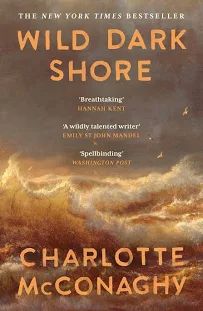
Or, from the perspective of another Canadian author, Lesley Crewe’s book The Spirit of Scatarie, which explores this transplanting journey from life in the big city to life in this foreign and isolated island in Nova Scotia. It’s a stark reminder that the spaces we occupy and how we occupy them matter immensly to the stories they tell, especially in the way, as the book imagines, these stories are enchanted by . A sentiment made vivid in one of this years most celebrated titles, Wild Dark Shore by Charloote McConaghy, a book that is all about movement between spaces, between society and the wilderness.

On a broader level, I also found my reading year leading me through questions regarding the greater nature of this world which these spaces occupy. To tell our stories and to engage the story of any place or any life is to equally find ourselves seeking something outside of ourselves, calling us to remember the once enchanted world of our childhoods we have forgotten exists (Impossible Creatures/The Poinsoned King by Katherine Rundell, The Mythmakers: The Remarkable Fellowship of C.S. Lewis and J.R.R. Tolkien). A sentiment echoed in Meg Shaffer’s The Lost Story, declaring that “what is lost can be found.” A sentiment embodied in the journey of the main character in Patti Callahan Henry’s The Story She Left Behind, a narrative about a young mother having her world expanded and thus reenchanted as she seeks her own story in the midst of a her own figurative wilderness, a journey that finds her moving from the isoalted American midwest to the city of London, and then once again into the wilderness of the English countryside.

This gets a philosophical/theological bent in something like Mircea Eliade’s Sacred and the Profane: The Nature of Religion. Here she observes that “Even the most desacralized existence still preserves traces of a religious valorization of the world.” And indeed, as the travelogue Monsterland: A Journey Around the World’s Dark Imagination by Nicholas Jubber inadvertently shows, such a need to seek the image behind the reality is embedded in all of the worlds stories, something the above mentioned Mythmakers unpacks through its examination of the friendship between two of histories greatest thinkers on the nature of myth.

As Eliade suggests, the Sacred (defined as differentiation) and the profane (defined as homogenuity) gives way to this idea of the sacred sanctifying the profane. Mythic language begins with the cosmic at its center and then it moves out into the stories that shape our world, the people and places that occupy them. On this same note, I had something of a revelatory moment when I finished the quirky travelogue Go to Hell: A Traveler’s Guide to Earth’s Most Otherworldy Destinations by Erika Engelhaupt. The journey she takes in this book is geographical, but it is a journey through history., that being the history of the idea of hell as a conceptual metaphor and language. What I found so intriguing and profound about this was the simple observation that in the early going of telling this history she is firmy postioned in the old world and its myths. And it was rich and exciting and alive. It is when she gets to the later places that suddenly she is trying to shoehorn this idea of hell into a modern mythology and landscape which has stripped the language of any metaphorical power. This is a micocosm of this idea in play, to be sure, but it was the sheer emptiness of the modern lens that struck me in this regard. She might as well have abandoned the word altogether at this point, because it no longer had any meaning or power or ability to evoke anything beyond the empty descriptives of a place. It just felt the spaces she was now describing had no metahpor to appeal to. That it had lost its intrigue or meaning or depth in this transition is what struck me the most in this moment.

From the cosmic to the personal.

This might apply to something like an Empire, such as the question Alizah Holstein asks in her absorbing memoir My Roman History: What does a place do when it is no longer an Empire, when it finds itself being lost to the arrow of time yet somehow still existing within it at the same time. Such a question applies equally to the struggle of the individual, such as the feeling of being lost as an aging person in an aging world. (Sipsworth, Simon Van Booy), or a book like Water Moon (Samantha Sotto) and its emphasis on feeling like we don’t belong in the spaces we occupy. Which once again brought me back to that central concern of how the stories we tell in the present shape our lives in  light of the past and the future, a question on the mind of the novel What You Are Looking For Is in the Library, Michiko Aoyama, where lost people are driven to seek some semblence of truth and coherency.

Part of the answer here of course comes down again to the question of our participation in this world, or how it is we participate in this world, forever traversing these paths between the wilderness and the city. Such as the call in Brother Lawrence’s The Practice of the Presence of God to engage in a life of prayer as acts of daily surrender, and the invitation towards participation in the liturgies of the daily life in Soul Feast: An Invitation to the Christian Spiritual Life by Marjorie J Thompson. And once again Barbara Brown Taylor’s call to make altars in the world as we go, marking the spaces as we encounter them so as to give this journey its shape. Adam Ross’ frustrating but fascainting and alluring romp in Playworld through a particular period of America’s history as an act of preserving memory. The preservation of customs and Traditions in Eliot Stein’s fantastic Custodians of Wonder: Ancient Customs and Traditions and the Last People Keeping Them Alive, a book that is bursting with that needed desire to constantly re-enchant the world as we go, where magic tends to be forgotten. The desire and need of Lewis to be reenchanted by the English Romantics (The Last Romantic by Jeffrey W. Barbeeau) on his own journey through the wilderness. Or the quiet power of my number one book of the year, Isola (Allegra Goodman), which follows our main character as she carves out and creates a liturgy of the everyday in a wilderness and circumstance that presses back on her in every corner of her experience of the world. Robert Macfarlane’s journey of finding the world reenchanted through its rivers (Is a River Alive), a sentiment shared by Mark Wallington’s Boogie Up the River, Jerome K. Jerome’s Three Men in a Boat, and Olivia Laing’s To the River: A Journey Beneath the Surface. The journey of seven women finding God in the wildernesss of their own worlds in unexpected ways (Godstruck: Seven Women’s Unexpected Journeys to Relgious Conversion).

And yet I was also struck on my own reading journey that for as much as this appears to define the shared quest of our existence, forever seeking the light in the dark, finding wonder in a world framed by cynicism, how it is we find this thing Pope Francis calls in his memoir “hope” (Hope: The Autobiography) in the wilderness requires one to constantly be willing to reconcile the world they are enountering with the specific narrative lens they are applying in any given moment. Again and again it seems to come back to the necessity of narrative or story as the driving foce for how it is we make sense of any of this thing we might call existence. Something James Monaco helps personify and embody in an artform in his monumental book How To Read a Film, an artform that is all about attending for the observer and giving defintions to the lens through which we filter the world we observe and experience. Spencer Klavan argues the same thing from the perspective of physics in Light of the Mind, Light of the World, one of the most definitive defeaters of materialism that I have encountered yet.

Here my reading journey kept coming back to that same question of how it is we understand our lens, both in what it is and how it is shaping our perspective. For example, in The Banquet of Souls: A Mirror to the Universe, Joshua Farris asks, what if we took seriously the existence of the soul- how does that lens shape everything else? His book becomes a philosphical exercise in teasing that question out. Or in Paul Shutz’s book A Theology of Flourishing, his thesis is built around the question, what if we made a theology of flourishing the lens through which we make sense of everything else. It reframes the world entirely. It leads us to ask different questions. Hopefully better ones,

Or in a really practical way, what if, as James Martin imagines in his book Come Forth: The Promise of Jesus’ Greatest Miracle, we understand the beloved disciple in John’s Gospel to be Lazarus (something he makes a really strong case for leaning on Ben Witherington’s work). How does that reshape the Gospel we are encountering, the words we are reading? The world behind the text? For me that became a powerful exercise in seeing how a simple lens can change ones entire perspective on the truth of a thing. What would it be for this story, these characters to be expressed through this lens.

Or, in one of the most defining books I read this year, what if, as Loren Wilkinson says in Circles and the Cross: Cosmos, Consciousness, Christ, and the Human Place in Creation, Christ is found at the center of all of our stories. This notion of Christ as our primary lens is not unfamiliar, including being represented by another wonderful scholarly work I read this year, Scripting the Son by Kyle Hughes. But here Wilkinson provides a unique and sweeping vantage point beyond the interests of reading and encountering the scriptures, something that brings in the whole of the cosmos and the whole of history. And for me, what made this more powerful was reading the monumental work, Jesus and Divine Christology by Brant Pitre alongside that, which for me makes an incredibly strong case for being a definitive defeater for the whole quesiton of whether Jesus saw Himself as the incarnate Christ shaping the middle of history or not. Pitre leaves little  doubt for me that this is the strongest explanation for the evidence, that the reason we find this in the Gospels is because Jesus saw and understood and represented Himself to be precisely this. And if that is the case, then adopting this lens takes on far more than a theoretical exercise.

If Timothy Caulfield is correct, and I think he is, there is a caveat to all of this. His premise in The Certainty Illusion: What You Don’t Know and Why it Matters is a qualifying reminder that what upholds any lens is the necessary tension and paradox that accompanies any knowledge of this world. Here knowledge is not information but rather reflects our true awareness and understanding of the world we observe and experience. Just as the Kings Ransom (Ed McBain) imagines the moral tension that shapes and accompanies any social and societal construct, often over and against specific western appeals to this concept of certainty, so does any appeal to a given and applied worldview. In a specific Christian sense this gets unpacked in Suprised by Paradox by Jen Pollock as an essential rule of the life of faith and belief, but in a way that we find inherent in all things.

Or, what if the typical globalization of the western lens which gets applied to America at its cener gets applied to historical narrative stemming from India as its applied lens instead. This is what we find in The Golden Road: How Ancient India Transformed the World by William Dalrymple, a book that equally brings the tensions of its own narrative to the table by way of this transplanted lens. To put it succinctly- the imagined world in The Golden Road looks a whole lot different than the imagine in a book like Shadi Hamid’s The Case for American Power (one of the worst books I read this year).

We can equally step out of the particular stories of Empire and look at the larger reality of how the world itself works in The Revenge of Geography: What the Map Tells Us About Coming Conflicts and the Battle AGainst Fate by Robert D. Kaplan. A book that throws into question all of our narrowed assumptions and narratives regarding any occupation of our space as the center of world history.

For example, in The Great Divide by Christina Henriquez, and equally in The Path Between the Seas: The Creation of the Panama Canal by David McCullough, we are brought straight into the geopolitical tensions that played a central role in the rise of the West. If the Western narrative of progress becomes our lens we cannot escape the fact that we are equally upholding a history laden with such stories of oppression and conquest and power and politics. This finds a particular Canadaian context in Tanya Talaga’s The Knowing, which is a writing of our history through an Indigenous lens. Or a local interest in North End Love Songs by Katherean Vermette, writing a story of my neighborhnood with all of its tension filled history.

Ths would be equally true on a more sweeping level for the book Ocean: A History of the Atlantic Before Columbus, John Haywood, a book that brings us into both the prehistorical landscape and the recent history shaping the modern world by way of these interconnectingt tesnsions between the old world and the new, divided by the worlds most important body of water (embodied as well in the more personaly and narrowed story of The Waters by Bonnie Jo Campbell, which imagines these two worlds its characters are inhabiting poetically divided by the waters).

Or the tensions contained within a reading of our global history through the lens of coffee (A Short History of Coffee by Gordon Kerr). Or, as Bruce Gordon wonderfully unpacks in The Bible: A Global History, even in the creation of the Bible. As he writes,

“What defines the Bibles worth is the tension that shapes it… For Christians there is no greater fear than getting the Bible wrong.”

Gordon goes on to describe the Bible as “a book without end,” a notion that contextualizes its presence into the source of the tension- the fact that our human participation in this greater reality that informs the world behind the text finds us on this path between the human constructions and the wilderness. This is the same tension that we find in the story of one of the great living filmmakers (and one of my personal heroes), Del Toro (Guillermo del Toro: The Iconic Filmmaker and his Work, Ian Nathan). Here Nathan unpacks his journey of being caught between the dogmatism of his grandmother’s catholicism and the cynicism of his nihlistic father, which becomes the tension that fuels his storytelling and his own seeking to reenchant a world that he sees “destorying magic everyday.” A sentiment echoed in the storied journey of the main characters in Amy Sparkes A House of Magic.

These tensions aren’t just contained to feelings and experiences. They are are also, as my reading journey would unpack, contained in the fabric of our evolutionary and cosmic history.  For Jeff Hawkins, A Thousand Brains: A New Theory of Intelligence, the tension is personified in the image of the new brain literally wrapping itself around the old brain, a definitive and emblematic sign that explains our movement from the old world to the new, arguing that what was once necessary to survival of our species in the old world (emotions) now becomes a detriment to a new brain world built on technological advancement and information. Hence why the brain evolved the way it did. In James Kimmel’s book The Science of Revenge: Understanding the World’s Deadliest Addiction and How to Overcome It, he unpacks the tension that exists in our social evolution, between the natural seedbed of revenge as a survival mechanism and our perceived efforts to locate a coherent understanding of an emergent world that acts against it. Or the social realitites of a modern world in which we experience exhorbitant amounts of new found and emergent forms of anxiety rooted in the new and emergent constructs of this new world (Chatter: The Voice in Our Head, Why It Matters and How To Harness It). These are the same questions being posed in Mary Shelley’s Frankenstein and this years sequel Frankenstein’s Monster (J.S. Barnes) writing a story that sets the old world questions of our nature against the modern emergence of this new technological shift.

This would be the same tenion I found in Iain McGilchrist’s book The Master and His Emissary: The Divided Brain and the Making of the Western World, where he reclaims the old mistaken idea of the left and right brain by recasting it and reframing it within the emerging science. Here this echoes strongly with the experience of Donna Frietas, whom descrbies herself as feeling like a left brain person caught in a right brin world in her book Wishful Thinking: How I Lost My Faith and Why I want to Find it. A sentiment that once again pushes towards this notion of reenchanting a world seemingly purged of its magic and her self defining as one who deals with a chronic and perpetual restlessness towards this end.

Which brings me back in my reading journey as one that finds me along the way of rediscovering a world that contains magic. “Surely there is such a sea somewhere,” George MacDonald writes in Phantasies. Something that echoes with the grassroots nature of the convictions anchoring narratives like The Boxcar Librarian, Brianna Labuskes and Three Days in June by Anne Tyler, both of which marry ones investment in this participatory sense of life lived in relationship to a broader reality with the specifics of their own contextualized concerns, one social and one personal.

Like the touchpoint of the 1960’s that John Hendrix describes in Mythmakers describing the hunger of a generation seeking to identify with story in a culture of consumption, something they found in translating Tolkien’s universal appeal to the power of myth to their own time and space. Or Paul Kingsnorth’s Against The Machine: On the Unmaking of Humanity, where he deconstructs the modern myths and the impact they have had on a world that both seeks and desires real and true meaning. These religious yearnings are something these tensions reveal all over the place in human, social and societal structures, beckonging us on what is ultimatlely a shared religious quest. There is the idea of the sacred discourse as a conversation between the knower and the known in the already mentioned Godstruck: Seven Women’s Unexpected Journeys to Religious Conversion, Kelsey Osgood. Or the question in First Ghosts: Most Ancient of Legacies by Irving Finkel, which is why do we seek anything at all. The reshaping of our understanding of the Medieval world (and indeed the reductionist world the Western narrative has handed us) in They Flew: A History of the Impossible by Carlos M.N. Eire. Or the question and claim in Ross Douthat’s Believe: Why Everyone Should Be Religious. One of the key things I took away from this is the differentiation between the  idea of hostile agnosticism (which is a product of a culture of certainty) and a yearning or seeking form of agnosticism (which defines the essential need and desire of the shared human experience). The latter understands that it is possible for someone else to know truth, the former operates on the underlying assumptions that such truth can never be known.

Here I am also reminded about the difference between knowledge and information once again. We have altered every aspect of the world that life, however undefined it has become in the modern lens, has occupied for all of its emergence in time (thus is the claim in A Briief History of Everyone Who Ever Lived: The Stories of Our Genes, Adam Rutherford). Which leaves us with the tension of a world which now sees and assumes in a contrary fashion, and often in a contradictory fashion to what we observe and know to be true about life in this world. If this is the case, what we have then is a battle within the modern consciousness between the tendency to want to reduce the world to something that we seek to control or find in the oberved world something that accords with our experience of it, which is an exerience of something that illuminates that which is outside of our control. This is what we find in Maggie O’Farrell’s experiment in this marriage of facts and possiblities in Hamnet, finding a way into the trancendent nature of a formative historical narrative by way of this buried historical voice. Or in the need to constantly recast the the stories of yesterday into new and fresh context and questions. (Frankenstein’s Monster by J.S. Barnes, R.M. Bouknight’s Cratchit, Hazel Gaynor’s Before Dorothy).

All of which bridge that universal concern that informs the human experience as an existing tension between life and death, light and dark, with the changing nature of our contextualized realities. Something that Sarah Arthur unpacks in A Light So Lovely: The Spiritual Legacy of Madeleine L’Engle, a historical presence whom held an astute and unique awarness of this tension and the transcendent reality that permeates the whole (made alive as well in the meandering Bright Evening Star: Msytery of the Incarnation, Madeleine L’Engle, one of my advent reads this year). She is someone who found herself caught between some of the trappings of progressivism and the problematic conservatism she was constantly critiquing. Ultimatley resting on the power of story/myth as the only proper way through the tension. An idea that Ryan G Duns plays out in his book Theology of Horror: The Hidden Depths of Popular Films, one of the more powerful narrative arguments for the Christian lens as the true myth that can make sense of all the worlds stories I read this year. Here he frames the universal tension embodied within the genre of horror and finds the mystery we are drawn towards called the holy. If the problem is a world or creation burdened by the frag-event of Sin, an enslaving force that impacts the whole of creation, Duns is specifically concerned with capturing the idea of knowledge as revelation. The revealed truth that God promised and did and still is liberating creation from the Powers of Sin and Death (the active or meta-paradox of it all). Moving through the tension we are able to move from the seed of horror towards the seeded desire for the Creative other in the incarnation. This becomes the means of bringing forth newness and transformation. It’s worth mentioning another book I read this year which offers similar insights, Joseph Loconte’s The War for Middle-Earth: J.R.R. Tolkien and C.S. Lewis Confronts the Gathering Storm, 1933-1945. Here the horror is war, and the hope the power of the truth myth that makes sense of all the world’s stories.

Perhaps this can be embodied on a broader level as being a bridge between the questions we find in a book like Sean Carroll’s From Eternity to Here: The Quest for the Ultimate Theory of Time, and the specific concerns of a book like The Invention of Good and Evil: A World History of Morality by Hanno Sauer. If, as Sauer argues, morality is a construct, something that emerges from societial and social function (which itself is a construct), this informs the essential tension that then informs all of life. Which is simply the question, how is it that we find both that which emerges in time and a reality that is, logically speaking, eternal or infinite. Meaning, there can not be a time when reality wasn’t. And yet the entirety of the human experience rests on this notion of the arrow of time. This is the language we understand from the position of our finite nature- things come into existence and they cease to exist. In our attempts to justify the time inbetween we then appeal to conceptions that we see having inherent meaning. We give a name to that which we suppose all of life is responding to as a way of reconciling this finiite nature of reality with its eternal or infinite quality. Take this away and the finite has no anchor. It is that act of naming that allows us to participate in (or with) the tension. And how do we name? As Will Stor says in The Science of Storytelling, through narrative. The key question that moves all of this however is, what Truth do these narratives seek to unveil and reveal.

If Ethan Kross is right (Chatter The Voice in Our Head, Why it Matters and How To Harness it), and “we spend upswards of half our lives not living in the present,” then this seems to point us towards that key and central idea and observation: everything comes down to narrative. As Olivai Laing writes in To the River: A Journey Beneath the Surface, ; “The present never stops no matter how weary you get. It comes as a river does, and if you aren’t careful you’ll be swept off your feet.” We are born into a story, we are born as a plot point within that story, and we live in concert with that story. This is the image of the river. It becomes an interesting question then; is being swept off our feet a good thing or a negative thing? A liberating force or a danger? Life or Death? Finite or eternal?

Narrative always points us outside of ourselves, precisely so that we might make sense of ourselves in this world. And what do we find when we look outwards?

“Life, they were surrounded by life- death’s instant and glorious opposing truth.” (The Poisoned King, Katherine Rundell).

“Surely there is such a sea somewhere…But I could not remain where I was any longer, though the daylight was hateful to me, and the thought of the great, innocent, bold sunrise unendurable… What distressed me the most- more even than my own folly- was the perplexing question, how can beauty and ugliness dwell so near… But it is no use trying to account for things in Fairy Land, and one who travels there soon learns to forget the very idea of doing so, and takes everything as it comes, like a child, who, being in a chronic condition of wonder, is surprised at nothing.” (Phantasies, George MacDonald)

“I believe in two things- God and time. Both are infinite, both reign supreme. Both crush mankind.” (Guillermo del Toro)

“Does a scientifically minded person become a romantic because he is a leftover from his own science… There was this also: a secret sense of wonder about the enduring… The enduring is something that must be accounted for. One cannot simply shrug it off.” (The Moviegoer, Walker Percy)

“The beginning of faith is not a feeling for the mystery of living or a sense of awe, wonder and amazement. The root of religion is the question what to do with the feeling of the mystery of living, what to do with awe, wonder and amazement. Religion begins with a consciousness that something is asked of us.” (Circles and the Cross: Cosmos, Consciousness, Christ and the Human Place in Creation)

“We will recover our sense of wonder and our sense of the sacred only if we appreciate the universe beyond ourselves as a revelatory experience of that numouos presence when all things came into being. Indeed, the universe is the primary sacred reality. We become sacred by our participation in this more sublime dimension of the world about us. (Thomas Berry)

“This book is a journey into an idea that changes the world- the idea that a river is alive. (The river is) “the drive to “reach the ocean.” (Is A River Alive, Robert Macfarlane)

A world full of information, and humans observing and experiencing such a world as part of the universal seeking for something beyond themselves- true knowledge that awakens us to the true nature of this reality. And yet, for every narrative that we find ourselves lost in, the lens through which we interpret the true nature of this thing we call reality, we are also confronted with a world of different and contrasting narratives. This is the source of that tension. That we have this universal experience of being human in a world filled with information, and yet also contrasting interpretive lenses. I think of Joyce’s contemplative narrative in The Homemade God;

“When someone dies or disappears, we can tell stories about only what might have been the case or what might have happened next. And perhaps it is simply a question of control, but it is easier to imagine the very worst than to allow a space in which several things might be true at once.” (The Homemade God by Rachel Joyce)

One of the questions this paradox, this tension seems to engage is, does this keep us at arms length from actual knowledge of this world, or is this somehow part of the process, the way in which the world that we inhabit can be known. Truly known. I think part of what my reading year has unpacked for me is, it is precisely because everyone sees through a lens that we can then also say that all people naturally believe that this world can be known in some way, shape or form. Not in the sense of aquiring scientific information but as an interpretive process we are all free to engage and must engage in order to be full participants. Participants who hold beliefs and convictions, beliefs and convinctions that we trust enough to allow us to step into something outside of ourselves. And indeed, even to go inwards and engage ourselves as well.

It is simply a matter of what world our lens is revealing and what the implications hold for our particpation in a world with the tensions of both Life and Death, ugliness and beauty, time and eternity. That’s the thing our differences engage. That’s the shared tension. That’s what it means to seek and then to be brave enough to also believe. It is the difference for example. between something like Hawkins old brain/new brain view in which reality is defined by technological advancement (A Thousand Brains), and David Bently Hart’s appeal to a metaphysical reality in which All Things are Full of Gods.Two different stories emerging from the same observed and experienced world.

One final practial note. It was in reading Mandy Smith’s Confessions of an Amateur Saint: The Christian Leader’s Journey from Self Sufficiency to Reliance on God, that I was left grappling with a very real example of this kind of tension. Entering into a new job informed by a contract containing a statement of (religious) beliefs. Having to confront the idea that we are at all times and in many ways living in a world shaped by such social contracts. The question this bring up for all of us is, where do we locate the integrity of a life in a world where we both find ourelves signing on to such contracts (figuratively or actual) while also upholding the tension of our necessary critiques and the nuances of our beliefs? Can we both sign our name and participate honestly in this world as those seeking after the ongoing revealing that life represents? In some ways we don’t really have a choice- this is how life works. And one of the things Smith helps liberate is that thought that if we enter into these “contracts” that we cannot actually live honestly. In fact, such a suggestion would leave us unable to live at all.

Rosebud 2026: A Conversation About Resolutions In the New Year

What is Rosebud

A number of years ago I started a New Years Resolution Plan called Rosebud. I heard about it on one of the travel podcasts that I follow. The process essentially looks like this:
Step 1: List Three Roses-
This is the stuff that I would consider the greatest strengths, successes or accomplishments of the past year, the stuff that has managed to blossom into a Rose.
Step 2: List One Thorn
This would reflect my greatest personal struggle of the past year.
Step 3: List Three Buds
Based on my “thorn”, this is a list of what I would like to “bud” into potential Roses in the coming year.
Step 4: Come up with a word for the year
Based on my three roses, this should be a single word that can help reflect the direction I want to head in the coming year, a single word that can give my year a theme or a recognizable focus and narrative.

Why Rosebud

I have been asked the question in the past, why three Roses but only one Thorn? It often goes unaware, but it tends to be much more diffciult to come up with roses than thorns. People, speaking in a fashion that I think has objective interest, tend to gravitate naturally towards a self critical and self depreciating view, whether we recognize it or not.

Equally difficult is learning how to speak about thorns in a way that imagines potential for growth. People also have a tendency to want to keep things in that self critical light, at least in part because to think otherwise leaves so much outside of our control. It’s kind of like that old piece of advice that says when you are in an interview for a new job and they ask you about your weaknesses, always give a weakness that you can do something about. More than this, forcing someone to give genuine thought to three Roses becomes a way of cultivating hope, even against our tendencies.

Another great part of the Rosebud system is also that it allows one to document their struggles and their growth year by year as a kind of working and interactive diary. You can build on the previous year and form an ongoing narrative that sets everything in conversation. This is not about resolutions persay, at least not in the traditional sense, it is about making space for introspection and observation and perspective. It gives someone a place to start from, not a script to follow or a to do list of accomplishments. And it allows one to not just make goals, but to examine what those goals are actual about, the why of our goals.

With that in mind…

Looking Back at Rosebud 2025

My three buds:

  • Find a way to reoconfigure my current work situation into something with long term sustainability
  • Take a first step in regaining agency and control, beginning with reclaiming this blogspace as an important part of my ability to process.
  • Reclaim time and routine, beginning with getting rid of certain social media presences which have allowed me to escape the weight of my anxieties

Reflection:

It’s interesting to look back on where things were a year ago. There has been a lot of changes, especially where it concerns my work situaiton. In my summary of the three buds and my one thorn (which was the inability to control my anxiety) I noted that much of what was consuming me at the time was the question of my present working situation and an overall feeling of being out of control and locked in despair. A 4 hour a day position came with a lot of positives- being three blocks away from my work, a split shift which not only gave me the opportnity to be at home with the dogs during the day, but also to still retain a reasonable morning start time and a full evening during the weekdays. In some ways even the economic challenges had a slight upsight, showing that it was possible to survive on a fraction of my normal wage. And as the year went on in many respects I had adapted to the new pace of life and was making the most of things in regards to investing in one of my biggest projects: finally making some headway on a “writing my life story” project that felt stuck in the mud. But in the moment of penning last years Rosebud this economic position and pace of life had also opened up a spiral into a really bad head space.

Fast forward and I would find out last Spring that my present place of employment would be offering me a full time postion as Transportation Manager, which I have since accepted and which bumps me back up to full time work. And as mentioned, I likewise made some major headway in my project, having managed to at least push through a crude first draft, meaning I finally have something completed and which exists on page that I can start to work with and retool and reshape.

In other words, lots of positive changes that directly impact the buds above. My full time job still allows me to be home during the day for the dogs and to have my evenings. More so, this feels likely to be the last real job transition, save for some unforeseen issues, before I reach retirement age (yikes). On that same note, 2025 also saw us sitting down with the bank to refinance our mortgage at an amount that officially sees a mortgage free future quickly approaching. Which is to say, if I started the year with uncertainty I ended it with more stability than I’ve had in a while. And it should be said, I do genuinely love my job, which might be the most important factor.

My word for the year was reclaim, a word that was largely targetting my thorn, which related directly to reclaiming the many portions of my life from the anxieties that were holding it enslsaved. Some of these were forced and needed decisions, choices, actions that I knew I needed to navigate this past year which felt overly massive and overwhelming to me. While the job change and the ensuing change in pace did steal the early momentum I gained in reclaiming and keeping up this blogspace as a kind of ritual presence, cutting out most of the facebook groups that had been sucking me into that vortex of never ending argumentation that was largely enabling me to escape my anxieties helped to reformulate some of attention and energy into pushing through those needed decisions, choices and actions.

Looking Ahead: Rosebud 2026

Three Roses

  1. Managed to leave and stay off of the facebook groups that had been eating up so much of my time and mental space.
  2. Accepted and navigated a change in job
  3. Faced some big fears and pressed back on some crippling anxiety

One Thorn:

  1. The new pace of life has pushed me into a place where my brain has less time to get lost in those anxieties, but also less time for intentional management of my mental space. Figuring out how to stay aware of where I am at when my attention and world has become so narrowed is something I need to figure out.

Three Buds:

  1. I  struggled big time with turning 40. Turning 50 in 2026 is bringing its own unique set of challenges mentally, emotionally, spiritually. I need to get ahead of that stuff and try and harness it in a direction that keeps me from spiralling. A big part of that feels like tapping into what motivates me on the broader level of meta narratives and beliefs, but also in the specifics of my participation in that story.
  2. 50 feels ike the kind of moment to check something big off your list. If that’s the case, perhaps this is the year I finally do my trip to England, a bud that has shown up here year after year. Given that our current circumstance, having a pair of dogs that cannot go to the kennel and which require certain sacrifices that keep us bound to home I am not sure what that looks like or how that happens, but here’s to a potential bud
  3. Shifting into more intentionality when it comes to my investments when it comes to my time and money and attention. I am thinking here mostly of this growing experience and feeling of turning 50 and being confronted with a world I no longer recognize or know. This year in particular has seen the most viceral and visible stripping away of one of my great loves- film. Something that has not just been a formative part of my life since I was a young kid, but which has been a massive part of my daily routine and conversations and relationships and passions. Thus this bud is about making space to grieve the many losses that the arrow of time represents and making and carving new space to preserve and recontextuaize why that stuff matters. This includes membership at my local arthouse, subscribing to services like Mubi instead of Netflix, donating and participating in the restoration of the local theater in Selkirk (my adopted second home town), shifting from Kindle to Kobo where my purchases can better support authors and books directly, continuing to support local bookstores, making direct connections with the people behind the art I value.

Word of the year: Motivation

Making Everyday as Sacred as Christmas: Learning from History, Tradition, and Ukrainian Christmas

“Christmas-day makes all the days of the year as sacred as itself.”

“He was one who believed with his whole soul in the things that make Christmas precious.”

  • George MacDonald

There’s an anonymous quote from Nadiyka’ Gerbish’s book A Ukrainian Christmas, a book I finished this Christmas morning as I sit waiting for the family to get up (along with 8 cups of coffee, two more books, three christmas films and this blog post) that goes, “Light never fights darkness, but overcomes it with its very presence. Christmas does not fight hoplessness- it just comes, leaving no room for despair.” 

This is a sentiment made alive in Gerbish’s exploration of Ukranain Christmas Tradition, which is, from the authors own explanation, less a description of facts and more of a lens through which to see and make sense of the Ukrainian story and history. Through this lens it then becomes possible to see the shaping of world history from this perspective of this central space holding that social and geopolitical realities of both East and West in its same soil. 

One of the unique things about Ukraine is that it became this fusion of Traditions and beliefs and cultures born from (often competing) cultural realities rolling like a snowball from one side to another, picking up all of these bits and pieces as it goes. This is no more evident than it is in the Ukranian Tradition, with its customs becoming a window into understanding the rest of the world that surrounds it.

And yet its not just the preservation of its own Tradition that matters in this discussion, is the ways this window brings an understanding of that central tension that guides the whole of the human experience. A tension in which darkness is the norm and light is the exception. Where war is the norm and peace is the exception. We tend to miss this in the sheltered spaces of our western traditions where the tensions take on a different shape and concern within our ideological and largely privileged battles for cultural dominance, but we are nevertheless part of this same reality. In one of the book’s most fascinating chapters (Songs and Carols), one of the ways this becomes most aware is in recognizing the stories and contexts behind the songs that we sing, detached as we’ve become from that history. Looking at these songs from that vantage point can be a humbling thing, because it makes one aware of just how much of our Christmas celebrations struggle to articulate the same sense of necessary presence.

I’ve noticed a trend in many of the podcast episodes I have been listening to this season towards deconstructing many of misconceptions about the biblical narrative of Jesus’ birth as well, with a particular interest in dismantling our assumptions about there being “no room in the inn,” a word that isn’t in the text and wouldn’t make sense of the second temple context (Jesus was born in a family home in the great room). The same discussion can apply to the ways we recontextualize the birth narrative into our time and place as well. Here the book A Ukranian Christmas helps us see that in its historical narrative,

“Christmas is a time that reminds us that justice and love prevail, even when it seems that both are slowly dying. It ensures the indestructbility of hope in times of the greatest hopelessness. For as long as we celebrate Christmas, we can neither be defeated nor destroyed.”

As long as we celebrate Christmas. From this end critiquing our own space and own place and time need not be the discarding of our Traditions, but rather seeking to understand them. Yes, we can follow that history in a way that brings us through the soil of Ukraine, but we also are living and embodying our present moment. It is understanding both of these aspects as existing in relationship that can bring the appropriate tension to the surface. Light and dark, hope and despair, war and peace. As the author concludes,

“In times such as the people of Ukraine are living through today, the Christmas story has particular resonance. God sent a vulnerable chid to the world to bring peace, reminding us that genuine peace should also embody justice for the poor, the weary, and the oppressed…. there is hope for that in the mystery of Christmas”

As George MacDonald writes above, Christmas is the beginning of the story of hope, and thus is the lens through which we see all of history. It is the means by which every day becomes as sacred as this day of common and worldwide celebrations, in all of their cultural representations

The Gospels as Words, The Gospels as Narrative: How the History of These Compositions Brings Us Closer to Jesus

In the most recent episode of the Give and Take podcast, titled The Gospels as History, with Edward J. Watts (#315), host Scott Jones talks with Watts about his “Gospel maximalist” approach to the story of Jesus, (a discussion he qualifies as a holiday themed episode)

Watts is coming at this as a historian who’s specific interest relates to the history of ancient Rome, especially where it concerns bridging the very different worlds of the first century and the later centuries. He’s also looking at it as one who stands, relatively speaking, outside of the Judeo-Christian Tradition, or at the very least without any clear allegiances outside of his specific historical concerns.

What I found really interesting about Watts’ perspective, especially as I get set to dive in to his massive The Romans: A 2000 Year History (which Jones interviewed him for on an earlier episode), is the way he cuts through some of the noise that extant disciplines can sometimes create. Certainly one area this applies to is in his argument for an earlier dating of Marks Gospels (which of course brings the whole in tow) than certain popular disciplines would allow. His foundation for this argument, placing Mark in the 60’s prior to the destruction of the temple, is his analysis of the ancient world itself. As he notes, there is nothing strange at all regarding the way the Gospel compositions emerge in its world and as part of its complex environment, which would be perfectly in line with other figures in first century Rome.

One of the central facetes of his argument stems from the infamous theoretical Q source. While there has been a larger movement away from that theory (a path I think I would follow at the moment), one of the things he helps to unpack is how these accounts of figures emerge. If, as is largely accepted, Paul’s writings are the earliest window we have into this emerging Tradition(s) surrounding Jesus, what we have then is a figure (Pau) writing at a time of transition. Paul was writing at a time when those who walked and talked with Jesus were still alive and where these voices were accessible. Paul is also writing to communities whom have clearly been established around an already prominant credal presence, and within his specific Greco-Roman concern is clearly writing to communities where Jesus’ life and teachings were assumed to be known. Thus, as the Gospels emerge out of this soil they would have emerged as part of that natural concern for the preservation of this figure, in light of these eye witnesses dying out, whom they see as having utmost importance to their lives. Which is precisely how any such figure gets preserved at this point in history.

And in purely historical terms, this practice and effort would not have been taken lightly. Hence why Watts argues that a Q source makes perfect sense. This is how this act of preservation worked in the ancient world, and it actually gives us a window into how the Gospels all fit together as a larger conversation.

What’s interesting about this is contrasting this with Mark Goodacre’s new book, The Fourth Gospel: John’s Knowledge of Matthew, Mark and Luke, which actually fits within a similar argument as Watts with the exception of applying a later dating. Its worth mentioning that in the larger discussions within biblical scholarship right now John has found itself once again at the forefront, with much reconsideration for how common misunderstandings of its detachment from the world of the synoptics is being addressed. Goodacre I think is one voice making a compelling argument for this material swimming in the same waters as the whole.

If Watts is accurate, what we have is an active effort by disconnected communities to preserve the words of Jesus (hence the Q source). Why the words? Watts helpfully explains how when it came to figures of philosophical and theological concern, it was always the words that mattered over the story. The stories themselves were free to ebb and flow within these distanced contexts, told as they are within literary conventions and concerns and compositions, but the words were seen to be the thing that had to be preserved in the way they were spoken. Watts argues that this is exactly what we find in all four Gospels. Juxtapose this with histories of a people or an empire or a nation, and what you get is a story first mentality with the words themselves being the thing that was free to fluctuate.

Lots to think about. One of the things this evokes for me is simply a needed corrected in certain assumptions regarding the relationship between compositions and the sourcing. Any composition is a window into a pre-existing  credal presence. Even in the case of Paul, an argument can be made that his earliest writings place us within 3 years of Jesus’ death, thus presupposing an already existing creed that arguably places us within a year of Jesus’ death. Of course of concern for academics is trying to trace this composition history, and the question for debate is whether or not these creative compositions are actively inventing new ideas, particularly around the person and identity of Jesus. I think writings like Watts and Goodacres, and I would throw in Brant Pitre’s new book Jesus and Divine Christology, which I think is the most definitive defeater of the idea that Jesus did not calim to be that which we find in all four Gospels (the incarnate Christ), actively give us very good reason to trust that these sources are actively preserving the words of Jesus. And not simply the words but a unified conversation between these distanced communities. To engage with the storytelling of the Gospel narratives, something which we expressly do in this season of Advent and Christmas, is to be entering into a conversation about those words within their specific second temple Judean framework. That I think makes it all the more powerful.

End of the Year Reflections: How I went From The Waters to the Brain and What it is Teaching Me About The Nature of the World

I don’t know what happened on the mountain but something deep has changed. Cause who I was is not who I’m becoming, I’m not the man who came.

I found love like I never thought I would. I found love like I never thought I could.

But it didn’t happen the way I was always taught. Like my religion ran away with every other thought. Cause how on earth could you resist Him or struggle to believe when you have met with Heaven’s maker and you’ve seen what I have seen.

Who am I that you would so abandon the pleasure of your throne. Cause if its just the doors I keep I wanna be your hands and feet, I want to say I’m hopelessly in love.

Cause I found love like I never thought I would. I found love like I never thought I could.

I have a hunger I’ve never had before. Like every moment I’m only wanting more. There’s no remedy to set it all at ease when you have met the one who moved you to your knees.

  • Seen What I Have Seen, Seth Carpenter

I had been ruminating on a line from one of George MacDonald’s Christmas stories.

“A man may have light in the brain and darkness in the heart.”

In an unexpected turn, while I started the year in the water, exploring the theme of rivers and oceans and lakes, I found the later part of my year in 2025 turning towards the subject of the brain. I’m honestly not sure how I got there, but I ended up working through the likes of Iain McGilchrist’s The Divided Brain and the Making of the Western World, Ervin Laszio’s ‘The Immortal Mind: Science and the Continuity of Consciosness Beyond the Brain, Andrew Newberg’s How God Changes Your Brain: Breakthrough Findings From a Leading Neuroscientist, Hawkin’s A Thousand Brains: A New Theory of Intelligence. All of these building off of Spencer Klavan’s Light of the Mind, Light of the World: Illuminating Science Through Faith. Or perhaps on a larger level one of the more defining books I read this year, David Bentley Hart’s All Things Are Full of God’s: The Mysteries of Mind and Life

At the heart of all these discussions is the same essential question: what is the mind and what is the spirit. Can we even distinguish between such things? Can we locate something beyond the materialism that holds so much of our explanations in a coherent and logical box which we can then control? And if not, what is this thing precisely that appears to transcend the material brain? Are we merely moving into the realm of physics as another expression of the same fundamental appeal to materialism? Are we making leaps in our reason to justify our values and our appeals to meaning by appealing to this commonly called complexity? As though moving in the other direction away from the reductionism that grounds our assumptions can somehow hand us something other? Do we appeal to the common scientific premise of “energy” to try and deny our fundmental appeal to materialism? Ways of partioning out mind and matter using the same terms.

To borrow from author/philsopher Paul Kingsnorth, I know what it is to feel like a right brained person stuck in a left brained world, something he evokes to describe the experience of living in the West and its scientific worldview. And to be clear, while the scientific concern has long critiqued this reductionist approach to the brain, recent work in the field (See Mcgilchrist) has been recovering a revitalized and reconstituted version of this same observation. Not in the sense that we reduce the conversation to two competing sides of a brain, but in the sense that we, as humans, are responding to something that is also intuitively aware in our biology, relating specifically to how it is we percieve the world. We live and breathe this tension because we live and breathe this apparent cognitiive disonnance- this world is matter, and yet it matters because it is also more.

When I came across that quote from MacDonald it sparked something in me that started to bring some of these observations and wrestlings together with a percieved clarity. If this notion of the heart as an allegory for the human experience has morphed and changed over time and with different cultures, the ancient conception of the heart as the seat of the spirit has nevertheless persisted within the tendencies of the modern west to take this cognitive disonnnace and cloak it with our own conceptions of meaning. One of the problems with applying this in the modern world however is that while the metaphor makes sense of the way the world actually works in terms of our experience of it (or in terms of all things existing in relationship), it struggles to reconcile this with the truth of its foundation. To borrow from Hart, it’s not rational to say all things are full of gods if what we are describing is a world measured in terms of the material, be it through mechanics of physics. Metaphors only hold power in so far as they are rooted in something true, and thus it is the truth behind the metaphor, the thing to which it is pointing, that reveals its strength or its efficacy.

Thus we are brought back to that essential tension. What do our metaphors point to? In MacDonald’s quote, and indeed in each of the book’s that I cited above, one could argue that the metaphors are the very thing that bring us back to that necessary tension. This becomes the grounds for our necessary embrace of what we might call the mystery. But here’s the thing. An appeal to mystery doesn’t mean an appeal to something we don’t yet know. Mystery requires an active trust that this Truth we are seeking after exists. Mystery is not reduced to information, to the science that is yet to be discovered. Science itself requires msytery in order to justify its practice. It is not filling in the gaps between the information we know and that which we don’t yet know. Rather, it is, as all things are, the embodied practice of participating in a world we hold to be true. That simple question is- what is that world. Or what is the qualitative nature of that world.

A world measured by its complexity is a world we experience based on our prior convictions of what this world is. It is that foundation that frees us to participate in it. To contextualize it. To justify it according to the way we actually live in it as embodied creatures.

And here is where I think things come back to the essential revelation of that tension. I think we all intuitively understand this wrestling between mind and heart to be true. For me I find this to be most aware in my need to ask the why questions. I live in a world that is constantly telling me that it is about the what questions. This is the necessary foundation of modernism. The why then occupies a seperate metaphysical concern in this view. And yet this same modern conception reveals the simple truth that we can never make sense of the what (utility and function) apart from the why. Or more to the point, we don’t. This might get buried, it might be disguised, it might be represented by a willful ignorance or honest neglect or forgottenness. And yet it would be near impossibly to make the logical statement that it is not in fact true to how humans work. To how knowledge works.

It is the why that fuels the what.

Or perhaps more relevant would be statement that modernism has hollowed out the what by diluting and neutering our access and awareness of the why.

We cannot approach any honest discussion about this world without these coexisting and interdependent facets. The why is informed by that fundamnetal and underlying belief that we trust enough to allow us to move out into the world as participants. The what is a part of the embodied space we occupy as a result. As these two things function together they bring us towards proper knowledge, something that can equally be said to be always incomplete but similtaneously coherent, precisely because it is rooted in the place we begin from: the beating heart of it all.

And here’s someting I’ve been thinking a lot about over the course of this year. If materialism, however complex it inherently is as an experession of reality’s constanty emergent properties, informs our foundation, if this is the location of our inherent trust, the heart of it all, we are left with this truth that for all of the ways we participate in this world according to that complexity the mystery remains bound to and is contained by that which clarifies it. Thus the tension that is revealed by of our participation in this world cannot tell us otherwise- this is the true shape of the world. Apart from this our observations can only hand us something we can control in technological terms. Hence why what we end up with in this point of perspective is the western myth of progress. Hence also why I think Hawkin’s is right in suggesting that such a worldview essentially commits us to an old brain/new brain view, where the new brain wrapping around the old becomes our primary metaphor for this modern myth. It represents a truer form of knowledge, that which enables us to control technological progress. It supersedes the old emotions, that which was once needed for our survial but now impedes us.

But of course, to borrow the sentiment from Midgley in “The Myths We Live By,” this understanding has an awfully hard time making sense of the rest of life. Meaning, if Hawkin’s theory is true what we are handed is a human experience we cannot reconcile, given that it actively fights against it, whether we are aware of this or not.

Which brings me to the lyrics of the song I started this post with, a song I happened across in the still darkness of this mornings awaiting dawn. The line that rang out for me and that captured my attention was “it didn’t happen the way I as always taught.” This not only brought me to consider the the unexpectedness of the Christmas story, but the shape of my own lifes story. What my mind seeks is humbled by the beating heart of it all precisely because of the ways my assumed foundation keeps breaking in and justifying itself. This, I find, is how any given foundation gains its explanatory power. And part of this journey for me is constantly asking myself the question, how does my foundation accord with the world I observe and experience. Or from the other vantage point, how does the world I observe and experience reveal the truth of my foundation (and in what ways).

I think back to my once storied journey out of Christianity. I think as well of my journey out of atheism and towards an exploration of compartiive religions. I think about my journey back into a reimagined Christianity. In some respect all three of these points in my story were attempting to engage the same thing- the existing tension of mind and matter, spirit and brain.

If I was to point to why I find myself situated where I am in the present, the rest of the echos in Carpenters song also ring true for me.

I don’t know what happened, but something changed.

It invaded my certainty.

Invaded my assumptions.

Caught me off guard.

I would not stop at my own story however. One of the most compelling things to me about the world I observe and experience is that this same quality marks the stories of the vast majority of people that I encounter from around the world within different tradtions and different experiences. This is, to put it in simple terms, the quality of such foundations that hold the transcendent to be reflective of a union of body and spirit rather than something that emerges from this material reality. As the lyrics of the song suggest, this is the shared and coexisting idea that we don’t know and yet we know. Such foundations are never certain, and yet they are rooted in that which we observe and experience, in that which is tangible and demonstrable.

The simple fact of this world is that it seems to have these qualities. So much so that it transforms its inhabitants by way of this inherent trust or faith that allows us to participate as though it is true. Like the atheist who says “I can’t force myself to know what I know,” so goes the sentiment of the one who holds to this transcendent nature as being qualitatively true. As the song goes, I can’t force myself to resist when I have met it. This is something I feel, something that resonates. Something that explains the world I experience and observe.

End of the Year Reflections: Reclaiming The Power of a Story

“Mirren was a lifelong book obsessive, who never felt she had quite enough books, who could really only feel secure with half a dozen unread paperbacks propped up by her bedside table, three libary cards, two Kindles, and an emergency set of Douglas Adams in the bathroom, in the case the lock broke.” (The Secret Christmas Library, Jenny Colgan)”

But his power of reading began to diminish. He became restless and irritable. Something kept gnawing at his heart. There was a sore spot in it. The spot grew larger and larger, and by degrees the centre of his consciousness came to a soreness;” (The Gifts of the Child Christ, George MacDonald)

The above confession made by Colgan’s main character (Mirren) comes in the first pages of chapter 1 of her book The Secret Christmas Library, and my immediate reaction was that I felt seen. This describes the way I live my life (and the reality of how books occupy ever space of my home, my car, my work, my jacket pockets). This fear that at any point in any place I might find myself caught in a moment without a book is real.

Those who don’t get it will roll their eyes. Those who do know the battle is real. To be lost in this world without a story is to be stranded without a means of making sense of things. This is bigger than the pages of a book, and indeed the unfolding journey of Mirren in Colgan’s Christmas mystery witnesses to this truth.

The calendar year is quickly coming to a close, and I’ve been turning my attention to both reflection and anticipation. Looking back at my reading year it struck me how immersed I’ve been in these waning months in both that question of why story matters, certainly fueled by the sobering realities facing our cinematic landscape with the recent news of mergers, and in reading stories about why it matters. It is the sacred call of Mary Midgley’s The Myths We Live By, the science behind Storr’s The Science of Storytelling, the interest of Jason Baxter in his exploration of the Medieval Mind of C.S. Lewis, shaped as it is by the books that he was abosrbed in. It’s even embedded in the why of Tolkien and Lewis’ own embrace of mythmaking (Loconte’s The War for Middle Earth, Hendrix’s The Mythmakers). It’s been found to the central lens through which we understand the different parts of scripture (Numbers: A Commentary, Johnson’s Understanding Biblical Law).

As 2025 comes to a close this essential truth seems to be prevalant: story matters.

I found the early months of 2025 sweeping me towards the subject of rivers and oceans. Heading into 2026 it feels like I’m now tumbling head first into that which water awkaens in me: the myths the waters hold and preserve. Thus I’ve been building this into my 2026 plans as  my starting point, shaped as it is by a couple interweaving componants:

  1. Books about story
  2. Books about scripture as story
  3. Books about the art of letter writing

On the first front I’ve got a collection of related books with a shared emphasis on why reading matters. As the above quote from George MacDonald evokes, there is a restlessness not simply to finding ourselves lost without a story, but to understanding why story matters. Here I’ve lined up Shannon Reed’s Why We Read: On Bookworms, Libraries, and Just One More Page Before Lights Out, which is described as a book exploring the simply joy of storytelling.

Along with that I’ve got Lucy Mangan’s Bookworm: A Memoir of Childhood Reading, which looks at Mangan’s own childhood draw to stories and the page. Broadening out beyond memoir, she also wrote Bookish: How Reading Shapes Our Lives which gives this examination of her childhood a broader application. The Keeper of Stories. To round that out is also Mac Barnett’s Make Believe: On Telling Stories to Children.

What is perhaps the driving force of this collection, Hwang Bo-Reum’s Every Day I Read: 53 Ways to Get Closer to Books, and Kaitlin Curtice’s Everything Is a Story: Reclaiming the Power of Stories to Heal and Shape Our Lives (which felt like a good pairing with Frederic Brussat’s Spiritual Literacy: Reading the Sacred in Everyday Life)

On the second front, I am diving into the Gospel according to Mark in 2026, along with continuing on with my foray into the Old Testament narratives. Here David Rhoads Mark As Story: An Introduction to the Narrative of a Gospel is helping to shape that connection, along with Jeannine K. Brown’s The Gospels as Stories: A Narrative Approach to Matthew, Mark, Luke and John and on the OT front, David L Petersons Genesis: A Commentary

The third componant (letter writing) might feel like an odd addition to this whole endeavor, but I’ll see if I can explain. As mentioned, a big part of what has shaped the waning months of this year has been the news of the merger with Netflix and Warner Brothers. Without getting lost in the weeds of why that matters to an entire Tradition of storytelling, one that is been a vital part of my own life ever since my first time gracing the screen as a young kid, suffice to say it has sparked discussion of things that I can preserve or, in to use what has been my word of the year, reclaim. In a world and in an age, looking ahead to my 50th year, where life seems more and more to be shaped by loss, are there things I can do to recenter myself on why such things mattered in the first place.

It was a recommendation to pair Virginia Evans The Correspondent, a novel that celebrates letter writing, with Syme’s Letter Writer: A Guide to Modern Correspondence About (Almost) Every Imaginable Subject of Daily Life that got me thinking. Described as reclaiming the lost art of letter writing by way of a cultural history, it brings to light one simple example of putting pen to paper and resurrecting a long lost tradition, a practice that can translate to any area of life. If the world I find at 50 is seeming less and less familiar, perhaps there is a way to live adjecent to the way of the world around me.

In thinking about bringing these books into the fold as an interconnecting piece of that larger discussion regarding lives as story, I also came across a book by Elana Zaiman called The Forever Letter: Writing What We Believe For Those We Love. A book inspired by the Jewish Tradition of the ethical will. Given that much of 2025 was given to trying to “tell my story” in the form of a long standing project to put my story to page, a self reflective process that has found a good deal of progress since January. It felt like this could be a good thing to pair with that exercise.

As it is every year, this is a starting point. Soon I’ll be turning my attention to my annual new years resolution practice called Rosebud, and part of that exercise is building on the year that preceded it, noting the strengths and weaknesses and forming that into a sense of needed attention or focus. The most exciting part of that exercise is that it is simply a place to begin. Where things go from there remain a mystery, but as a number of authors and voices have reminded me in 2025, mystery is the necessary means to reminding ourselves that Truth exists and Truth can be known, a simple statement of faith that frees us to emody the present.

Netflix/Warner Bros and Hamnet: Grieving the Loss of a Life Long Love Affair With the Movies and Being Reminded of Why it Matters

The first movie I ever saw on the big screen was Lady and the Tramp. What added to the allure of this family affair, which reflected a spontaneous outing with my parents, my brother, my aunt, uncle and cousins to a since closed downtown Winnipeg movie theater, is the fact that we were expressly told that we wer not to tell my grandparents about our afternoon out on the town. This was to be our secret.

You see, at the time my grandparents looked at the theater as being “of the devil.” That place where all manners of temptations coexisted and cohabitated, threatening to lure us away from God.

Funny how it ultimatley became a place where I have rediscovered and met God  over my life time.

From that very first experience with the lights and the sounds and the people and the magic, all packed away in the safety of my childhood memories, my imagination was captured. Here was moving picture telling a story using an artform wholly unfamiliar to me in the moment, beckoning me into the mystery. Giving me a way to make sense of the world I was existing within.

It sounds cliche. It sounds hyperbolic and melodramatic. And maybe its all those things. But it’s also true.

While books remain my first love, this was something categorically different. Rather than sending me inside my own head this brought me out of it. Yes, even as a young child encountering this classic animated tale I was enchanted. Some might say this was still in the glory days of Disney storytelling.

What I have found myself thinking about over the last number of days is why that is. What is it about this moment that reshaped how I conceptualized the power of story? What is it about the express power of film to evoke this in me the way that it did.

I’ve been thinking about this while sitting in the aftershocks of the recent headlines regarding Netflix’s aquistion of Warner Brothers. If you aren’t familiar, or just want a good conversation and anaylsis of the situaiton and the broader issues at hand, I highly recommend listening to the latest episode of Next Best Picture (Episode 469). It’s marked, so you don’t need to listen to all three hours, you can fast forward to near the end. Suffice to say however that this has felt like a singular moment which has robbed me of nearly 50 years of this love of the movies. Conjuring up memories of visiting WB sturdios in the late 90’s when it was still a part of that vibrant era.

To be sure, this is just a feeling. Although what is reason but feelings being expressed. But it is this awarness of how quickly the world we know can be pulled out from under us at the blink of an eye. Where the innocence of wonder and hope and faith and trust starts to give away. Of how the world I’ve occupied and been formed by and that handed me my sense of place and identity starts to feel strange and foreign and false, something seemingly not my own.

And how all of that translates as loss.

This isn’t a singular moment either. I’ve been feeling this in many aspects of my life as of late. Loss that evokes grief in a social media landscape that not only fails to recognize it as grief but leaves no space for it. Ridicules it. Calls it irrational.

I know for me, and for many of the stories I’m seeing that bea similar feelings and sentiments, this particular moment is bigger than just a transaction. It’s more than the popular and abused rhetoric such as “things change” and “adapt or die” would imply, phrases that fail to recognize the simple truth that change is never benign. It matters because so much of me is bound up in this stuff. Thus why something that can seem and feel insignficant on the surface can awaken these feelings of being left lost and alone in this increasinbly foreign world. A cast off of this cruel thing we call life. A forgotten relic of an age that pretended life was significant and yet revealed itself to have always been about adaptation. Making our lives just a necessary step towards this thing that gets romanticized as illusions of progress.

Strong feelings to pull from this, I know. But as I often say, every conversation matters because life matters, and this is all the stuff of life. When you have spent so much of your life carving out space for this thing called cinema and everything that surrounds it, when this as been such a massive part of your daily routines and community dialogue and anticipation. This becomes a very real part of who a person is.

It’s interesting that this moment, this first encounter with the sights and sounds of the moving picture, was birthed from a small act of rebellion. And not even one of my own. An act of rebellion by my parents as they were navigating the very real changes of their own time. They were the ones saying, once upon a time, maybe the ways in which we experience this world should look a little different than yours. All while quietly navigating the carefully crafted parameters of their decision to bring their imagined world into existence through us, their children.

I wonder if this is what all acts of rebellion utlimately look like. In some ways the world we inherit as kids is the world our parents reimagined for us. Until of course we reach the point of our own rebellion, as all grown up children inevitably do. And then we start that cycle all over again from our own vantage point.

That’s one side of the equation. But what about the other? What about the world of my grandparents? What about the world they were losing? It’s funny how that’s the world that I found myself most compelled to uncover and understand as I got older. And the older I get the closer I seem to come to feeling a kind of affinity with the other side of the equation. And yet they aren’t here for me to share that space with. Which perhaps is what can make this process feel so alone.

There is something that seemed to strike me in fleshing that out though. That’s the simple notion that what seems to get deconstructed in this process is any notion that this cycle is about heading somewhere particular or better. At least in terms of the world we are building. This might be what drives us in our acts of rebellion, this innate belief in the illusion of this promise of progress, but what its actually about is our ability to make sense of the spaces we occupy in the here and now, in the present, in light of our past. Our here and now will always be met with an act of rebellion, but that rebellion isn’t working to disqualify it in terms of bringing about a superior future. Rather, this brings us to a greater awareness of that thing that draws all of history foward at the same stim- Truth. The things we build in this world will always change, Truth does not. And if this affords me any comfort, any sense of coherency, it is that the potential (and in truth, its been happening now for a while already) dismantling of the space that I held to be sacred is not synonymous with the Truth these spaces allowed me to seek.

If this love of cinema was shaped first by an act of rebellion, the other facet that lingers in these recent ruminations for me is its connection to that space that ultimately became sacred- the theater. There can be many spaces one holds to be sacred, but one of the most beautiful things for me about my relationship to the movies was that it was caught up in this movement. This intentional act of of displaceing myself, of going from one space to another in an expectation of encountering the transcendent. This was the investment.

All this said, there are still moments to be found. There are still filmmakers making art. There are still experiences there to cherish. For me Chloe Zhao is one of those filmmakers with the rare ability to remind me of why I love cinema, a truism that held fast in my recent viewing of Hamnet.

I experience that love all the time, but to be reminded that it’s there is what makes her work transcendent 

I fell in love with the novel. In the early going I confess I was wrestling with how the internal dialogue that shapes those early sections was translating to a quick moving plot on screen. Not necessarily in a bad way, simply in a way that left me trying to unpack the nature of this adaptation. It’s when we come to the initial big moments though that the subtle threads she was weaving start to come together, and the final 45 minutes truly soar to some exceptional heights, not least of which comes on the shoulders of Jesse Buckley and Paul Mescal and its captivating score.

This is a story about the ways art can make sense of life’s tragedies. Similarly, it is about how such experiences give life to our art. This is a deeply hopeful film about faith conquering doubt and life conquering death, but it’s also a film about the things that bind us. The things that enslave us.

Perhaps it’s this present moment and it’s especially charged emotions, but there was a moment in which I found myself in tears, and suddenly it hit me that I was sitting in a company of tears, all of us impacted by this story at the same time from the vantage point of our own stories. And I realized that in this moment that this was a metaphor for all the ways I was grieving this latest news about Netflix and WB, and that feeling of having 50 years of this love for the form stolen right out from under me. To begin to see the years ahead inevitably shaped by this sense of loss was met with a reminder that this moment matters.

And so I cried some more, remembering why I cherish this space and this experience. Being once again made aware of the Truth this space is unveiling in my need to learn how to see the unchanging nature of God more clearly.

The Myths We Live By: Some Thoughts on Mary Midgley’s Timeless Treaties.

I have found myself coming back to this book many times over the years, but always by way of portions or summaries or external dialgoues about her ideas and her thesis. That it felt due time to finally sit down and read it front to back was an afterthought to the stars finally aligning. This wasn’t on my radar to read this month (December, 2025), but it nevertheless found its way into the line up.

Here Midgley has an aim or a target. We might call it science, but its more so a particular formulation of science into a worldview. But I think her target reaches even further, bringing in the whole enlightenment enterprise as part of a necessary critique. She even gives it an embodied form- the new atheists. Whom she cites repeatedly within the context of the larger problem. Of course its always dangerous to reduce any work to a singular idea or concept, but given her interests I do think its fair. These thinkers (Dawkins, Hitchens, Dennett) all have their own voices but are birthed in the same soil and breathe the same air. If someone percieves there to be a problem (an observation I am in agreement with), it is those core Enlightenment ideals that provides the way into naming it. That these particular examples of “representative voices” are evoked is simply because, as she intuits, we are still living in their shadows. I don’t think its unfair to call out their well established presuppositions as having certain implications when it comes to our understanding of knowledge and science and truth and myth, and in her most upfront and biting critique, the phrase that still stands out for me is that if what they presuppose is true, “it would not (be) a very convenient arrangment for the rest of life.” This feels apt I think to where many of us find ourselves on what is arguably the other side of our needed efforts to deconstruct the world the new atheists handed us.  

As Midgley points out, such a view of the world is based on a conception of science that cannot accord with the way reality, or our interpretation of reality actually works as an experiential act. This notion, that we are all necessary interpreters of the world science hands us, roots knowledge, or logos, within a conceptual framework that includes science but is not reducible to it. A world reduced to a subject of function or utility can say nothing about itself, and in fact acts as a defeater of subsequent attempts to speak in terms that reach beyond the parameters of function and utility.

We know this inutitively, as to see the world in terms that reach beyond the subject of function and utility is in fact a quality of that function and utility. To observe human function is to recognize that we actively resist reductionist pictures of the world we occupy. And for good reason. And part of what Midgley is arguing is that even someone like Dawkin’s knows this to be true. It’s why his efforts to root knowledge in science inevitably keep being betrayed by the invading force of his value systems. And yet his, and much of the reasoning tthat we find birthed from this same soil and breathing this same air, is built on a foundaiton that has certain implications that must hold it to account if it indeed wants to be rational.

The problem is, the great allure of redefining knowledge in terms of science as, in Midgley’s own summarization, “a storage cupboard” of objective facts, is that it hands us the illusion of control. And that control is found when we reduce the world to facts. That it also hands us the subsequent need to uphold illusions of value and meaning in the process is the part we ignore.

More importantly, a proper defintion of knowledge hands us a narrative of human and natural history that undermines the exceptionalism of our modern enterprise, namely through the fact that it reveals a historical reality where myth coexists with science. This betrays the motivations of this enlightenment foundation. Indeed, science, a qualitative part of what it means to be human, has been a necessary part of every human society in history. Thus when the enlightnment reconstitutes the idea of knowledge as scientific facts, it can then wieve a narrative that sees the modern world as more evolved, more aware, more intelligent than the world it sets itself over and against (the world of superstitions). And therefore better and more necessary.

Defining knoweldge through the language and lens of participation critiques the modern world precisely by exposing the lie that knowledge=facts. As though human evolution is all about trading the meaning making parts of our humanity (the old brain) for the vastly superior functionalism of the new brain (see Jeff Hawkins’ A Thousand Brains: A New Theory of Intelligence). And yet, treating science as a worldview would lead us exactly to where someone like Hawkin’s is going with the data.

Midgley pushes further to speak of enlightenment morality as a social contract that upholds the rights of the individual in ways that demand us versus them pardigms. This of course exposes the foundation of a scientific worldview that needs this notion of primitive to enlightened to uphold our notions of progress. This has only become muddled in light of globalism, something that has thrown our conceptions of responsiblity to one another into chaos. When values and ideals are held captive to the notion of social constructs, how can it be possible to say that oppression is inherently bad in all places and all ways in all of life. And yet the enlightenment ideal of the unity of all defined as the liberty of the individual must say this, even as the natural world that we occupy pushes back. That this is a tension that always by its nature exists within a culture not between different cultures is one of Midgley’s more astute points.

On eft neglected aspect of this whole discussion is the simple observation that reasoning is powered by feeling and all feeling is rooted in reason, and yet we occupy space in a culture that elevates thought, or a kind of thought that has to do with data and information, as the primary source of objective truth. Which of course sidelines and deligitimizes the role of subjective truth. As though data is what frees us and all else must bend to it in order to be true and rational. Thus the contractual language is the scientific language and the unity language is the language of feeling (hence: irrational), and yet the enlightenment uses the latter to justify the former.

If Midgely sees a way out of this it is through understanding how so much of this traverses the dominant scientific language of our time. Where atomism dominated so did certain conceptions of a mechanical world full of meat machines. Where physics as replaced it comes opportunities to reimagine the world using a different metaphor. And in some ways to reenchant it by reaching back into one of its most formative tools- myth. Here we move from reductionism to complexity, or a sort of science that is not demanding a unified theory of everything but rather recognizes that different ways of knowing are all participating in the same conversation, which is what is knowledge (or true knowledge) and how is it that we know anything at all. Here science is but one part of a larger conversation, and even within science are the different sciences that inform the discipline within its different areas of concern. She uses the illustration later in the book of a map, which I think is helpful. We can have 20 different maps all speaking of the same observed and experienced reality or world, but all categorically different perspectives. This is how knowledge works.

Most imporantly, it is on this front that we find the freedom to locate knowledge outside of oursevles. That we are free to see values as occupying its own space, even as part of the same conversation. In fact, as Midgley points out, it is only within the different disciplines that value can be truly established. Humanism, for example, or the natural sciences, are the only places where values can be imposed on its subject from the outside. Which becomes an interesting discussion where myth is involved. Because such an acknolwedgment must at once recognize that it is the human subject affording this value, and yet it is also being pulled from the outside. Such is the nature of the discipline. Here Midgely points out that it is simply not the case, as the enlightenment has been want to believe, that we can move from a world of belief in God to a world in which the God is made human. Here science masquerades as ideology and value systems. Not just an age where we use science, but an age where we are guided by science. Since all human socities have engaged in science, it is the “guided” part that distinguishes the modern age. It wants to root all of the things science can’t be or do in science, while similtaneously defining science as the essential “human” accomlishment that raises us to the role God once occupied. It is “we” who have made the world better because of science. And it is the we that must be better than “them” in the myth of progress

This is my own aside, but it is interesting that the Christian story does in fact speak of a historical moment in which God is made human. The key difference is that this movement comes from the outside. It roots all value making in the notion that where all things exist in relationship, all relationship is rooted in Truth. It is that Truth that has the authority to afford the subject of this natural world value. As her final chapters unpack and point out, all else leaves us captive to the wildness of nature, forever attempting to reconcile evil as good and good as evil within the contexts and paramters of our social concern. Such becomes the illusive ebb and flow of our moral constructs, leaving us enslaved to irrational justifications of the natural world.

And really, this is the central problem. As Midgley points out, the scientific worldview represents knowledge as “building” information rather than as interaction with the world. It takes out that relationship componant which allows complexity to have a kind of agency in the conversation, and instead reduces the world to that which we can control. Hence why such a worldview is really about the progress of technology. Because in the end this is what intelligence becomes when we bind ourselves to such a myth (properly defined, not as a story that isn’t true, but as a story that brings to light the truths we are being shaped by). One such facinating insight the book provides is this concept of science looking both ways. If we can see science as the central human function that informs our relating to the world, captured as it is through all the varied disciplines it embodies, this allows us to look both ways, towards nature and towards God. Here Midgley is using God more as a metaphor, but I think she also gets at why “religion” is one of those necessary disciplines. It is as much a part of the world as anything else. Where we root that becomes a further discussion, but what’s important to note is that in both directions we are looking away from outselves and towards the whole. Defining one depends on our ability to define both. Even more so, how we define one dictates how we define the other. Which is why the stories, the myths, we tell are the ones we live by, precisely because they reflect what we really understand to be true about this world, this reality.