
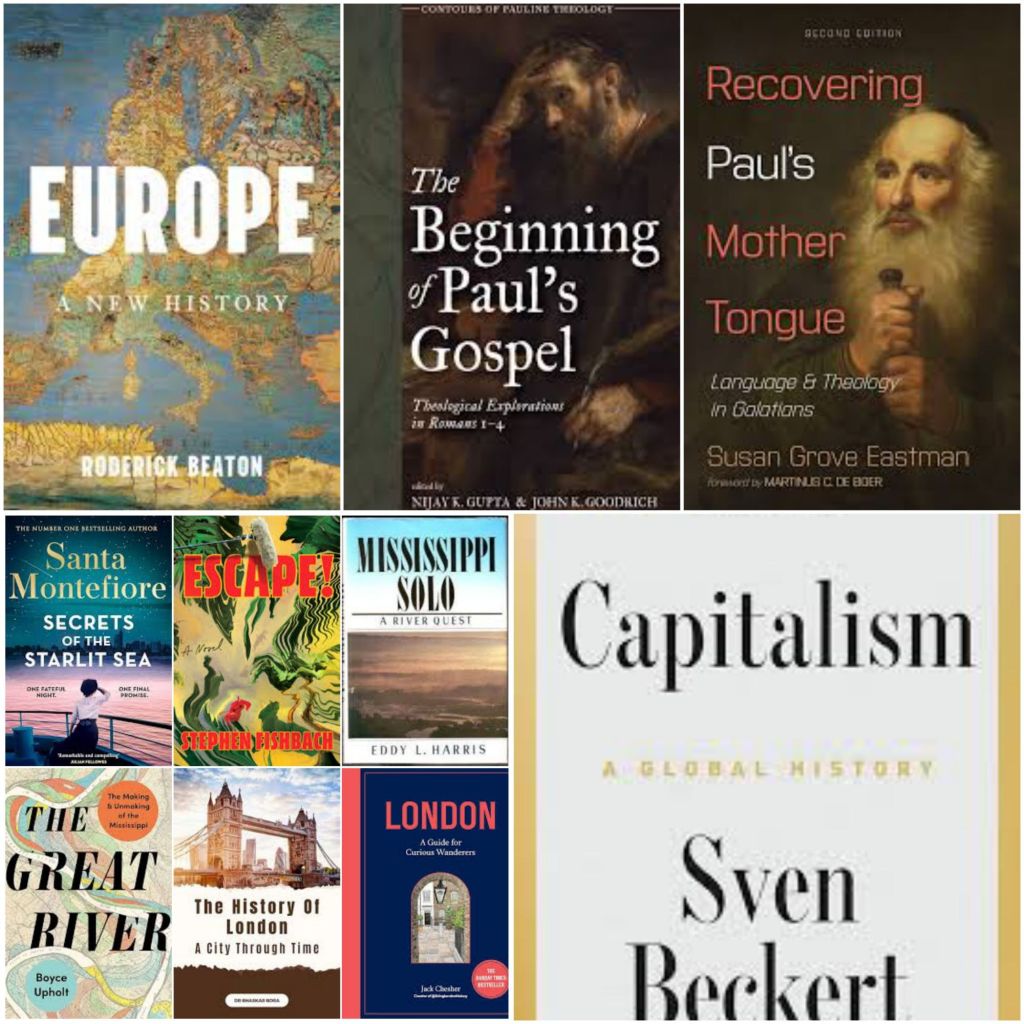
Time travel, a timeless city, a river and an apostle. Envoloping all of this were two complimentary (and massive) historical works, one about the global history of capitalism, the other about applying a European lens to that global history
I had timed finishing my reading of famed Survivor (play, voice and anaylst) legend’s first book Escape (Stephen Fishbach) to coincide with the final episode of season 50, which provided an added layer to that overall experience.
Turns out the guy can definitely write. I was a bit mixed on the book’s second half, where the nuanced approach of the first few hundred pages had struck a nice balance between this feeling that Fishbach is at once pulling back the curtain on reality tv, and at the same time upholding this equal awareness that the reality is being amped up to 11 on a parady type level, sensationalism fully intact. The fact that we never quite know where those lines truly cross is what makes it addictive. If the second half seems to go all in on the parody, and in my opinion loses some of the character appeal in the process, it’s never less than an entertaining ride. At it’s strongest it’s a unique exploration into the disorienting space of pop culture and it’s consumption through the lens of the reality tv genre.
I only finished one other fiction book this month, the second being Santa Montefiore’s The Secrets of the Starlit Sea. A book I almost set down after realizing I had started a sequel without reading the first. I hung on though thanks to the opening 20 or so pages (and also because it checked an easy box for me- the other thing I failed to realize is that it’s a time travel story). Bonus points for bringing in the supernatural/spiritual undertones. Yet more bonus points for an unexpected setting (I really should have done my research first it appears, or just payed more attention to the title). That historical setting, which I won’t spoil, proved the perfect pairing with a book that was next up on my list (which I am reading this month).
It should be said, in terms of a sequel, while I am sure (or rather, I know) I was missing some context and set up, by the time I was 50 pages in none of that really mattered. I knew the characters, and the gaps in the story were essentially non-existent. While there’s nothing overly deep here, the themes about reconciling with the past are present enough to give it some staying power.
Eddy Harris’ Mississippi Solo: A River Quest had been sitting on my shelf for a bit now. With the warmer weather finally settling in, it seemed like a good time to get back into one of my passions- rivers, and particularly the Mississippi. This one is an autobiography, featuring an unsettled soul making the (percieved) questionable decision to set a canoe on the river and make it to New Orleans. There are larger concerns driving the story, Harris being a black man navigating the waters of a percarious portion of America, but the approach here is less structured and more organic. Befitting the story of a man who knows nothing about canoeing or the river. As he encounters the towns and the people and the obstacles along the way, so do we, and we get these snippets of wisdom breaking through from moment to moment within the escapades. The book is dated, but it’s a reminder of both the river’s complicated history and it’s magic. Mostly I found it to be a captivating entry point into one man’s perspective on such a journey, becoming as it does a window into the larger world.
I happend across The Great River: The Making and Unmaking of the Mississippi by Boyce Upholt as I was in the middle of Mississippi Solo, and while I was reading that on paperback, I was listening to this one on audio. I have a shelf full of book’s on the Mississippi, so keep that in mind, but while I think this book would be a perfectly fine introduction for anyone unfamiliar with the river, I found for me it failed to see past the static details of what the river is, and into it’s actual character and ethos. It’s an information dump, with a lot of emphasis on the ecological realities embedded in the river’s past and pushing back on it’s future, but I found it lacked the necessary poetry needed to give it life.
On the flipside, I have been busy planning a summer trip to England, a “if I could only travel to one more place, what would it be” sort of trip marking my upcoming 50th birthday, largely centered on both a literary interest reaching back to my childhood formation, and connection to my family hertiage. Part of that process for me is of course books, beginning with the book London: A Guide for Curious Wanderers by Jack Chesher. It’s designed as a travelogue for the curious wanderer, with a focus on the sacred art (and space) of walking. It teaches the reader how to “read” the language of what it sees as one of the most unique landscapes in the world. A modern space where layers and layers of active globe shaping history and identity are hiding in plain site. An unplanned city in it’s nature that somehow finds order in the chaos. A city built to wander and to get lost in. The book is organized by theme (Stepping Through Time, Language, Culture), and designed as a collection of self guided walks. And the illustrations are wonderful. A book I will definitely be bringing with me.
The other one I finished this month was The History of London: A City Through Time by Bhaskar Bora. This is a very quick, bitesize overview of London’s history, and one that is unapologetically biased (read: not nuanced) towards its unabashed love of the city. Which there is absolutey space for (get me talking about my hometown of Winnipeg and I’d likely be handing you something similar). If I am visiting a city, I want to hear from those who genuinely believe in and defend it’s city. The ones who are ready to tell you why it’s the greatest place to be, and who will gush about it’s rivers and canals and gardens and quirks and bookstores and art and iconic sites until the editors step in and tell them to limit it a couple decent sized print pages per subject.
Speaking of passion and love for a subject, the element of my family history that runs through England is very much wrapped up in John Wesley, who’s home and grave and museum will be my starting point. For something (Wesley’s methodism) that played such a central role in what would become the stream of my family’s Pentecostalism traversing the pond to our side of the ocean, I know very little about it. Thankfully I am a bit more familiar with Wesley’s history and theology. Thus the reason I picked up (in audio form) Kevin Watson’s new foray into the history of Methodism, titled Perfect Love: Recovering Entire Sanctification- The Lost Power of the Methodist Movement. A great read (or listen) for anyone interested in those Methodist roots and development. An inspired read for making a case for it’s central doctrine- whole sanctification. Every movement exists in conversation with and in relationship to another, and those relationships awaken a larger conversation, be it western, eastern expressions of Christianity, early church development, and even the second temple period from which so much of the larger Christian Tradition finds its most immediate context. That these conversations and relationships are still active and ongoing today is a reminder of why they remain relevant, even if we are far removed from the context that first gave these movements their needed life. Perhaps more so, I really appreciated the way this book helped to lay out the flesh and blood practice of this thing I will soon be encountering at it’s source. It’s a way to imagine my family tree making it’s way through this (now to me) foreign soil as itinerant preachers of their own time.
Continuing in that vein, although not related to England, I continued on my journey through checking off the works of Susan Eastman, a blindspot for me, finishing Recovering Paul’s Mother Tongue: Language and Theology in Galatians. On the other side of that equation was the prefect compliment in The Beginning of Paul’s Gospel: Theological Explorations in Romans1-4 by Nijay Gupta and John Goodrich. Galatians is known as one of Paul’s earliest writings, and notably the one where we can most clearly see him working and fleshing out his theolgoical frameowk in real time. The material is raw, honest, muddied and revealing, and there is a reason why Eastman uses it to access what she distinguishes as Paul’s mother tongue, which is simply the shared language, broadly defined, of a given community forged from life and partcipation in community. This contrasts with the father tongue which is the language of a given populist reality as it intersects with the governing Power shaping a society. Where these two things meet in conversation, the mother and father tongues that make up this society, is called the native tongue. For Eastman, recovering Paul’s mother tongue is the necessary way into the force and motivation of his theology, a theology she names as a theology of participation (one that is informed by Paul’s apocalyptic context), a theology that is born in the soil of his own “fleshing things out” in relationship to the Powers.
Romans on the other hand, is known as one of Paul’s final letters, the one where his fully formed theology is layed out in ordered, narrative fashion. In contrast to Galatians, Romans is a grandly structured tome bringing all of the pieces together into a grand vision. No suprise then that it has become a pouplar spot from which to interpret Paul and formulate theologies, most commonly a theology of atonement or salvation. In Gupta’s book, which is a series of essays from a large collection of voices embedded in the current field of Pauline scholarship, the focus is specifically on the letter’s most popular section: Chapters 1-4. Here so much turns on our interpretation of a few select verses, and this book helps to bring us staright into the heart of the larger debate that exists regarding these select vereses. The different voices reflect different positions, but much of it exists as an example of how the dialogue itself works within scholarship, at points building off one another, critiquing portions of one another’s theories and work, and bringing different emphasis and focuses to the foreground depending on what one is seeing from their own vantage point and specialization. I found it to be informative and refreshing, aligning more with some than others, but having plenty of it challenge me along the way. In a broader sense, beginning in Galatians, and then seeing what Paul’s body of work becomes in Romans, was an equally interesting and revealing part of this ecercise for me personally.
I alluded to these two book’s earllier: Capitalism: A Global History by Sven Beckhert, and Europe: A New History by Roderick Beaton. I’ve been working through Beckhert’s book for a while now, which lands at around 1100 pages. Finally finished it alongside reading through Beaton’s book (listened on audio) over the course of May. Both books find their overlap in the ways they look outwards towards anaylizing a global narrative. Beckhert’s challenging treaties takes aim at capitalisims noted adaptibiliy, something that allows it to ebb and flow through different contexts precisely by taking different shapes stemming from a myriad of different concerns and questions. On that front it’s not accurate to reduce it to a singular conception. And yet, this ability does tend to mask the fact that capitalism is also distinguishable as a singular idea. The thing that sustains it is progress. And not just progress, but a kind of progress.
Beaton’s book comes into the conversation by applying a specific European lens to the same question regarding the formation of a global society. It is equally provocative, although perhaps a bit more precise and narrowed in it’s starting assumptions (as opposed to the broader objective of Beckhert.) I loved both, and I found them pushing me to consider the ways societies are formed, not in a bubble but in a constant clash of powers and peoples and cultures and movements. That we find universal concerns withinn this is a witness to the fact that our way into history is through those transcendent truths that give rise to our critiques. For me, as someone born and raised and living in a particular section of the west (and as an inheritor of that historical context), it also is a way of reminding me that all such histories belong to a bigger reality.

