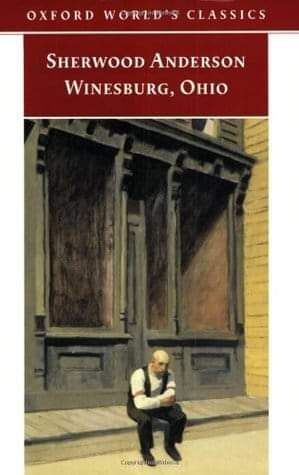
Reading Journal 2024: Winesburg, Ohio Author: Sherwood Anderson
Winesburg, Ohio could be described as; chronically melancholic, cynical, depressing. Those descriptives might be true, or at least partly true, but I think it would be a mistake to suggest that this is all the book is. As a collection of short stories that are bound together by the arc of a singular, reoccurring character (George Willard, a young journalist who works and writes for the local newspaper), Winesburg is a deeply immersive and honest portrait of the life of different people living in a small, unassuming, isolated, mundane, non-descript town.
The book is marked on the front end by a chapter titled Book of the Grotesque’, and ends with what I might suggest is one of the best final lines of a book I have ever encountered, if for the pure simplicity of its presence, bringing Willard’s particular part of the storyline to a fitting and poetic conclusion.
Speaking of the prose, while the nature of a short story collection is that some will inevitably be stronger and more interesting than others, which is true in this case, rarely did a page go by where I wasn’t highlighting memorable and quotable phrases, lines and sentences. It is described in the introduction as a “fetish for simplicity”, but that simplicity is profound, “seeking always to penetrate to thoughts uttermost end.”
Which makes his first chapter that much more fitting when he surmises, “in the beginning when the world was young there were a great many thoughts but no such thing as a truth. Man made the truths himself and each truth was a composite of a great many vague thoughts. All about in the world were the truths and they were all beautiful.”
Beautiful even where it finds things like depression, loneliness, boredom, death, addiction, and unrealized longings. This is a book that doesn’t feel the need to mask over the truth of these realities, instead embracing them as part of what binds us together.
I’ve been accused of being melancholic, depressed, cynical myself, so I’m not surprised I found myself connecting with this, and even more so appreciating it. As one character proclaims in the chapter called Mother, “it seemed like a rehearsal of her own life, terrible in its vividness.” Or as it described of Willard, “He is groping about trying to find himself. He is not a dull clod, all words and smartness. Within him there is a secret something that is striving to grow.”
Don’t be surprised if this becomes your own response as well should you give this book a try. I couldn’t have put it better than what I found in this sentiment: “I don’t know what I shall do. I just want to go away and look at people and think.”
I’ll leave it with this exceprt from the forward, “It is essentially a literature of revolt against the great illusion of American civilization, the illusion of optimism, with all its childish evasion of harsh facts, its puerile cheerfulness, whose inevitable culmination is the school of “glad” books, which have reduced American literature to the lowest terms of sentimentality.”
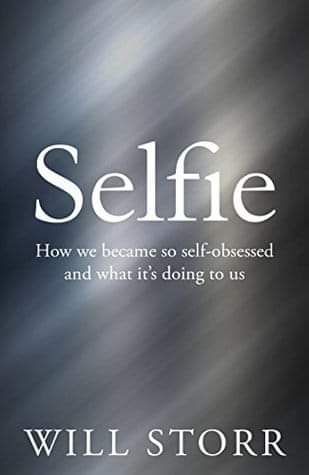
Reading Journal 2024: Selfie: How The West Became Self-Obsessed Author: Will Storr “All we ever wanted was the illusion of control. But we have none, not really. Neither do the people around us who seem so intimidating in all their radiant perfection. Ultimately we can all take comfort in the understanding that they aren’t actually perfect, and that none of us ever will be. We’re not, as we’ve been promised, “as gods”. On the contrary, we’re animals but we think we aren’t animals. We are products of the mud.”
“If the self is a story, then the story the Western self wants to tell is one of progress. Reality is chaos, chance and injustice, our future is illness, bereavement and death. All about us there is terrifying change and there is little we can do to manage it. But our sense of self hides this disturbing fact from us.”
“We’re not all constructed from the same precision-tooled machine parts. We havent all been equally perfectly designed to face the challenges of our environment. We’re lumps of biology, mashed and pounded into shape by mostly chance events. Our human potential is limited.”
“By the time we’re old enough to really understand what our personality is, and begin wondering if there’s anything we can do to change it, most of the work has been done.”
The best treaties and arguments are the ones that are able to be truly honest and upfront about their assumptions and their worldview. This is unfortunately rare in much of liberal, secularized academia. Emphasizing claims to true empiricism and focusing on the functional is often used as a means of sneaking in value claims through the backdoor where they don’t have to be submitted to reason. To challenge those value systems as being irrational typically leads to charges that one is placing too great a burden on reason, formulating this deep inconsistency of logic and argumentation that becomes impenetrable to critique.
Will Storr is nothing if not brutally honest about his working assumptions and the implications of his reasoning. In his worldview the self is a fabricaton, reality is nihilistic in and of itself, meaning is the stories we tell about ourselves which are constructions of our illusions, and there is no such thing as the will or actualized control over our circumstances.
We are, by nature of being naturally born creatures, tribal.
We are, in fact, products of our culture, which means slaves to our nature and formed by our influences.
But this book isn’t according to its author, “a message of hopelessness”. It is in fact a response to the hopelessness that emerges from failing confront the basic truth of our reality and our existence. It is about recognizing that happiness is a purely functional reality, and by recognizing that notions of perfection are in fact a fallacy and that we are ultimately products of chance in a world that is neither equal or fair in its biological function, we can allow our natural tendencies, dependent as they are on our illusions, on our stories, to shift us into environments better suited to enabling feelings of happiness, defined as it is as human flourishing.
And why be concerned with happiness? Because suicide is an epidemic in the modern world. It shouldn’t be given our nature is wired for self preservation and survival. But, as the author submits, it is, leading him to set out and answer the question why. This leads him to a singular observation- it is rooted in the art and function of social perfectionism. If “one of the most critical functions of the human self”, that illusionary construct comprised of story, or the stories we tell ourselves, is “control”, then feelings of failure leave us out of control and thus prone to self destruction. In truth, the idea that we are in control is fact an illusion based on greater illusions of the self.
While this is a modern evolutionary trait of humanity, it can be made sense of by understanding empirical observations about nature, biology, and human evolution. Suicide might seem counterintuitive to our nature, but in reality it is rooted in observable truths about ourselves as creatures existing within the natural world and the natural order. Knowing the patterns can help us parse out where suicide fits in what are inherited self obsessed genes and traits.
And yes, everything, even altruism and self giving practices and concern for the other are inherently selfish activities.
So why does this ultimately matter? Here in lies the conundrum. Suicide is a natural outcome of our natural selves living in a natural order. Once we understand what it is we can see that it is not an abnormality. And yet, so is survival. Thus to understand and to respond to suicide as a “problem” is part of our natural drive towards self preservation, in this case being locating ourslevses in the western concept of human flourishing defined as happiness.
And the best way to be happy? Recognize that perfection doesn’t exist, that progress is a fallacy, thus stripping away the comparative measures that lead to feelings of failure. Here the author distinguishes between depression and failure, suggesting that if we commonly associate depression with suicide, depression is in fact more acutely connected with confronting reality, not suicide. Suicide is nearly entirely connected to feelings of failure.
The author spends each chapter deconstructing the different historical movements that lead to the modern west, both to show how the west is no different in its nature and function than the ages that preceded it and to show how it is equally distinctive in its context, and thus it’s questions and concerns. Nature stays the same, culture changes. And we are products of our culture. Whether we are talking about Greco-Roman culture, Christianity, the enlightenment, neo-liberalism, industrialism, the digital and technological ages, they are all constructs out of which we locate and find our cultural norm, and thus the integral self that frames our cultural obsessions. These things matter because it is the self and the world that we know, and we need these constructs, and even to believe in their realness despite what we know empirically, in order to survive. Thus these things are formed into value systems, value systems that don’t correlate to realty but rather function as part of it, as illusions. To change our cultural realities, to change ourselves, is simply about changing our position, as to occupy different spaces is to gain different influences that then drive us in particular directions. More importantly, those with chance capacities, wired biologically, can change others by changing cultural influences. However, the key here, if we are to tackle suicidal tendencies, is to recognize that cultural changes are differentiated from the natural order. When culture, which reflects value systems, is made synonymous with the natural order, it likes to pretend that it can supersede it, which is precisely what makes the west distinct in its history. It turns illusions into reality, creating false standards of perfection that reality ultimately unmasks as failure. It takes the truth of a nihilistic reality and reframes it as a functional nihilism in practice, both binding us to the illusions and fallacies that allow us to live while convincing us they are untrustworthy.
I’ve got two essential responses to this book. First, I greatly appreciate its honesty and transparency. This is the implication of the worldview and assumptions it is building from, even if it is difficult for us to accept,
On the other hand, I think I would hold the authors convictions more directly accountable to those implications. I’m not convinced that the author has grounds to say that suicide is wrong or bad in his view. He is bound to the ultimate aim- happiness, and in truth happiness is free to express itself in a myriad of ways that dispel what feels to be encroachment of concrete claims of good or bad. Human flourishing is far more malleable as an aim than I think he wants to admit, and I think there is good reason for most of humanity to see the reality he observes and argues for as nihilistic in nature and function. It is thus possible, and indeed most likely, for happiness to function apart from any fundamental concern for the given value of human persons, let alone the world.
Nevertheless, I think this would be a book I would cite and reference in any conversation that wants to suggest empiricism and reason are value systems in and 0f themsleves, and even for that matter reliable or relevant apart from the value systems we are assuming to be true when we engage such things. We are all naturally bred master storytellers. If Storr is right about realty, we just don’t like to be confronted with the fact that the stories we tell to give life meaning are inherently false when measured by the same terms we use to govern reality (empiricism and reason). I don’t happen to agree with Storr’s observations about reality, but i do agree with the implications of his view and appreciate his willingness to deal with that head on. I don’t buy his appeal to hope, but if I had to locate his hopefulness I think I would point to thus summarizing quote:
“I thought once again about how counterintuitive it all was; about no matter how convincing it might seem that our perspectives and beliefs come from a personal place of freely willed wisdom, my investigation hinted at the extraordinary extent to which we are, in fact, our culture. Which is not to say we’re all clones, of course. We have different personalities, different in-group identities, different political biases, and so on. But all of that still sits within this dense web of stories, heroes, dreams and dreads that makes us all, no matter how far apart we might sometimes feel, a family.”
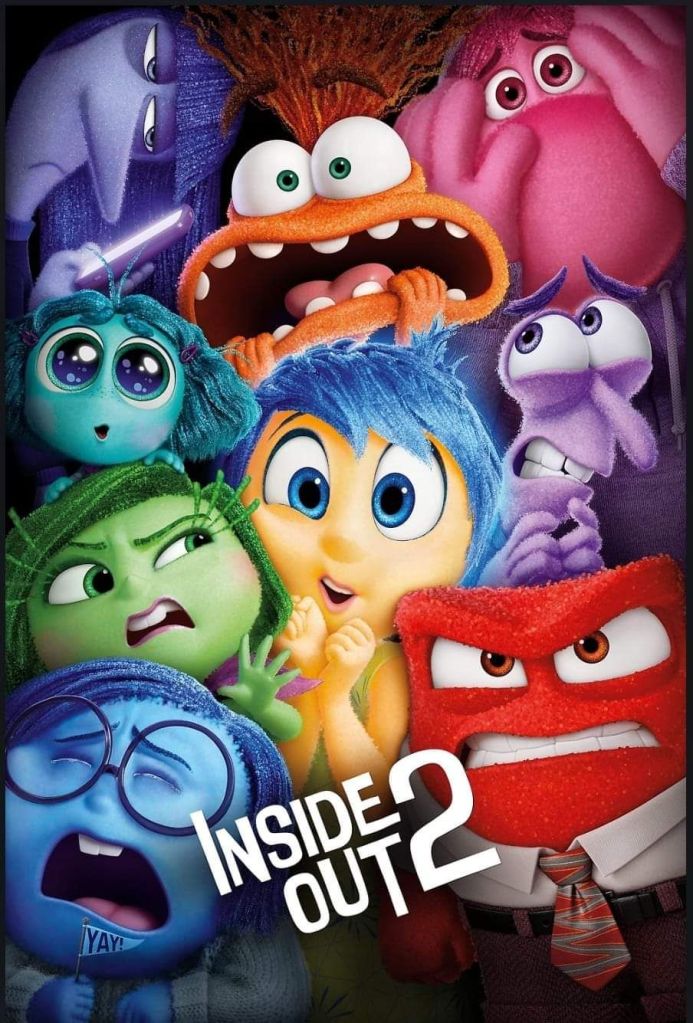
Film Journal 2024: Inside Out 2 Directed by Kelsey Mann
I’m glad I did a recent rewatch of the first film, and that I watched both films in essential succession this morning. I hadn’t actually revisited the first film since seeing it once in theaters back when it released, so I knew that a rewatch might bring some interesting and maybe suprising results. More importantly, it gave me a better gauge for which to make sense of my experience with both films as a seperate but also singular story.
Just to clear the air right up front, if you are stuck on begrudging this as a sequel, seeing it as emblematic of the larger problem plaguing both studios and theaters as they continue to doible down on familiar IP, that will likely define your experience of Inside Out 2. The simple fact that it is operating without the novelty of experiencing its inner world brought to life for the first time I think could feel like justification for resisting its existence.
In truth, I do think this fact forms what might be my biggest critique of the film, which is, by nature of contextualizing both stories into a narrow framework based on age and formation the sequel naturally condenses the reach of its message, both in its present context (puberty) and retrospectively (childhood). Of the two films the sequel suffers more, as I think the original has an already established legacy that applies its message and themes more universally as a concept. Similarly, the first film has the advantage of doing the leg work, which means it does the heavy lifting of parsing out the complexities of its vision and concept in ways the sequel doesn’t need to, leaving a fair portion of the sequel feeling a bit episodic in nature and even a little too on the nose.
It should also be noted though that the first film anticipates the sequel. It sets the stage for it, so to speak, and upon rewatch I think really does operate in faith of its eventual existence. This should help dispel some of those feelings about it being either unnecessary or simply a cash grab. And true to form, if much of the film feels episodic, the recognizable and familiar Pixar “magic” shows up for the final act.
Thematically speaking the film continues where it left off, bringing in the new emotions that come along with puberty and, as the film posits it, the subsequent formation of the self. What’s interesting about the way the film navigates this is, the whole puberty aspect does tend to get left in the shadows the further the film gets into exploring its conception of the self. This is at least in part because the story is so contained and narrowed to its particular situation. I feel like it wanted the simplicity of its scenario driven plot (young girl going through puberty has a chance to discover her dream to be a hockey player at a time of personal transition) to afford it the freedom to then dig deeper into the bigger ideas it is exploring about the self, but there is a bit of a push and pull within the story between these two parallel lines that does end up feeling disjointed. To be fair, the plot of the first film is also far simpler than I remembered, but it had the freedom to commit more wholly and completely to the conceptualized inner workings of the emotional world precisely because it didn’t need to worry as much about the functional self. The natural progression of the sequel is towards bringing in that added dynamic of identity.
I remember when the first film came out that there was a plethora of think pieces dissecting the science of its premise, some supporting it and some criticizing it for pushing the science too far into the realm of ideology and transcendence. I also heard critiques about how it depicted emotions as seperate entities functioning in isolation. The sequel sort of addresses this in a round about way. It assumes the same fundamental end- happiness, or as some define it, happiness as the grounds of human flourishing, but it adds in a new emotion (anxiety) which has the power to bind all the others together. If happiness is the end, anxiety is the means that ensures it is attained. In the first film the story is about embracing sadness as a key to joy rather than its antithesis. In the sequel it is about embracing the whole as the true expression of the self.
Here is where things get really interesting however. The film roots the self in the notion of core beliefs. In theory, it is bringing together beliefs about the world and beliefs about the self, rooting in the natural outworking of puberty as the point in which we begin to build and formulate our identities in the face of these two interrelated realities. Not against our formative years, but in light of it. Beliefs here are seen to represent agency, toying with the question of whether our biology makes us who we are or if we (an operative self) determine our biological function. There is plenty there to parse out as far as reading between the lines in one direction or another, but suffice to say what it is teasing out along the way is the concept of a functional will.
I feel like the contained nature of the film does get tripped up here a bit, because it fails to leave room for wrestling with how past and future connect to the present. It seems to give in to the danger of allowing a point in time when the self generally sees itself as both conceptually autonomous and as the center of the world (puberty) to define the reality of the self in a more empirical and universal way. Its not difficult to look at the way the film conceptualizes beliefs and see that these beliefs are essentially constructs based on perceptual and conceptualized realities. This leaves the self as entity on shaky ground. And not only that, but these are constructs that are determined by external forces.
This left me thinking; why and how should we trust these core beliefs, especially when they appear to be operating in the form of concrete perceptions (I am a good person, for example). The film tries to weave into this a sentiment that sees us as the sum of both our good and bad parts, successes and failures, but this only works on a philopshical level if we make the necessary assumptions about the self that can and will allow us to function freely in the realm of perceptions.
That’s where the conception finds some challenges, most notably when it comes to bringing in a future perspective. If anxiety is about control of the future (or self control), then the future is about contending with life’s impact on our conception of the self. This seemed to me to be a missing piece of the puzzle for anyone trying to apply its concepts beyond puberty. The real question is, can the films construction of the self make sense of reality looking backwards, a notion that gets teased through a reoccurring gag throughout the film. Sure, it can speak to the perception that puberty affords it, but what happens when it is forced to contend for a different reality than our core beliefs assumed? What happens when reality threatens the legitimacy and trustworthiness of our perceptions?
I suppose one of the ways this film addresses this problem is by attempting to say that joy is not constrained to, confined to, or defined by our circumstance. It exists apart from it as a governing force over our lives, holding within it both our meaning and our purpose. There is, i think, fair and good truth here. But what is clear is that puberty perceives life according to its potential. It can feel what it does in the present because it believes there is a certain kind of future to be obtained in service of the self. It functions according to the belief that life has an aim, that progress has a shape, and that human flourishing is bound up in our happiness, or our experience of happiness.
Further, this is tied to our fundamental beliefs, structures that are built through our experiencing of the world. One of the lingering images in Inside Out 2 is of shattered beliefs being reconstructed in a way that pushes further and further out towards something transcendent. At the same time though its philosophy bleeds this transcendence back into its essential construct- the self. Even those things that see beyond ourselves are demonstrated to be part of our personhood, our identity. So what would happen if a third film was made looking back at this person from the perspective of times passage? Would a meaningful life and true identity rest in proving this conception of personhood to be true? In experiences justifying our commitment to joy/happiness as worthwhile? Would our understanding of reality overturn our core beliefs once again, and if so in which direction and to what end? These are of course the sorts of existential questions that recast those fundamental constructs which hold together our sense of meaning and purpose and existence in a different light. I do wonder how the missing component of this story might or could work itself into the story’s we tell to this films target generation, a generation that finds its meaning in a given cultural expectation and norm.
If nothing else, this is the sort of conversation the film opens the door to, and that’s a testament to its strength. Its willingness to go big with its ideas is an admirable thing. And all the storytelling elements that made the first one a beloved classic- humor, character, emotion- are here, just in a slightly more streamlined and compartmentalized fashion. And as I mentioned, the third act finds a way to break the door wide open in this regard, so even if the bulk of this film isn’t operating quite on the same level as its predecessor, it’s defintiely worth the investment as a whole.
I penned this a while back. A pair of sermon series podcasts brought it back to mind- The Crystal Sea by Greg Boyd, in which he talks about all of life, and indeed all of creation, in its finite perspective catching up to what God says is already true of it, and Darrell Johnson’s Having the Mind of the Master and All I Finally want, in which he describes the infinite Truths that define our longings, such as joy, not as something we attain through the exercise of our temporality, but as something that attains us through its infinitude.
With my recent shift in jobs, I’m still driving a school bus, and still driving for a private school (which, for my American friends, means religious/faith based schools here in Manitoba). These things are the same.
I have seen a very real shifts though in location and the students. I have shifted from a rural setting to the city, and from most to not all Christian kids from a uniform background to driving a busload consisting of no less than 10 different ethnic backgrounds and 7 different religious expressions.
Which has been really interesting for me. Given that it is a private school, there is a certain degree of freedom I have in discussing matters of religion and faith that I wouldn’t have elswhere, only in this case I find myself engaging with a very real diversity of opinions and convictions and perspectives. I’ve been really appreciating learning from them while also challenging myself to think about the universality of such discussions and concerns. I’ve also been struck by how the students are not afraid to talk about religion at all. In fact, they seem genuinely interested in it.
This past week one such subject was the idea of heaven, or eternity. Strictly speaking, it’s a topic that requires some imagination, as we don’t really have good language for it. I was curious to see how this subject might translate in the midst of the diversity of those imaginations that make up my busload. Here there is both overlap and specific departures, but all pointing in a similar way to the problem we all wrestle with from our different vamtage points- the reality of death. Defined more broadly than mere non-existence, rather to speak to the basic function of reality, or life, in a finite existence ruled by the law of entropy and decay.
Usng my own imagination, I might begin with this simple observation: I thought about how we experience time from a finite perspective. So much so that it is common to think in terms of borrowed time, or the concept of making the best of the little time we have. This is the language that we have. Time begins. Time ends. And we experience this in the space between birth and death. To begin to imagine a universe with no beginning or no end, scientifically, philosophically or religiously, is a bit of an impossibility, because we don’t have language for it. It’s not something our brains can comprehend. This is why, as the book The Soverignty of Good, a philopshical treatment of transcendence and sovereignty in a purely material world, finds itself needing to collapse notions of the transcendent back into the functional, binding this common struggle and definition of reality to the language of functionality. In doing so such arguments turn finitieness into a transcendent virtue in and of itself.
And yet, at the same time, on a purely functional level, if we compare an era when life expectancy was 40 with an era when life expectancy is 80, we can see how easily we shift our value systems accordingly to fit the potentiality that this given life span represents. We don’t decry that added 40 years, we shift our expectations of what a good life is. We see anything less than that expectant life span as lost potential and, on some level, a tragedy. Thus, it would seem natural to at least consider that our tendency to make finiteness a value in and of itself perhaps should be given pause. If 80 years is our present reality, it seems reasonable to conclude that it’s, at the very most, a contextualized reality and contingent value.
This is one part of the equation. The other part of the equation relates to the quality of a life as it is experienced in time. It’s one thing to talk about length of years, It’s another thing to talk about the quality of those years. In truth, the reason we know the language of finiteness is because we experience decay, suffering and death. This is, then, the measure of a life according to our potential. The potential becomes the value. But what happens when we shift this measure from matters of quantity to the question of quality. What kind of life do we experience in the in-between space, and how does this become a measure of our value. Here things become far more complex and often muddied on the level of morality.
In some sense, it is the collison point between expected life span and the quality of our experience that informs the push and pull of these values. This is how we arrive at the concept of constructed potentiality as the driving value system that governs existence. Potentiality is driven by norms, and norms require context. Context is shaped by the experiences of the present. Thus, if experiencing finiteness on a human and cognisent level as a measure of 80 years with a plethora of medicines, practices and tools that can alleviate sickness and suffering is our context, and this context has been normalized by our culture, then potentiality becomes an incredibly fluid and malleable notion that is held captive to our present reality. Especially when you begin to apply these norms to contexts that are not our own as a comparative exercise. The conundrum exists when we begin to parse out the relationship between longevity and quality as part of a shared value. Two different trajectories and progressions each dependent on the other and interested in the same undefinable aims when considered against the idea of human progress.
This brngs up numerous questions: 1. At what point do we deem the notion of our potential to have been exhausted?
2. How do we measure what we might call unrealized or unreached potential? Do we imagine this potential to have limits?
3. Is something like suffering deemed to be an enemy of potential only within the parameters of our constructed norms, or is it deemed simply to be an enemy of potential and thus something that needs to be done away with by way of our constructed norms? The same question could apply to death. When we think of unrealized potential, do we imagine this only reaching so far when it comes to the evolving nature of length and quality of life? What is the aim of progress in this regard?
4. Can our concern for the present ever be detached from our assumptions about this unrealized potential which we can ultimately only imagine?
Here is the thing. The language of finiteness depends on our experience of suffering, decay and death. This is what defines our reality as a “kind” of reality (one which experiences suffering, decay and death). All discussions of potential are held captive not onjy to this reality, but our context. Time as we know it exists only because of the existence of suffering, death and decay. At the same time, life is defined by its potential. This potential exists in opposition to suffering, decay and death, even as it is also held captive by it. This becomes the working tension that we carry forward into discussions of the eternal or the infinite.
In truth, and this is something that philosophical systems of thought can help demonstrate, for as long as our reality is defined by suffering, decay and death it cannot speak the language of eternal or infinite. It can only broaden the parameters as a matter of function, and as I reasoned above, there is no reason to believe that such broadening has a limit. Hence the philosophical problem, because to speak of unlimited potential, or to speak in terms of the eternal and the infinite, requires one to imagine a different kind of reality altogether, one that requires a different language in order to be expressed. And this is key- it requires us to imagine a reality that is defined by tne defined by the absence of death in its broadest sense.
If this is all true, then I think we can see how the language of finitensss tells us two essential things; First, death, suffering, and decay is in fact an enemy of life, not its defining mark. Second, the fact that we think in terms of potential tells us that in some way, shape or form, we understand that finiteness is not our primary language. We may have lost our mother tongue, but it nevertheless is still present in the ways that life continues to exist in opposition to death. Finiteness is not a value, it is a problem that needs a solution. The real awareness emerges when we consider that finiteness is not a problem that can ever be solved by simply broadening our parameters. We need a different reality to break in and not only transform our thinking and our language, but to redefine and change our experience. To give us a different context through which to measure the notion of potential.
From here I could go on to explain why the Christian narrative is, for me, the thing that helps me to make the best sense of the truth of this reality as we know and observe and experience it. But as a foundation for even beginning to think about this realty, I think this, for me anyways helps to make sense of our common longings and experiences.
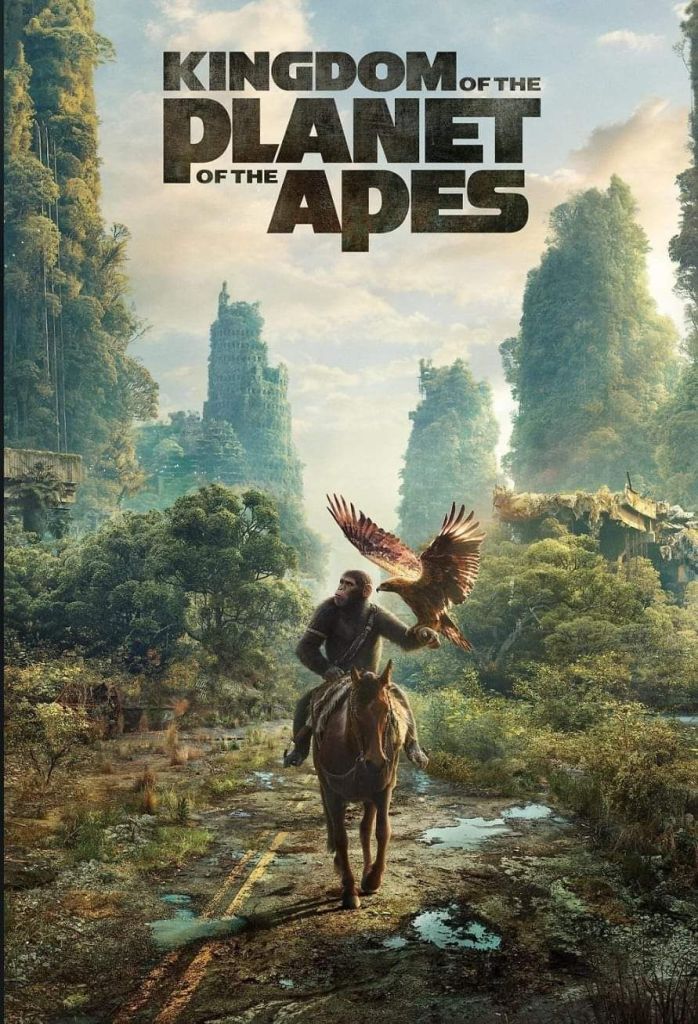
Film Journal 2024: Kingdom of the Planet of the Apes Directed by Wes Ball
Set generations after the events of War, Kingdom of the Planet of the Apes positions itself both directly within the timeline of the aformentioned trilogy while also establishing its own storyline.
I admit, I was very uncertain heading into this one, afraid that a new director and, on a technical front, a seemingly unnecessary reboot, would end up detracting from what is arguably one of greatest trilogies of all time. My concern proved to be unnecessary and unwarranted however, as Kjngdom not only succeeds on nearly every front, it actually finds a way to further the franchises vision and ambition. It’s a bonafide blockbuster in every sense of the word, and an undeniable thrill and technical feat. It’s also stirring and emotional, establishing a high stakes and tension filled moral tale that achieves true Biblical proportions. While references to Rome are readily apparent, Noah, the film’s central character, is also obviously intentional in its nod to the biblical story. If Ceasar stands as a Christ figure, Director Wes Ball deftly weaves that theme into parallel allusions to the Cain to Noah storyline as a way of imagining a new creation gone wrong.
An early battle scene moves us as viewers through the full gamut of emotions, establishing clear stakes and motivation for the central characters. The way it parallels the human and ape story’s is especially poetic here. From there the story only builds, bringing us into the heart of a post Ceasar world, one in which Ceasar’s name is being evoked as justification for the evils of Empire, power, and progress. It taps into the conundrum of Roman history by navigating the tensions of a promised plurality and prosperity that also demands allegiances to the hierarchy of the Roman pantheon so to speak. It is built on false promises and appeals to unity, while also existing in the face of what are very real fears and needs for preservation in an uncertain world.
Which is really where we see the complexities of the story emerge. Where it all heads is to a place of epic stakes and epic proportions. Its stunning, to be sure, the heights this thing is able to reach while feeling wholly fresh and necessary to the larger story at the same time. If it sounds like I’m gushing, its because it deserves every ounce of praise thrown its way. In retrospect, I should have had more faith in its Director, because I thought the Maze Runner films were exceptional and even underrated. This just proves the skies the limit for this young talent, and I can’t wait to see where he takes this current iteration of the familiar story.
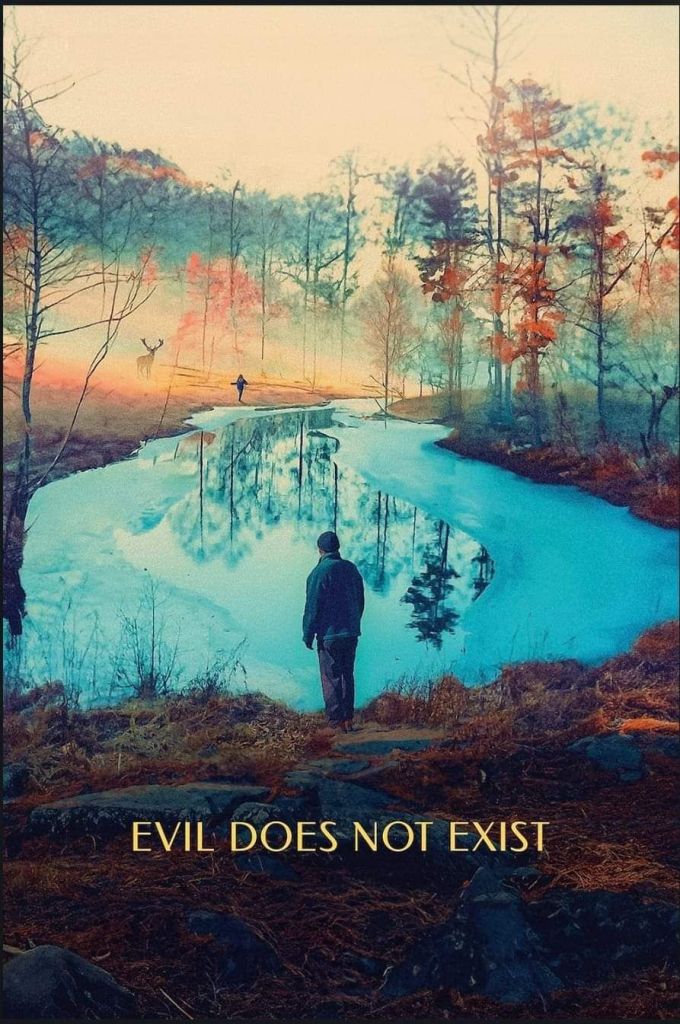
Film Journal 2024: Evil Does Not Exist Directed by Ryūsuke Hamaguchi
Evil Does Not Exist is a fascinating study of the ways in which simple ideas and experiences can inspire the genesis of a story. And more specifically in the case of the filmmaker, how different aspects of the form can drive a story’s function.
The Director has been on record about how the foundation for this film begins with the score, the result of utilizing an imaginative and emotive creative expression in a way that demands contextualizarion. What we as viewers are meant to feel in the soaring and tension filled notes finds its interpretive process in the filmmakers second primary source of inspiration- his observation of nature.
This is evident in a lengthy, drawn out opening sequence where we are immersed in a world where matters of POV are inmediately complicated and blurred. As this framework is filled with its human participants and further contextualized by a small town’s dealings with corporate takeover of their land and the impact this has on their quality of life, the camera works to keep us off balance, constantly leaving us unsure of whether we are seeing the human participants from the perspective of nature, whether we are observing nature from the perspective of the persons, or whether we are simply observing both from the perspective of the camera. This dance is accentuated by sharp breaks in both the score and the POV, the Director also being on record in suggesting that part of his aim was separating these different components of the film so as to allow them to exist and speak on their own. The end result is a unique and wholly intriguing experimental exercise that takes a while to find it’s full expression as a film, and will likely demand subsequent viewings to really substantiate itself with degrees of clarity and weight. This is slow cinema at its heart, beginning with a largely undefined space and filling it in with context as it goes. The real test of its strength then comes from how an abrupt and largely decentering conclusion is able to shed light on the larger ideas contained within the score and the POV.
One aspect of these ideas that finds its expression in the varied elements is the idea of a working tension and contradiction. Its inherent in the title, something pointed out by the individual I saw this film with, which isolates the word “not” by making it red in contrast to the blue of the phrase “evil does exist”. This feels intentional given how the Director is immersing us in a natural world that is full of activity we would call evil, and yet at the same time would deem wholly natural. This forms a tension when we look at the conflict between the human participants, and likewise between the human participants and nature. How and why do we label things, be it actions or persons/nature, evil? What is our measure?
The singular phrase that anchors this tension comes right in the middle of the film, and it is the phrase- “balance is the key”. If this is an attempt to locate a measure, the Director never allows it to slip into easy answers or platitudes. After all, balance presupposes nature as it’s own authority, or as it’s own object of worship. A guiding and determining force. This is precisely the thing the ending looks to unsettle by grappling with a certain, unresolvable point of crisis and logical inconsistency. It forces us to ask the question of the films title one more time. What seems automatic- yes, evil exists- becomes a philopshical and theological problem that pushes back on our interpretations of the world we are observing.
The way the film is designed really lends itself to a reflective process. So much of the films progression can only be truly understood looking backwards. Thus it invites lingering and processing and meditation. It’s a testament to the filmmaker’s giftings as an artist that such a film not only invites such a posture and process, but creates the need and desire to do just this. And, I think, the films lasting quality will come from its ability to reward the necessary work that it requires from viewers. If Drive My Car did more of this processing for us, I think this follow up gains its reward from tne calculated risk of leaving much of it up to us as viewers to unpack.
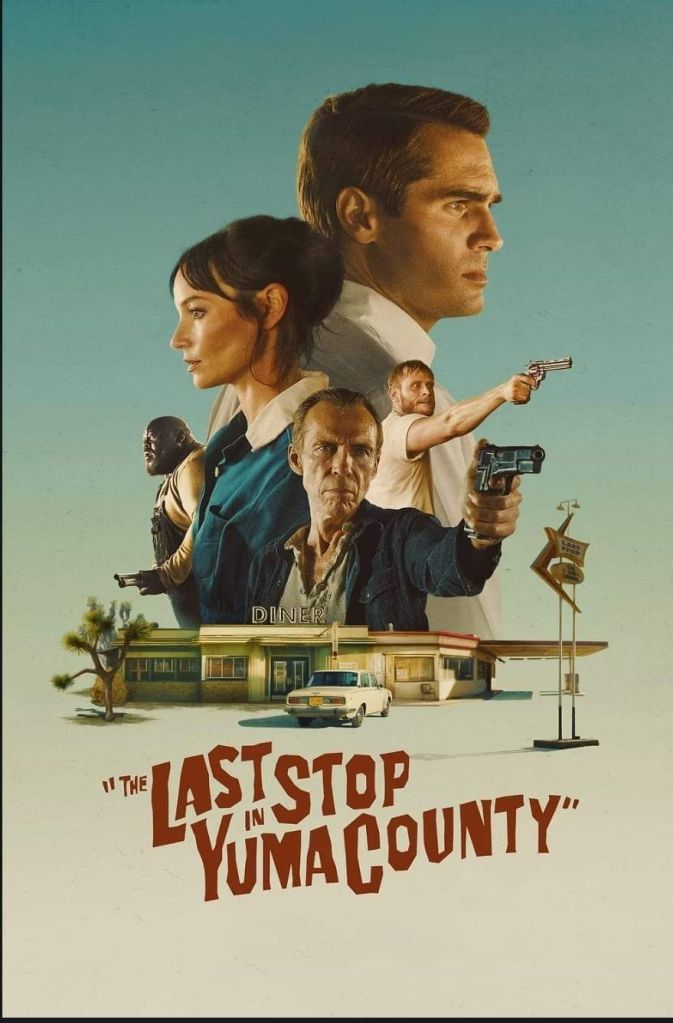
Film Journal 2024: The Last Stop in Yuma County Directed by Francis Galluppi
I wish we were given more character development. There was plenty of space sitting around at the restaurant for this to happen through dialogue and back story. Stylistically it’s going for something different however, drawing out a situational thriller in a way that is meant to be fun, dark chaotic, and visually creative. I think it succeeds in doing this quite well. Really liked some of the camera work too. Has a bit of a nostalgic flavor to it, and definite neo-western vibes.
And it has Jim Cummings, so you definitely can’t go wrong there
Film Journal 2024: Hundreds of Beavers Directed by Mike Cheslik
This film is looney tunes. In all senses of that phrase. One of them being an apt descriptive that marries a kind of live action Looney Tunes styling with an outright homage to the silent film era while blending in notes of satire, folklore (think Paul Bunyan) and a dark commentary on America’s colonialist past.
Its unlike anything else you’ll watch this year, I can guarantee it. It’s strange and admittedly stretches its premise past its breaking point. However, it has all the markings of a film that I would have loved when I was 20 years younger, especially given that it likely would have been that solid find from browsing the indie section at Blockbuster. I know I would have been immediately passing this on to all my friends.
Watching it now, I definitely respect it, and I’m glad I gave it a try, but I’m not sure I have the energy or wits to be helping give this the shelf life it probably deserves. Not to mention it is difficult to know how precisely this film manages to find it’s way to cult classic territory in today’s landscape. I’m not sure it’s possible, but I’m glad it is out there trying and doing its thing.
Stage is one of my favorite horror authors. This is probably my least favorite of her books. Great premise, less than stellar execution.
I have to hand it to her though- she knows how to write dysfunctional families and messed up mother-child relationships like it’s no one else’s business.
So what makes the premise great? It was written during the pandemic, and the pandemic plays into the story in a way that proves the perfect set up for the mother-daughter interplay. Over the course of the pandemic Grace has just bought a house and just lost her job. Her mother Jackie has just lost her husband and her health but gained some money. She makes a suggestion that she move in with Grace so that she can help Grace to keep the house. Grace agrees.
But there are questions surrounding the obvious tensions that are inherent in this relationship early on, questions that play into who is good and who is evil. One of the key questions concerns a dead twin sister who was born with cerebral palsy, a death that seemingly drove a wedge into their relationship. Thrust back into close and closed quarters, how will the past reemerge and what will the past tell us about their conflict and how or will it be resolved?
Great premise with tons of potential. And truth be told, it starts off strong. So why didn’t it ultimately land for me? It was the use of an unreliable narrator and dream sequences. Dreams are fine as a plot device, but when they are used to keep you uncertain about what is real and what is not, things can fall of the rails pretty quickly. Which is exactly what happened here. The ending, taken on it’s own, is actually decent. The problem is the entire middle of the book is taken up by these slight of hands. So much so that nothing really happens. It becomes a bit of a game that is being played on us as readers, and one that ultimately is intended to mislead. It’s like we are stuck being pulled back and forth and back and forth, and where we land no one knows until the final chapters. And where we land in terms of dream or reality we might never know. Or at least thats how it feels going through the process.
I did like the characters however. I like that all of them had the potential to occupy different spaces at different times in ways that rewrite their narrative. I also liked the underlying subtext of grief and trauma. As the blurb on the back says, “home is where the ghosts are”, and there were a few sections where these ghosts from the past come out to play where I found it genuinely effective and unsettling, frightening even. It’s too bad the author couldn’t have honed in more on an actual progession of plot and story. It needed something to ground it for the relational dynamics to have their impact.
If there is one word to describe Robinson’s demeanor and approach it would be grace-filled. This word drives her theological commitments. It drives her scholarship. It drives her exploration of ideas and her deeply felt interest in the God-human story.
Perhaps another word might be warranted here- nuanced. Not only in her examination of the text, which in this case is the Biblical book of Genesis, but in her willingness to bring in a multi-faceted discipline and approach. What she is engaging in here is historical criticism, to be sure, but also infusing theological, narrative and textual criticism, along with philosophical approaches. She never wants to hand one element power over the other, choosing instead to see all these disciplines operating in conversation together.
Full disclosure. I am not a calvinist. The sheer fact that she writes as a calvinist was an issue I had to grapple with personally in her previous book, The Givenness of Things. In the case of Robinson, I had to engage a level of humility and a necessary openness in order to recognize that what she was actually advocating for was not the version of Calvinism I had studied and rejected. As I said in that review, if anyone could convince me of its merits, she could, precisely because she is willing to bend its claims to what one could call a generous orthodoxy. There is no version of her belief system that settles for anything less than a God for all people, nor anything less than a God in whom we can properly locate and define the necessary polarities inherent in the Judeo-Christian strory- good and evil, life and death, love and hate. What she believes in is the goodness of God and the goodness of Gods creation, and however we appropriate the text and theology and narrative of Genesis to explain the world and our experience of the world, it must bear witness to this simple truth.
One example of such nuance is the way she traverses portions of the text that are notorious for being applied in support of a hard determinism or compatibalism (which, for me, is a fallacy built and used to suggest the appearance of a loving God by talking around the problem of hate and evil inherent in calvinist theology). I love the way she uses the literary function of the text to tease out a fundamental and critical observation. Yes, on one hand we can say the story is designed to show a series of interconnected events which all lead towards a purposed end. She notes how this is bookended in the text by two parallel stories- Cain and Abel on one end and Joseph and his brothers on the other end. Thus one, assuming a more modernist perspective that uses a sharply drawn literalism to define the text, might be left wondering, well what if this person hadn’t done this or that person hadn’t done that. Would it not have derailed the story and subverted Gods willed for means and ends? Surely this points us to the theological value of determinism. Robinson pushes back on this assertion by leaning into the text in its world, noting how not only would the authors not have been thinking in such terms, but the very fact that we have the story that we have does not suggest determinism but rather providentialism. And there is a difference. In the former, the point is that God needed to determine every movement and every choice in order to be truly sovereign. Here it is the events leading up to the climax of the story that matter as the means to such an end. In the latter, it’s not about the different events so much as it is about a people confronted with Gods faithfulness looking back on their story and writing it in that light. In truth, the same story could have been written in an endless number of ways according to people’s responsiveness and particpation. We have the story that we do at least in part because this is the history that happened. The point of tying that together with a conviction in Gods faithfulness, and in writing it as though all od these differnt events are tied up in its known end, is in order to show that God is always at work to bring about His ends in a chaotic and unpredictable world, which is a huge thematic interest of Genesis, and which is at its heart a work that is for the world.
I love Robinson’s eye too for the smaller details in the text. The way she pulls out different observations of certain narrative flows, and the way she revels in the creaive design of the text, including its poetry. She does not allow herself to get bound either to a heavy set literalism or a direct rejection of the texts historicity. Rather she genuinely wants to look at how the text functions as a creative and theological work, and what that would have meant to the world of its authors and readers. She does an incredible job of showing how Genesis is a book that sits in conversation with the wider ancient world and the reigning mythologies. She is able to show, compellingly and distinctively, the way Genesis is challenging common conceptions of God and humanity and creation, particularly in how these perceptions relate to each other. It had a very real polemical purpose, and understanding why and what this polemic is can help us get behind what the text wants us to understand and why it needs us to understand this. She, along with many others, have found these points to sit at the foundation for why they take this text seriously and why they have allowed it to inform their Christian conviction and faith. The more aware one becomes about the books purpose, the more we are forced to wrestle with it, and wrestling demands a response.
Everything in this book really does boil down to discovering the nuance, and within that nuance finding the concrete expression and truth of grace. This is the driving and motivating force of what I think is an exceptional work on a familiar but often misunderstood book. And it shines through the quiet brilliance of her reflections and observations. Part of the process here is actually jumping from these observations and reflections into actually reading the text itself, thus she builds into the back half of the book the entirety of rhe text so that one can engage with it all in context. And, I think, if her book has its way, it should be an invitation to this end to embrace mystery and wonder and beauty, to be genuinely curious and not beholden to bias’, and to allow the external observations to tease out an inner truth, one in which the spirit is able to truly speak.
Reading Journal 2024: The Sovereignty of Good Author: Iris Murdoch
A fascinating little book, which is really more a collection of essays brought together to form a cohesive, and often persuasive argument against modern philosophy (read: Kant, existentialism, empiricists) and for a reclamation of Platonic ideals. I don’t agree with all of it, and I do find those Platonic ideas to be problematic in their own right, but what’s most interesting about the philosophical postion Murdoch is arguing for is noting the emptiness of the modern experiment. It cries out for a kind of re-enchanting of our philopshical aims, something he finds in history.
The critique begins with a dismantling of the cult of the self. Philosophy, in its modern context and largely due to the existential problem it creates, has found itself forced to reposition an unattainable higher virtue using concrete terms. We might call this science. We might call this humanism. We might call this progress. We might call this liberty or freedoms or human rights or globalism or nationalism. Whatever it is, such virtues function as the highest order largely detached from our ability to reason either from it or towards it. The end result of any reasoned attempt to claim that an empirical process is able and content to define and locate goodness on it’s own and within the observable functions of a society or natural order has been a sharp detachment, however invisible and out of sight it sometimes tends to be, from the very thing that is required for goodness to be sovereign.
What Murdoch argues for is an essential differentiating between beauty and goodness. Beauty is that which we can observe and experience as a shadow, while goodness is the higher virtue that can only be seen dimly. To say that goodness can never truly be grasped or seen or reached or defined might seem antithetical to the modern approach, but it is in fact the very thing that allows us to locate it within the empirical process. What we observe then in beauty (and its counter, the ugly) is freed from having to bear the weight of explaining it’s own existence, and it is this act of seeing that binds us necessarily to knowledge as an intrinsically external reality. It exists, even though we cannot see it, and we can know it exists because of its relationship to a functional reality that can be observed.
The sovereignty of the good seems to push us to want to name the good. There is soenthing in our human nature that seems to drive us in this direction. But this is precisely where the interchange becomes necessary and important between the sovereign and the functional realities that guide our existence. To name the good is to make the functional sovereign, when it is in fact not. Thus goodness must remain an unattainable and unexplainable mystery. Although not a mystery in the sense of being unknowable, but a mystery in the sense of being sovereign. A mystery that has the explanatory power to justify and define and explain things like morality precisely because it is not morality and contains the power to explain its own existence.
Here I would note a divergence between Murdoch and myself. One of the places Murdoch ultimately ends his argument is in making the claim that engaging the sovereignty of the good means recognizing and accepting our functional reality. This means, somewhat ironically, acceptance of the reality that the self does not exist, and that meaning does not exist, and that the humble man knows that he is in fact nothing and that virtue is in fact pointless. It is only by accepting these things that we can become virtuous or discover and see goodness and discover the self. Here in lies the great conundrum of reasoned existence. In some sense I recognize this sort of honest assessment of reality as a strength of his argument. It is the one of the great shortcomings of much modern philosophy that it has lost sight of this essential reasoned conclusion, thus demonstrating much of modern empiricism to be operating on a fallacy, even if through a willful ignorance. At the same time though, the modern experiment does reveal an important point about this philopshical postion all the same- awareness of the truthfulness of this kind of futility, nihilism and meaninglessness, even if the philopshical exercise desires to reclaim existence, meaning and purpose from its grip, needs and requires allegiance to our illusions in order to work. We have to remain at least willfully ignorant, even if the will is equally an illusion, in order to accept goodness as sovereign over our lives. And that’s a precarious postion for philosophy to find itself in.
There is another way though, which is perhaps sought after by those looking back at the philosophers who did not seprate the philopshical aims from theological ones. Its not difficult to see the religious language of Murdoch’s argumentation. We see Truth or goodness only partly or dimly, as we see God. Goodness must be able to justify it’s own existence, as would god. We see goodness in the functional, as we see god. We seek goodness as we seek God apart from our own workings. Murdoch acknowledges as much, but sees religion as an expression or outworking of his philosophical position, not as its source. It is simply the natural outcome of not naming the good in the modern sense. It is simply langauge that would translate to good/goodness rather than god/godliness. I’m not convinced that this works, however. I don’t think the argument in this book is able to accomplish what it sets out to do, which is to afford goodness a transcendent quality. Goodness is held captive to the necessary recontextualization that effectively makes it a moving target. Goodness becomes dependent on something else to explain its existence. In some sense the concept of god operates in this way as well, but the difference is that recontextualization doesn’t redefine god, rather god is a Truth that, by its nature, must always be contextualized and re-contextualized. This is two ways of seeing dimly, seeing partially, of seeing the shadows of the true thing.
A compelling read in any case. Lots to think about here and lots to revisit and wrestle with. And most importantly, I think it is well argued and succinct and compact as a philopshical treaties.



 The Stories of my Life