
“Blessed are the pure in heart, for they shall see God.”
Matthew 5:8
“I allow the question to surface, if only for a moment, “What is God?” Not “who” but “what”? What are You, Lord? What is this Reality that transcends it all and yet graciously chooses to meet with us? “They shall see God.” What shall they see?”
– Darrell Johnson (The Beatitudes)
👉 “You cannot see my face, for no one shall see me and live.” Exodus 33:20
👉 He who sees Me sees the One who sent Me” (John 12:44-45); He who has seen Me has seen the Father” (John 14:8-9)
👉 “A little while, and you will no longer see me, and again a little while, and you will see me.” Johm 16:16
👉 “Lord, when did we see You hungry, and feed You, or thirsty, and give You something to drink? And when did we see You a stranger, and invite You in, or naked and clothe You? When did we see You sick, or in prison, and come to You?” The King will answer and say to them, “Truly I say to you, to the extent you did it to one of these brothers of Mine, even to the least of them, you did it to Me.” Matthew 25:37-40
👉 “Blessed are the pure in heart, for they shall see God.”
Matthew 5:8
The Season of Virtue: Expectation and Preparation In the Number 40 (Lord of Spirits Podcast)
Reflecting on the most recent episode of the Lord of Spirits podcast, titled The Season of Virtue.
They point out that an oft neglected aspect of the season of Lent is the number 40. Without this number we miss the story that the scriptures are trying to tell.
40 can be measured differently (days, months, years, generations), but where it surfaces always connotes, for the biblical writers and readers, the notion of preparation and anticipation. It is the result of measuring things in sixes (again, in ancient numerology) rather than 7’s, which would denote completion/ perfection/fulfillment.
We see this in:
The 6 days of creation.
The flood narrative
Both times Moses goes up the mountain
The wilderness motif (including Elijah)
When Goliath comes out and awaits the one would take him on
The scouting in Joshua before the promised land
The reigns of David and Solomon
The time given to Ninevah in Jonah
The genealogy of the Gospels
The time between the resurrection and ascension
Pentecost
The reign of Evil in Revelation
Just to name a few.
The hosts point out that the motif of anticipation and preparation can carry a duel focus for the biblical authors which is based on the two times Moses goes up the mountain. The first time Moses goes up is in positive anticipation and preparation. Where the people failed to prepare and anticipate, Moses goes back up for 40 days in prayer and fasting (repentance on behalf of or as a mediator for) the people. Given how this is applied to Jesus, Jesus is then positioned as a mediator in this same sense.
Why is this important? Because it becomes extremely evident that the Biblical writers/authors lived and breathed this pattern of expectation and particpation. Moses, Elijah, David, they are all depicted within the framework of sixes. There are three key places where the number 7 is applied, narratively speaking- to God in creation, to Jesus in his resurrection, and to the promise of new creation. All of which function together.
And where the 40 days is concerned, the duel nature (the positive pronouncement/the call to repentance) informs how we approach Lent in practice, and how we frame that in light of Jesus being its completion.
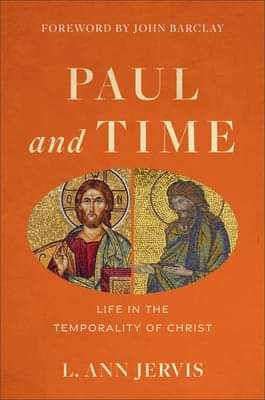
Reading Journal 2024: Paul and Time: Life in the Temporality of Christ
Reading Journal 2024: Paul and Time: Life in the Temporality of Christ
Author: L. Ann Jervis
Theological shifts begin with someone willing to challenge the status quo. Paul Barclay is a great example of this, pioneering a necessary shift in how we understand the terms Law, grace and faith within the social customs of the ancient world. Here he pens a forward for L. Ann Jervis’ Paul and Time: Life in the Temporality of Christ, a book that, not unironically, challenges some of the conceptions of a larger body of work Barclay is often included in, that being the concept of the “overlap of the ages”. Much work has been done to place the story of Jesus back within its Jewish context, one outcome of this being an increased emphasis on the notion that Jesus actually accomplished something on the cross according to the fulfillment of that story’s expectations (which can ultimately be summed up in the defeat of Sin and Death, the establishment of the Kingdom of God, and the inaugeration of the new creation). Thus, the language of the overlap of the ages has been employed to describe a world in which Jesus’ accomplishment is true, and yet at the same we still see and experience the effects of Sin and Death in the world. What many modern scholars have suggested is, Jewish custom thought in terms of the ages (this present age and the age to come), and so did Paul, one of the primary thinkers and writers of a post-resurrection world. Therefore, it is assumed that Paul thought in terms of the overlap of the ages. Where he insists that Jesus’ resurrection actually accomplished what the grander story was waiting for, he also sees this present age still persisting.
But, Jervis insists, we don’t actually find Paul speaking about ages anywhere. Which creates a problem for our assumptions about the overlap of the ages.
So what does Jervis believe Paul, and his Jewish Tradition, actually thought? This is where the book’s title comes into play. She believes that Paul actually thought in terms of time- death time and life time. Or capital Death time and Life time to denote its rulers.
As Barclay summarizes in his introuction,
“The suffering, mortality, and temptation experienced by the believer are not, for Jervis, a sign of living still partially in the “present evil age.” All such things have been enveloped, embraced, and taken over into the life of God in Christ and are therefore experienced by the believer “in Christ” and not in spite of him…Paul simply marches off the map of our human conceptuality of time; if we domesticate him to fit our concepts, then we have failed to appreciate how radical he is.”
Barclay also goes on to formulate this into a question: “If, as Jervis memorably puts it, for those in Christ death is not fatal, how is this to be believed, hoped, and practiced in a community that is shaped by such good news?”
Now, a caveat to Jervis’ assertion that Paul never actually speaks about the concept of the ages- he also doesn’t speak of the concept of time. However, Jervis insists that the concept of time fits with Paul’s view, or is assumed by it, far more succinctly and logically than the concept of the ages, particularly because the concept Paul does deal with is life (and death). She writes,
“Life and time are metonymies, for one without the other is impossible; to conceive or experience one is to conceive or experience the other. Death, on the other hand, is the destroyer of life and of time. To speak of death is to speak of the opposite of time.”
If time is indeed inherent to Paul’s thought process and convicitions regarding life, in particular how we conceieves Jesus to relate to matters of life and death, then the other thing Jervis suggests is that it becomes pertinent for modern readers of Paul to note that we al bring our own conceptions of time to the table, which may or may not intersect with Paul’s own understanding. Thus it becomes important to know the concept of time that we have been handed in a theological sense, before moving to then ask, what can a closer reading of Paul tell us about his concept of time. Much of the earlier chapters deal with our modern conceptions, followiing the philosphical and theological development of time, with are correlated. This would include the Western conceptions of “linear” time (or history), and the theological debates around circular conceptions of time, both which assume time as an entity seperated or intertwined with the concept of space. She speaks about William James’ classic conception, which sees time as inherently attached to tenses- “that what is past, to be known as past, must be known with what is present, and during the ‘present’ spot of time.” And further, “time “can only be coming from the future, passing through the present and going into the past… it is coming out of what does not yet exist, passing through what has no duration, and moving into what no longer exists.”
Eternity then, in theological and philosphical senses (and even scientific), is seen to contrast time by being wholly present without tenses (or, the impossible to comprehend notion of infinite progression, which carries with it the notion of change).
If we begin to narrow this down to a theological concern, what arises is the oft debated idea of salvation history. How God acts in and/or outside of time. Which of course is filled with all manners of debate regarding the nature of God and the nature of humanity, travelling lines between historical and apocalyptic viewpoints.
One of the biggest implications of the overlap of ages view for Jervis, and why she believes rethinking Paul’s viewpoint is necessary, is the question of the aim or goal of salvation. “The perhaps unintended consequence of this view is that Paul is seen to regard the new age as God’s salvific goal, with Christ as the means by which that goal is achieved. Now, as a consequence of Christ’s resurrection, the goal of the new age is here in part, though it must contend with the ongoing old age. However, when Christ returns and believers are raised, all will be as it should be: the old age will finally be obliterated and the new age achieved in its fullness. To the contrary, my reading of the evidence sees that Paul regarded not the new age but life in and with Christ as God’s goal for humanity. Paul connects certain concepts with that life (those that have been proposed as his language for “new age”) but makes clear that new creation, kingdom, and eternal life are the consequences and conditions of life with Christ.”
This might sound initially like semantics, and it partly is. One critique that could be lobbied at Jervis’ conclusions, along with pushing back on the notion that the overlap of ages isn’t compatible with Paul, is that much of what she says will find some familiarity in most Christian thought. However, I think the challenge for readers is to note where and how the nuances of Paul’s view of time not only challenge our own, but shift our theological concpetions, if ever so slightly. Even small shifts in thought can have iimportant implications, and I do think its fair to consider whether her obersavations of time and Paul change how we look at the person and work of Jesus (through the lens of Paul and his Jewish understanding).
After all, I do think it is true that many shcolars and theologians simply bypass the muddled ways we have of trying to make sense of the idea that Jesus both accomplished something AND sin and death appear to remain prevelant in our experience of this present reality (often called, this present age). This does represent a complicated reality that is not easy to address in a way that makes sense. Not that Jervis’ approach gets rid of the complications, but she does offer what is perhaps a way of giving the non-sensical a more logical framework. For Jervis, “Paul portrays believers as living entirely in Christ.” And what is the implication of this? She notes that Christ’s life is temporal, meaning, it exists in time. But it is a kind of time that exists in opposition to Death time. If one is in Christ, time does not end. And this is different than contrasting an old (or present) age with a new age in a couple ways. First, as was mentioned, it shifts the goal from new creation to life in Chirst. What flows from life in Christ IS new creation. Second, it shifts the common understanding that something changes upon Christ’s return more firmly and uniformly towards the idea that the change happened at Jesus’ death and resurrection. Jervis makes the case in later chapters that for those “in Christ”, time does not change upon Christ’s return, nor do they change. Rather we simply continue in a kind of time (life time) which is experienced in Christ. What does change upon Christ’s return, with the debate around God’s judgement aside, are those who are not “in Christ”.
Jervis also spends time unpacking how it is that life time in Christ can be temporal while also being uniformly past, present and future. At its heart, she is trying to retain the concept of time that she finds in Paul which relates to change and motion, two aspects of time which she accepts and assumes. As she writes,
“One manifestation of the constant of time’s being tied to action, event, and change is that humans can experience (perhaps typically do experience) the tenses of past, present, and future simultaneously, rather than sequentially… The present of past things is the memory; the present of present things is direct perception; and the present of future things is expectation.”
Further, she writes,
“The nature of God’s duration is not eternal timelessness and non-change. Rather, Paul’s letters indicate that he understood the eternal God to live a temporal existence in which there is past, present, and future, though for God these tenses are nonsequential…. The apostle understands there to be a primarily qualitative distinction: God lives a type of time that is life-time, not only because it does not end but, intrinsically related to its infinity, because there is in God’s time only life.”
This underscores the essential connection that drives her thesis- time is not related so much to space (although it can and might be) as it is to life. “God’s being is life”; “life [is] the fundamental element in the divine being…. Eternity is really beginning, really middle, and really end because it is really the living God. There really is in it, then, direction, and a direction which is irreversible… God’s tenses do not function chronologically. God’s past, present, and future are not sequential or discrete. The past and future are always in the present for God.”
Time, thus, can appear both finitely (death time) and infinitely (life time). And it is, in fact, in death time where time faces its biggest problems- “There is flatness and finitude to time over which death rules, in effect making this temporality an illusion”- something that moves us towards a natural conception of time that is infinite. Even those who deny God’s existence strive to hold on to non-sensicle conceptions of infinite time, because once we lose that all we have is death. Which of course means the absence of time.
This does ultimately bring us to the biggest question of all- what does it look like for us to live and experience life time in the here and now? If there is a qualitative difference between these two kinds of time, and we don’t ultimately shift from one to the other in an ambiguously applied “overlap of the ages”, how can we say that we are living life time in a world governed by death time?
Here is one way Jervis has of speaking to that quesiton;
“The ethical and perhaps ontological consequence of living Christ’s time by virtue of belonging to him is that those who do so have crucified the flesh. Defeat of the flesh can take place only in a type of time from which death—that anti-God entity that empowers sin in the flesh (Rom. 8:2–9)—has been excluded. Paul, then, conceived of two types of time: one that is dominated by death and another that is only life, for death has no power in it. Those united with Christ live his temporality—a type of time from which death is excluded.
Living life-time with mortal bodies is not an indication of living in the overlap of the ages or in an already–not yet existence. Paul identifies sin as the reason believers’ bodies die, but he claims that nevertheless their bodies are united with Christ and God’s spirit (Rom. 8:9–11). The exalted Christ lives in believers, which means that though their bodies are dead, they will live (8:10–11). Those in Christ are granted the liberty of working with and living with the spirit and Christ, which means having power over the deeds of the body (presumably deeds directed by sin). Their lives, even with mortal bodies, are structured by life. They live in a type of time from which death’s power has been exorcised. They live not in a mixture or overlap of two ages but in the one time of the risen and exalted Jesus Christ. This makes it possible for them, by means of the spirit, to kill the deeds of the body (8:13).”
For Jervis, “Christ’s resurrection, though an event in Christ’s and humanity’s past, is present for those living after that event.” She believes it is similar, for Paul, when it comes to Christ’s crucifixion. “In the context of Paul’s union-with-Christ concept, imitation is the reproduction of the living and present Christ. Believers can, then, have the same disposition as Christ (Phil. 2:5).” To this end, perhaps one of the more striking things she points out is this. “Given the wonders that the eschatological events will achieve for believers, and for creation (Rom. 8:19–23), it is not surprising that we should miss that the apostle thinks that Christ’s parousia is primarily about Christ… The parousia is an event in Christ’s life, in Christ’s future. It is Christ’s day.”
This is perhaps the biggest point I’ve been dwelling over, as it is a powerful one. Precisely when she goes on to flesh that out in the followiing way;
“Unlike Christ’s incarnation, crucifixion, resurrection, and exaltation, Christ’s actions at his day/parousia, except for his ultimate subjection to God, do not signal temporal change from before to after… Christ’s day/parousia and his judgment do not change his existence, apart from opening it up. What is still to come for Christ is that his present tense will be revealed.”
Apply this to our imitation “in Christ”, and you have the following:
“That Paul thinks that now those united with Christ can and should walk as in the day (Rom. 13:12–13) indicates that at the event of the day they will continue to live in it. Christ’s day does not change believers’ connection to Christ. Paul’s statement that believers are of and belong to the day (1 Thess. 5:5, 8) illuminates his understanding that believers remain in the day at the event of the day… Paul is not concerned to problematize death, as de Boer proposes, but rather to problematize Christ’s resurrection. The apostle wants the deniers to see the scope of the significance of Christ’s resurrection. It has not just defeated the power of sin, which the Corinthians appear to value (1 Cor. 15:17). Paul wants them to understand that Christ’s resurrection has made death so ineffective that dying is merely entry into life in incorruptible bodies (15:35–38, 42–44)… the power of death is not an obstacle to believers receiving the fullness of their salvation (imperishable bodies). Being in Christ is being in the one who has conquered death. Mortal believers live in Christ’s present reality… Believers do not await salvation from death at Christ’s parousia. They await, as Paul puts it in Romans, the redemption of their bodies (Rom. 8:23)28 or, as in Philippians, the transformation of humble bodies into the form of Christ’s body of glory (Phil. 3:21)… Death’s entrance into the world through sin (Rom. 5:12) is a problem that is solved through Christ’s entrance into the world. Justification, which comes through Christ (5:1), is in effect the defeat of sin. And where sin is defeated, so is death… The destruction of Death happens for believers when they are united with the exalted Christ.”
If this all sounds like heady stuff, it is. And Jaervis is up to the task of giving it the necessary work and exposition. These ideas are all fleshed out scripturally as well as historically and theologically. And it is all concerned for reshaping our sense of hope not on some awaited future, but on claims we can apply to the here and now.
“At the point of union with Christ, believers no longer live death-time but life-time; at the point of union, while living in mortal bodies, believers are already free of Death. In Christ’s time, the death of believers’ bodies is not fatal; their mortality becomes enveloped in and suffused by life. Those united with Christ are, like Christ, liberated from Death. Even before their bodily transformation, there is no death-time in the temporality of those united with Christ…. In Christ, dying has a meaning entirely different from that in the present evil age. In the present age, death is caused by the powers of Sin and Death (Rom. 5:12). On the other hand, in Christ—over whom Death does not rule (6:9)—dying is a transformative event.”
Thus the implications are personal- “Paul does not see “the Flesh,”25 or Sin, as the problem after people are united with Christ. It is rather believers’ perceptions of their relationship to Sin and its influence on the flesh that is the problem.”
And the implications are socially concerned as wrestling against sin means looking outwards beyond ourselves in the present- “Believers, however, are entirely capable of keeping defeated Sin in its impotent, excluded position. Such activity on believers’ part is not engagement in an ongoing battle for victory but enactment of their freedom and demonstration of Sin’s powerlessness. Union with Christ allows for avoidance of sinning. Put another way, believers wrestle against sinning not in spite of being in Christ but because of being in Christ.”
And it is cosmic- “Paul indeed conceived of a cosmic war between God and inimical powers, but the apostle is convinced that, through Christ’s cross, resurrection, and exaltation, God won that war.”
Thus the problem can be boiled down to one of knowlege- “The contest between true and false knowledge is not at once a contest between God and Satan; instead, it is a contest between those who accept their liberation and are obedient to Christ’s rule and those who resist the consequences of their liberation.”
Even if we can find threads of these modes of thoughts littered through common theological conceptionns, for me it breathed new and fresh nuance into what has been firmly entrenched theological ideas.
Reading Journal 2024: My Selma: True Stories of a Southern Childhood at the Height of the Civil Rights Movement

Reading Journal 2024: My Selma: True Stories of a Southern Childhood at the Height of the Civil Rights Movement
Author: Willie Mae Brown
There are qualities that make this book compelling, and qualities that act as a deterrent. Beginning, perhaps, with the choice of perspective. This is a Memoir, and it is mostly told through the eyes of a young, 11-12 year old Willie Mae Brown growing up in Selma at the height of its racial tensions and the famous march. She writes as an adult, but it captures her perspective as a child, creating a bit of a rift between the two vantage points gjven the limitations of that childhood perspective. That perspective is true, of course, to what she saw and experienced, but the book is not intended to function as a studied examination of that perspective. She is not looking to impose things on to that childhood perspective that she wouldn’t have understood or seen at the time. It is meant to put us in her shoes, to see things from that limited vantage point. Which has its merits and its obstacles, especially where the adult voice does break through.
It should be said, if the subtitle of the book suggests “stories”, the chapters are all sequentially connected In a way that reads as a singular story. At the same time, each chapter retains its own distinctiveness, so as to stand apart. This does create a bit of dissonance, and at times it’s hard to follow, which subsequently makes me wonder if this might struggle to land for the younger readers that represent its primary demographic.
As a portrait of a single, authentic childhood, growing up as a young black girl coming of age into womanhood during a volatile time in Selma (which she sees more at a distance rather than as a participant) the book does work, and it’s on this level that the prose proves endearing. When I was able to fully resist placing any external demands on the authors approach, I found that’s when it was most able to speak, content to simply take us inside the inner workings of a world that existed within the conflict unfolding around it, both in its normalcy and in its particularities.
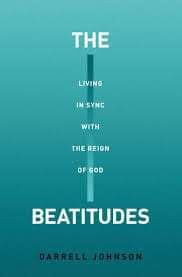
Reading Journal 2024: The Beatitudes: Living In Sync With The Reign of God
Reading Journal 2024: The Beatitudes: Living In Sync With The Reign of God
Author: Darrell Johnson
“On first reading [the Sermon on the Mount] you feel that it turns everything upside down, but the second time you read it you discover that it turns everything right side up. The first time you read it you feel that it is impossible; the second time, you feel that nothing else is possible.”
An easy read that affords readers a significant window into a familiar text. Johnson’s approach is a bit paradigm shifting, and there are places and points where I remain unsure about some of his assertions, but he nevertheless offers an intriguing way to read the beatitudes in light of some long standing disparities and disagreements, most of which revolve around the the theoretical differences between Matthew’s addition of the Spirit and the, at least by appearances, more socially concerned nature of Luke’s summation of the same teaching.
To start, Johnson alludes to the larger paradigm through which he sees the Beatitudes to be operating- the kingdom of God having arrived in Jesus. It is here, then, that he pushes back against certain normative readings which want to see the Beatitudes as saying, do this and you WILL inherit the kingdom of God. Rather, he sees the Beatitudes as the outcome of participating IN the Kingdom. The beatitudes don’t exist as a set of requirements we must meet in order to be saved, they exist as part of the proclamation that Jesus has in fact done a saving work in bringing about the promised kingdom of God on earth as it is in heaven. And these beatitudes are expressions or markers of the character of this kingdom. “Makarios (blessing) does not refer to how you and I assess ourselves or our condition; makarios refers to how God assesses us and our condition.”
It’s not, do this and be blessed, it is blessed are those BECAUSE this is the character of the kingdom of God in Jesus. As Johnson notes, “if we separate His Beatitudes from the context in which He first spoke them, His words, meant to give life, become either frustrating idealism or oppressive legalism.” Words that are actually, meant to imply freedom and liberation.
If, indeed, “He speaks His Beatitudes in the context of gospel,” and if it is true that the call to repentance, or turning around and moving in a different direction, that proceeds from the Gospels proclamation emerges from the following:
“The gospel according to Jesus is the announcement of a great fact that impacts all other facts. The gospel according to Jesus is that in Him, and because of Him, history has reached a major crisis point—“The time is fulfilled.” We are now passing from one era into a whole new era. The gospel according to Jesus is that in Him, and because of Him, the long-awaited, glorious, re-creating reign of God is invading the world.”
Then, “The clearest sign that human beings are in fact “turning around and believing” is that they are becoming “Beatitude people.” The clearest sign that human beings are in fact making a U-turn and embracing Jesus and His gospel is that they are becoming “blessed-are people.”
The other aspect Johnson challenges is the notion that the Beatitudes are describing different kinds of peope. “Jesus is not describing eight different persons, but is describing eight different qualities of the same person.”
Further, and this is what he will flesh out in the rest of the book as he walks through each beatitude, “one Beatitude flows into the next.” He sees in the construction of the Beatitudes a clear, literary design, anchored on one side by the “poor in spirit”, and the proclamation of the promised kingdom of God on the other.
Meaning, if you have one then you have them all, as each one is predicated on the other by their nature. One of the reasons he insists on this reading is because, any other approach creates division and turns things like poverty into virtues. More than that, the minute we seprrate them is the minute we find ourselves stumbling over the disparate nature that a descriptive like poor and a qualification like meekness or pure in heart creates. Rather, he says that poor means the same thing in both Matthew’s and Luke’s Gospel, underscoring this simple truth about the beatitudes- the proclamation of the kingdom breaking in begins with the truth that there is an enslaved creation this kingdom needs to break in to. We live in a world enslaved to Sin and Death, therefore we need Jesus to liberate it from this enslavement. Poor (in spirit), a phrase that denotes a lack of something, or a position defined by a lack of something, must be the natural starting point for the blessed life to take root. Blessings emerge not because of the poverty but in response to it. Which allows us then to mourn, not because mourning is a virtue, but because the blessing shines a light on the current state of things. Which creates meekness (or gentleness), a hunger and thirst for what is wrong to be made right, which flows through mercy and the pure of heart. All things which ultimately represent the upside down nature of the kingdom, which faces resistance from that which oppresses the world, a resistance ultimately layed powerless by Jesus.
In the beatitudes we find the great evangelical Word that the Gospel brings to all people in all times- the kingdom has arrived, therefore the blessed (right side up) life is now, even in the midst of the poverty it is responding to.
This does afford the beatitudes a nice narrative punch. And it seems to make sense, even if it feels like some elements of this reading don’t quite feel convincing (certainly when it comes to bringing a social context into the picture). I feel like one reading that makes sense to me is paralleling the beatitudes with the ten commandments, which has a natural break in terms of the two sumations- love God and love others. Johnson’s approach has definitely challenged my own percieved paradigms, though, and that’s certainly what one would hope for from any worthwhile read.
Film Journal 2024: Ordinary Angels

Film Journal 2024: Ordinary Angels
Directed by Jon Gunn
A perfectly good, above average faith-based movie based on a true story and boasting an advertising campaign that had it showing up everywhere for what feels like a solid six month period, is barely able to find an audience on its opening weekend. Meanwhile, no stone was left unturned to make sure Sound of Freedom’s numbers were known by everyone and their dog.
Turns out when a film doesn’t have a political agenda no one cares.
In any case, Ordinary Angels is a good film. It checks all the necessary boxes- a heartwarming true story with solid performances, a decent script, a family and community oriented story, redemptive notes, and a good message. It deserves more support.
Film Journal 2024: Drive-Away Dolls

Film Journal 2024: Drive-Away Dolls
Directed by Ethan Coen
Definitely missing the other half of the Coen brothers. Seems like there’s an intriguing vision here that doesn’t quite translate beyond the film’s extremely surface appeal. This is basic plot point stuff, taking its story from point A to point B, without much I the way of surprises, intrigue, depth, or nuance. Which is surprising given this comes from one half of the modern cinematic legends.
The film also struggles a bit on the technical front, employing some visual flourishes and editing choices that feel more scattered than cohesive. Those choices, including some digitally enhanced sequences, seem designed to add some artistic presence, but ultimately just end up feeling forced.
I knew nothing about the film and its subject matter going in, and for me, I wanted far less of its clear obsession with sex (it seems like it was trying to push the envelope and establish some noted humor) and far more of its characters. More of the two friends going on a roadtrip in the face of some unconventional circumstances, which could have been a decent basis for having some fun.
Not only that, but given the flavor of the film, it seemed odd for the story to ultimately bind itself to what I would describe as a clear sexual ethic. To be honest, it’s an aspect of the film I appreciated, as it’s rare to find a film willing to be honest about the nature of sex devoid of covemtal language. It just didn’t jive with what the film seemed to be going for in terms of its overall explicitenesss and exessivenesss. It was a weird message and moral to emerge from the film, even if it was a welcome one.
There are some moments that work, to be sure. It’s still a Coen afterall. But it ultimately felt pretty muddled, distant, and shallow as a film overall.
Film Journal 2024: The Taste of Things

Film Journal 2024: The Taste of Things
Director Tran Ahn Hung
The camera work in this film is nothing short of stunning. It not only soaks in every minute detail of its set design, it captures every nuance of the unfolding drama, seamlessly traversing the spiritual nature that exists between human connection and our connection with food. If both might find in themselves the trappings of a carnal nature, this film makes the case for the transcendent.
As it is with transcendent realities, such truths hinge on necessary revelation. Truths that are hidden. Truths that are revealed. Truths that are thus transformative in their nature, which bind us to the mystery. As the central character, an aging man living a storied love affair caught between trying to understand the mystery of human connection and the power of the culinary craft, suggests, we come to such Truths through a fusion of culture and memory, both of which are shaped by our experiences. There is one panoramic shot that does a full 360 through the kitchen, at once binding the present moment to the past in a way that embodies this observation in a visual sense. An example of how this film utilizes the form in a powerful way,
The beauty of the way the filmmakers shoot this film is that that the shared focus on the intimacy and the nuances of cooking food, and the equally stated intimacy of its complex human journey are paralleled in such a way that they tell the same story. The richness it finds in the art of creating a meal becomes a window into the richness of creating human relationship. Both ways in which we experience the world, and likewise each other.
More so, both ways in which we experience the transcendent. Together it drew my attention inwards and outwards simultaneously, reminding me that the space I occupy in this world by way of participation is one that rests in the reality of the transcendent. What we create binds us to that revelatory truth, and becomes a way of knowing the mystery that gives our experiences, our existence, meaning, especially in the face of its tragic notes. As the film so poignantly underscores, human ambition and human creativity can’t save us. However, such things can point us to and reveal that which can.
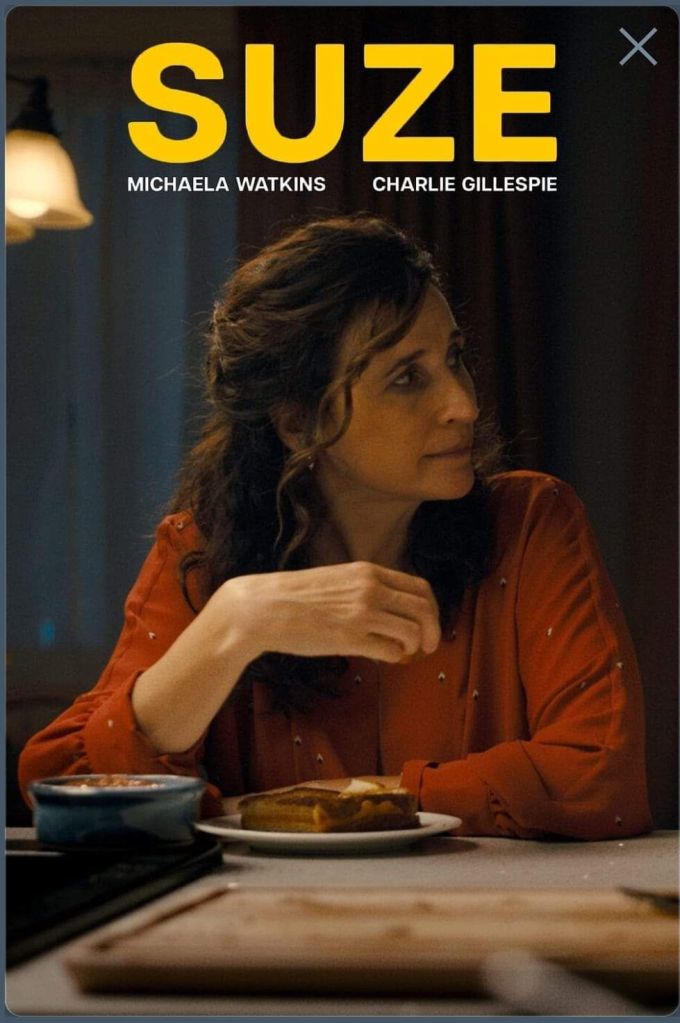
Film Journal 2024: Suze
Film Journal 2024: Suze
Directed by Dane Clark and Linsey Stewart
Anyone looking for an alternative to the behemoth that is Dune Part 2, this charming, good humored, big hearted drama is definitely worth checking out. It features an unlikely friendship between a middle aged single mother with early menopause and her daughters ex-boyfriend, explored through two likeable performances and a good dose of chemistry.
It’s always great to see films tackling a niche demographic, but the film has far reaching appeal as well.
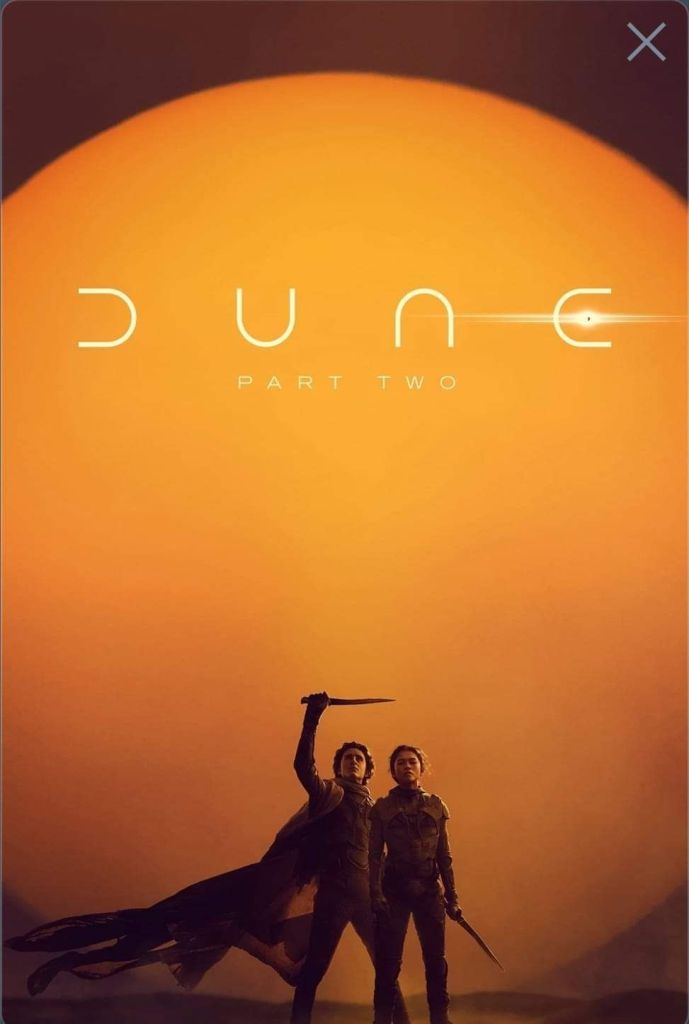
Film Journal 2024: Dune Part 2
Film Journal 2024: Dune Part 2
Directed by Denis Villeneuve
I’m not sure it says much to state Dune Part Two is a very good, and even exceptional film. Much more relevant to call it an event. The science fiction nature of the story might not be your thing, and you may have certain thoughts and opinions regarding how the film matches up with the book, but it is nevertheless the sort of thing that has the power to captivate the cultural conversation in one way or another, even if you never see it.
And certainly, for those who do see it, the cinematic spectacle is undeniable, from the visuals to the scope to the scale. Its impressive from start to finish.
I know the film has been compared many times over to Lord of the Rings. For me personally, my love and appreciation for the story doesn’t exist on that level, however I can say that the last time I encountered a story this big would probably be the epic finish to the LOTR trilogy. If its not quite reaching to that level for me, I can imagine it would for fans of the book and the science fiction genre.
I’m sure there are things to nitpick here or there, but they would be inconsequential to the experience at best, and a distraction at worst. It’s worth noting how seamlessly Part 2 flows in tandem with Part 1 as a singular arc. If Part 1 felt incomplete, this retroactively makes it that much better. At the same time, the transformation that occurs with the films central characters sets Part Two apart, allowing it carry much of the films climatic push. Thematically too, the film adds layers to the messianic motif, even establishing it as a timely message about the nature of holy wars. There is much to say here, as I noted in my review of the first film, about how Jesus occupies the messianic role in contrast to Dune’s enigmatic “savior”. In Part 2 it places such questions straight within the reality of the kind of motifs that surround Jesus, particularly when it comes to the realities of enslavement and power or rule.
If hope is to be found, it is to be found in the unexpected places that resist the allure of retaliation and Empire, not within it. What becomes even more apparent in Dune Part 2 is a world caught in such perpetuating cycles and needing a promise that can break it.
 The Stories of my Life