
I’ve been asked a few times in groups I’m a part of and in person and elsewhere what my theological association/disposition is. My answer is often a mesh of Traditions. However, one leading answer I often give is that I adhere to a form of covenant theology. Just not the sort of covenant theology you find in “lordship” or calvinst versions.
I worship in a denomination called the Evangelical Covenant Church, and it is a good example of a Tradition that fits within the Protestant/Reformed umbrella but with a need and a desire to be constantly reforming. To be on the look out for the dangerous and corruptible parts within the larger umbrella and address it within the denomination. They did this initially by splitting off from Lutheranism in favor of reclaiming a more robust theology of the spirit, and also by stripping much of the doctrine and replacing it with central “affirmations” that leave plenty of room for diversity, disagreement and discussion within the congregations. It is a pretty wonderful thing from my experience.
However, what I really wanted to say was that when I say covenant theology I mean something more like narrative theology in this article here. The theologian cited (Emil Brunner) is another good example of someone who falls under the Reformed umbrella while also being willing to hold it to the fire of ongoing reform.
“Doctrines are secondary to the story; they cannot replace it. They are judged by their adequacy to the story—their ability to draw out and express faithfully the character of God as revealed by the story. But the story is primary; the doctrines are secondary and that means always revisable in light of a new and better understanding of the import of the story.”
“The only way to interpret “God is love” is to look at the biblical story that reveals God’s character through his actions.”
“Narrative theology has no need of “biblical inerrancy;” perfection with respect to purpose is sufficient to express biblical accuracy and authority. It is in and through the story that we meet God, especially in Jesus Christ. The Bible is the medium, the instrument, the indispensable witness to Jesus Christ. It is our life-changing meeting with him through the Bible’s Christ-centered story that elevates the Bible over other books. We do not believe in and trust Jesus Christ as Lord and Savior because of our belief in the Bible; we believe in the Bible because it is the unique instrument and witness of our meeting with him.”
The Law as Love and the Law as Rule: Making Sense of the Particular Through the Universal
I always love the Office of Rabbi Sacks, but every once in a while an episode hits extra hard. This is one case.
The episode (which is also available in text form in the link) is talking about the Law within Judaism, and more specifically this verse:
Be very vigilant to keep the commandments of the Lord your God, and the testimonies and decrees with which He has charged you. Do what is right and what is good in the Lord’s eyes, so that it may go well with you, and you may go in and take possession of the good land that the Lord swore to your ancestors to give you.
– Deut. 6:17-18
He starts by focusing on Rashi’s analysis, saying,
“The difficulty is obvious. The preceding verse makes reference to commandments, testimonies, and decrees. This, on the face of it, is the whole of Judaism as far as conduct is concerned. What then is meant by the phrase “the right and the good” that is not already included within the previous verse?
Rashi says it refers to “compromise (that is, not strictly insisting on your rights) and action within or beyond the letter of the law (lifnim mi-shurat ha-din).” The law, as it were, lays down a minimum threshold: this we must do. But the moral life aspires to more than simply doing what we must.[1] The people who most impress us with their goodness and rightness are not merely people who keep the law. The saints and heroes of the moral life go beyond. They do more than they are commanded. They go the extra mile. That, according to Rashi, is what the Torah means by “the right and the good.”
He then contrasts this with another point of perspective (Ramban) writing that,
“the right and the good refer to a higher standard than the law strictly requires. It seems as if Ramban is telling us that there are aspects of the moral life that are not caught by the concept of law at all. That is what he means by saying “It is impossible to mention in the Torah all aspects of man’s conduct with his neighbours and friends.”
Law is about universals, principles that apply in all places and times: Do not murder. Do not rob. Do not steal. Do not lie. Yet there are important features of the moral life that are not universal at all. They have to do with specific circumstances and the way we respond to them.”
Here is the point that stuck out for me. The “Law”, in the Jewish sense, is about universals. But “Morality is about persons, and no two persons are alike…morality is not just a set of rules, even a code as elaborate as the 613 commands and their rabbinic extensions. It is also about the way we respond to people as individuals.”
He goes on to say this:
“This too is the difference between the God of Aristotle and the God of Abraham. Aristotle thought that God knew only universals not particulars. This is the God of science, of the Enlightenment, of Spinoza. The God of Abraham is the God who relates to us in our singularity, in what makes us different from others as well as what makes us the same.
This ultimately is the difference between the two great principles of Judaic ethics: justice and love. Justice is universal. It treats all people alike, rich and poor, powerful and powerless, making no distinctions on the basis of colour or class. But love is particular… that is what the Torah means when it speaks of “the right and the good” over and above the commandments, statutes, and testimonies.”
The emphasis here is on the collision of universal truths and the lived in reality of the particulars of love. It is when Law is reformulated as dogma that love is lost and relegated to the periphery of human relationship and human expeience, especially when it comes to awareness of the oppressed-oppressor paradigm.
This is, at least in part, what was going on at the time of Christ. Law as a formative force in the life of Judaism, for close readers of the Jewish texts, sits in conversation with their ongoing relationship to the world around them. it is revealing the way of love and as such love necessarily challenges the Law to be conformed to human experience and human relationship. You see this expressing itself all over the biblical narrative.
Continually though they (Israel) faced the temptation to take love and turn it into dogma and have to be challenged, rebuked, reformed in the way they are called to be formed by the Law according to the particularities of love. When we get to second temple Judaism in the time of Jesus, what we find is a faithful people who have grown the universals of the Law into a grandiose set of dogma. Jesus doesn’t come to abolish the Law in this sense, but rather to conform it to the original guiding principle of love and its particulars. To strip away the penchant for dogma being used to exclude and to reawaken loves ability to form us to the universal principles of the revealed Law.
We face the same challenges and have the same need for this message today
Ceasing to Understand the World: Making Sense of the World as That Which is Defined By Potential
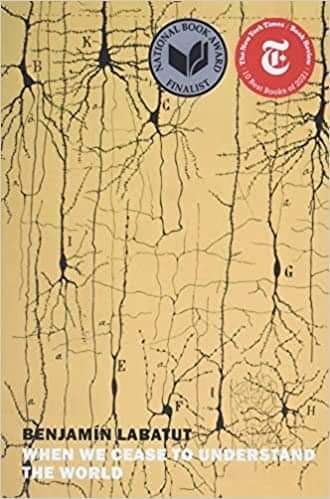
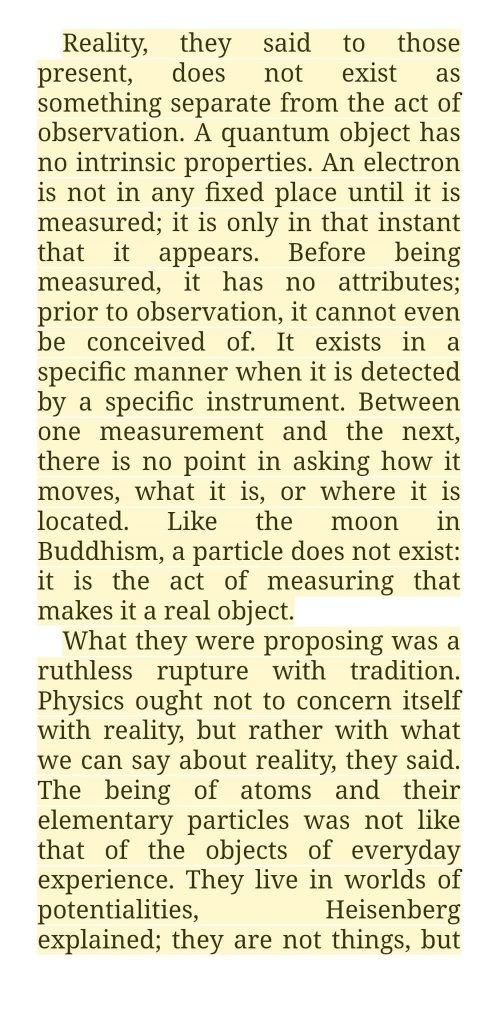
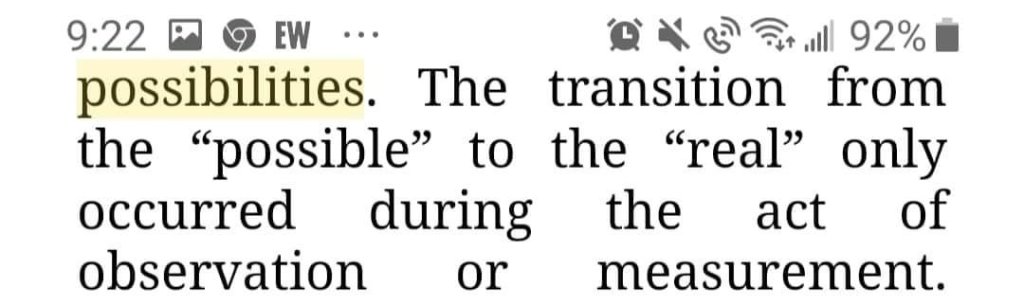
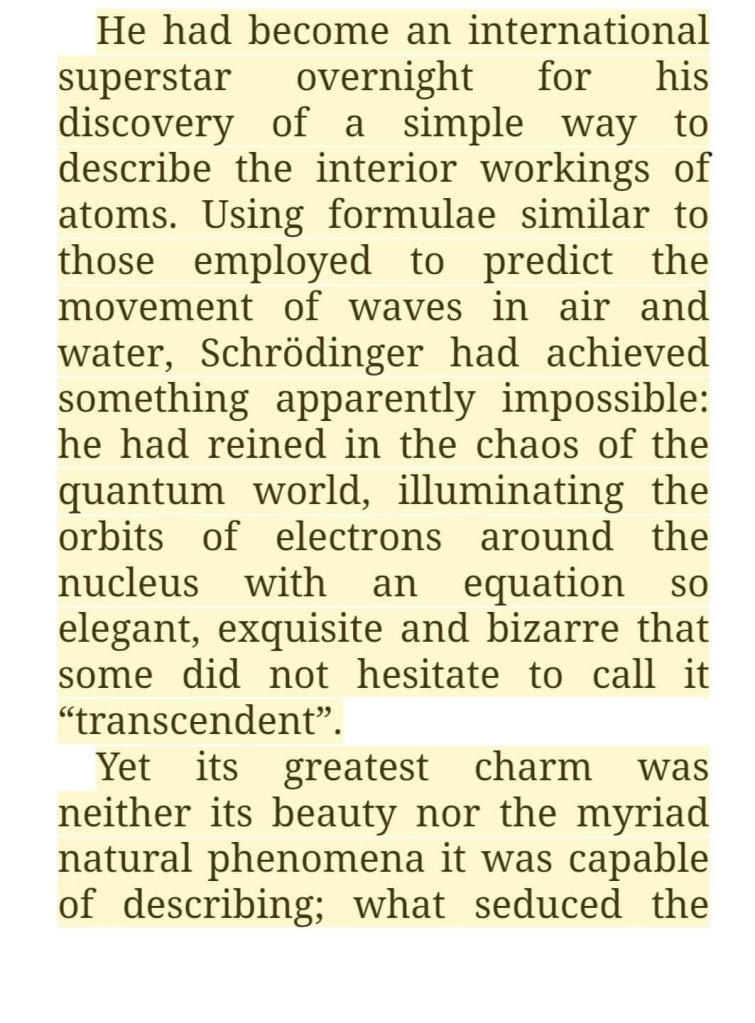
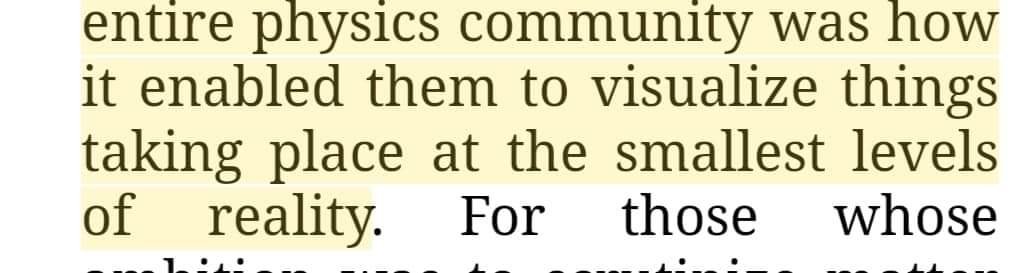
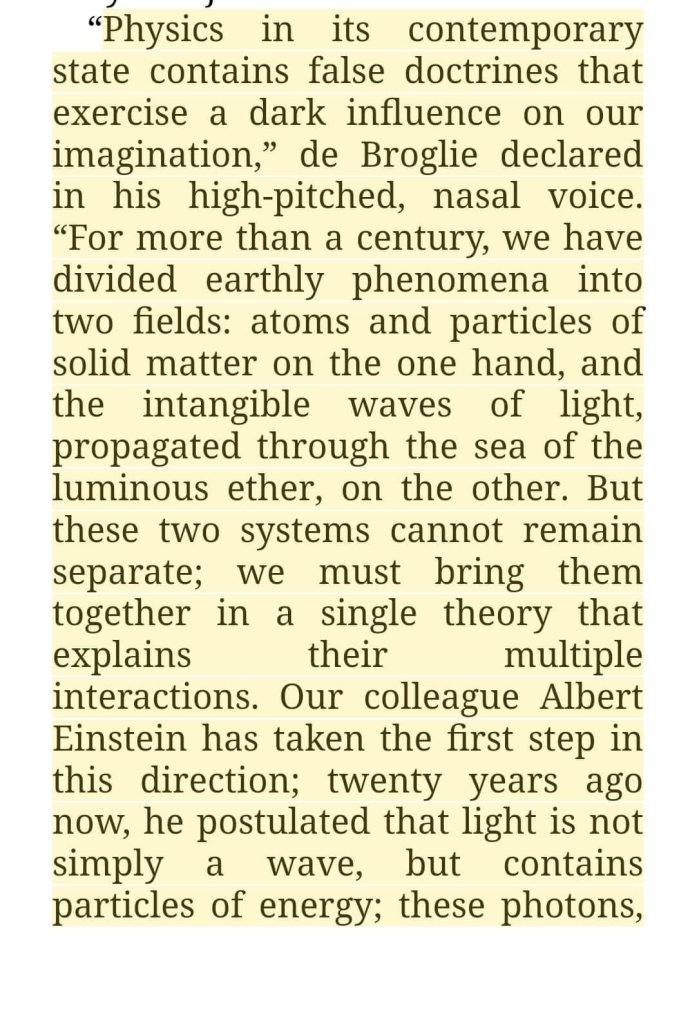
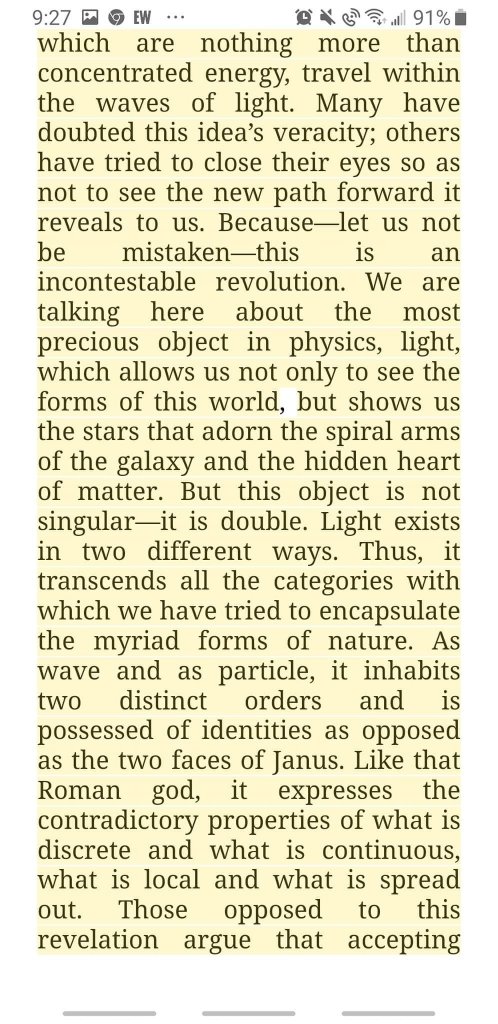
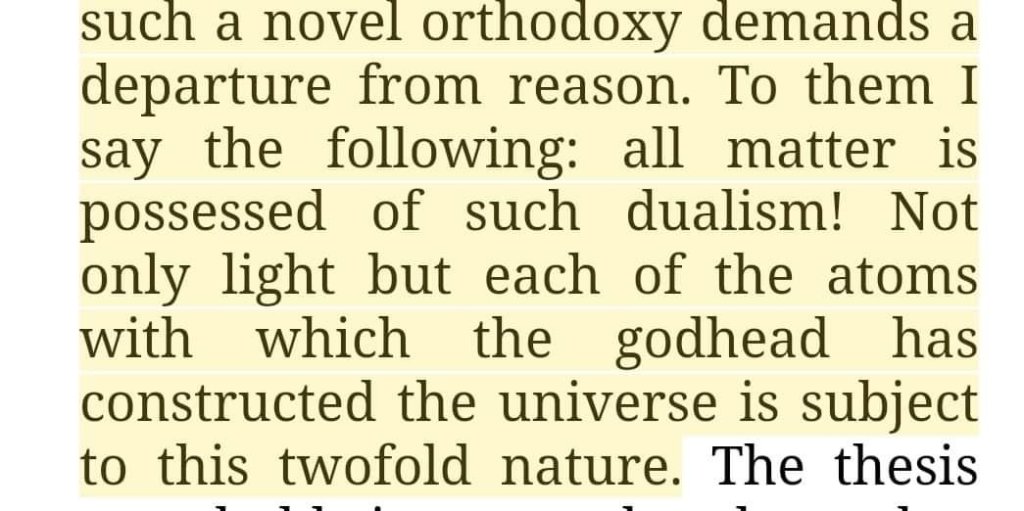
A few quotes snapshoted below from a book I just finished called When We Cease to Understand the World by Benjamin Labatut
I thought it offered some compelling thoughts regarding the sort of dualism that crept into the scientific revolution, the tension that exists in keeping the material and the immaterial together as we observe the realities of this world, and further thoughts about how reality always exists within relationship to that which can observe it.
There are implications here for how we think about faith. Think about the phrase there is no reality, only potential. In some sense this becomes a guiding principle in observing the world in tangible and concrete ways. In other ways it exposes the challenges of observing such potential apart from given truths about reality. In truth science as a function can operate without the sort of meta narratives that allow us to make sense of its meaning, but meaning making processes are bound to narratives that then give the function a purpose. Caught in between of course is the question of whether this meaning is created or revealed. Further, if we are to speak of morals or objectives the nature of observation as potentials rather than realities becomes positioned within a different kind of question altogether.
Futher yet, in making sense of a world defined by potentials there is a danger in wanting to divide it into material and immaterial forms of observable sciences. To some degree this allows one to move fluidly between asking questions of function and questions of meaning without abandoning the field of science itself. But as these quotes suggest, this does create certain tensions that challenge how it is then that we percieve reality in an operative fashion where meaning can inform matter and vice versa. Any dualism inevitably sets things opposed, and in terms of God/spirit leaves us thinking of God apart from the material world rather than within it. There is a real sense that the more we undertand the function of reality the more it should awaken us to a God who functions equally in the details.
Rethinking Salvation With Matthew Bates
Rethinking salvation with Matthew Bates. A couple quotes I thought were worthwhile:
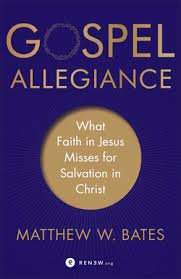
“The movement from outward to inward rapidly accelerated with Saint Augustine (354–430).
Augustine’s infinitely influential views on faith informed the medieval Catholic synthesis, as well as the Protestant Reformers. Faith became more introspective, psychological, emotive, and passive (or receptive) than is encouraged by the biblical witness. Faith came to be less about external allegiance to Jesus the king and more about what God does in us to cause intellectual belief in correct doctrine as shaped by love (medieval Catholicism) or cause inward trust in his promises (Protestantism). In the sixteenth century, Martin Luther’s most extensive definition of faith describes it as God’s gift, as belief in the correct body of doctrine, and as invariably resulting in good works. Since it involves seizing upon God’s certain promises it does face outward, in part. Yet Luther stresses that it is characterized by personal confidence or certitude and specific internal emotions:
Luther’s treatment, akin to Augustine’s, primarily divides faith into doctrine to be believed and internal feelings of trusting confidence. Like Luther, John Calvin grounds faith in God’s external promises but also treats it as if it is primarily an inward conviction (passively received) rather than actively embodied in outward-facing relationships:
For Calvin, faith is “not content with a doubtful and changeable opinion,” but “requires full and fixed certainty”—even though fear, temptation, and doubts will assail. For faith to be genuine, God’s promises of mercy must not remain “outside ourselves” but must be “inwardly embraced” with confident assurance.22 Calvin finds scholastic distinctions worthless between implicit faith (faith without knowledge, e.g., allegedly by infants at baptism), unformed faith (faith as mere intellectual assent), and formed faith (intellectual assent shaped by hope and love). This is primarily because the first two are not regarded as biblical faith at all, and the third compromises faith’s uniqueness. Saving faith involves true albeit imperfect knowledge in response to God’s proclaimed word, but always goes beyond intellectual assent. The assent portion of faith is “more of the heart than of the brain, and more of the disposition than the understanding,” so that true faith can never be separated from a “devout disposition.” Calvin thinks this is what Paul is trying to convey by the phrase “the obedience of faith” in Romans 1:5. Calvin correctly notes that in the Bible pistis has many definitions. But for him saving faith, as the Spirit permits, is primarily an internal conviction that God’s promise of mercy in the atonement through Jesus’s priestly mediation is indeed trustworthy.23
The flight of faith toward inward subjective feelings of trusting confidence would only accelerate thereafter.”
– Gospel Allegiance: What Faith in Christ Misses for Salvation in Christ
“The flight of faith from the outward to the inward was helped along by related ideas. Faith, as it moved from outward to inward, became something that happens in your mind or will or spirit, rather than in your body. Yet this is not how faith was generally understood in the New Testament world. Faith was embodied.
When flesh and spirit are regarded as differing substances in the Bible, the intention is not to contrast the physical with the nonphysical. Like his contemporaries the Stoics, Paul probably believed spirit/Spirit to be an invisible diffuse material substance of heavenly origin, and so it had a physicality just as flesh does. For Paul, the distinction is that the Spirit above all characterizes God’s realm and the new age of the Messiah that God is unveiling, but the flesh characterizes the mundane old order. This is why Paul thinks that those who live according to the flesh will die, but those who live according to the Spirit will find eternal life:
The contrast is not between physical and nonphysical. Rather it is between the old order and the new. The flesh and its sinful appetites are associated with death and the old order, the Spirit with life and the new order…
It may be popular today to think that the Bible envisions a nonmaterial spirit world that is in contrast with the physical, bodily world. But this is a simplistic reading of the Bible. And it has direct bearing on the faith-works question. For we cannot argue that faith is a spiritual or mental thing separate from bodily doing. Faith is embodied and enacted from start to finish.
Faith is embodied because our bodies are open to the environment and can be colonized… This is why Paul speaks of sin as a personified, colonizing agent. Salvation involves a recolonization through union with the Messiah.
In the Spirit we are no longer being jerked around by the hostile power of Sin that colonized the flesh under the old order. The Spirit uses its new-creation power to recolonize the human flesh thoroughly, delivering it from its previous enslavement to sin, the law, malevolent spiritual powers, and the fundamental structures of the old order. In the Messiah via the Spirit the entire allegiant community has been colonized, each self, all the way down to each person’s living-by-pistis flesh.”
– Gospel Allegiance: What Faith in Christ Misses for Salvation in Christ
In the Mouth of Madness and V.A. Schwabs Gallant: A Conversation
Wrote a piece for the Fear of discussing afterthoughts from an episode on In the Mouth of Madness in conversation with V.E. Schwab’s book Gallant. Written piece is available here
“Some people are repelled by darkness. Others are drawn to it, to the static crackle of power in a place. To the hum of magic, or the presence of the dead. They can see these forces staining the world like ink in water.”
– Matthew (Gallant by V.E. Schwab)
“Everything casts a shadow,” he begins. “Even the world we live in. And as with every shadow, there is a place where it must touch. A seam, where the shadow meets its source.”
– Matthew (Gallant by V. E. Schwab)
Rethinking Sacrifice and The Practice of Biblical Atonement
A central thesis of the book The Sacrifice of Jesus: Understanding Atonement Biblically by Christian Eberhart is the idea that we, predomonatly in the Protestant west, have reduced the sacrificial system to mean and represent two things- blood and necessary death. When in fact the sacrificial system reflects a much broader liturgy that isn’t about death but life. When we take the time to understand and hear what the sacrificial liturgy is saying it becomes clear that this notion of a necessary death so inherent in protestantism is not present in the sacrificial rite and that all death that happens is incidental to the rite and happens outside of the holy space in the space of the wilderness, the same space the goat on the Day of Atonement is sent with the sins of the people.
What is the central focus of the liturgy/rite of sacrifice? The burning. The gift giving practice that sends a pleasing odor into the holy space. Here blood, where it applies, is recognized as life, not because it atones through a necessary death but because it is life itself. As such it does the cleansing/covering work of space and being that allows us to move into the space where God dwells through faithfulness to the liturgical process. This cleansing is not internal but external, ridding space and body of the polluting effects of Sin and our participation in it. Unintentional and intentional sin then become bound together in the liturgy.
Every one of the central sacrificial acts functions as a gift with the burning process at its center. This is the point of the pressed hand on the creatures forehead, is representing our ownership of this thing being offered up. Eberhart makes the case that if we are to apply sacrificial imagery to any circumstance, especially when it comes to Jesus, we can’t simply apply the blood, we have to see the whole. And if we can’t equally apply the cereal offering, for example, along with the sin or guilt offerings and still come away with the same imagery and story then something is off with our reading of the text.
Let’s consider Ephesians 5:1-2
1 Follow God’s example, therefore, as dearly loved children 2 and walk in the way of love, just as Christ loved us and gave himself up for us as a fragrant offering and sacrifice to God.
As Eberhart points out, the word sacrifice here connotes two general meanings in the Greek employed to capture the essence of the Hebrew word for sacrifice. In both cases it would indeed seem very odd to associate these words specifically with Jesus’ death. Rather, we must see the whole of Christ’s ministry as the sacrifice, an embodied liturgy lived out in and for the world. This flows from the emphasis of 5:1, itself the culmination of a larger section dealing with right living. To follow God’s example is to give ourselves to God and others as a pleasing odor. To walk in the way of love is to embody the sacrificial rite and liturgy as an image bearing process This has nothing to do with something needing to die in order to atone for ones sins. Nothing needs to die for the sacrificial system to operate. The sacrificial system is in fact about what it means to move into the space where God dwells by way of faithfulness (allegiance/loyalty) to God, the gift giver. The gift was the Exodus from Egypt where the whole of the enslaved was liberated from slavery.. This brings them to Sinai where ernthen find the call to live in the new reality Gods liberating act brought about in and for the world. Jesus’ ministry tells the same story. The gift of Jesus is the liberation of the whole of creation which brings us back to Sinai and the call to live in the new reality God has brought about in and through Christ.
In both cases these are considered sacrifices. When we sacrifice to God by way of the liturgy we are sacrificing our whole selves, meaning offering the elements of our life as a gift, so as to follow God’s example. In the liberating act we find God’s grace gift to the world. This is what the sacrificial liturgy is all about.
“It is a burnt offering, a food offering, an aroma pleasing to the Lord.”
- Lev 1:9
21 The Lord smelled the pleasing aroma(A) and said in his heart: “Never again will I curse the ground(B) because of humans, even though[a] every inclination of the human heart is evil from childhood.(C) And never again will I destroy(D) all living creatures,(E) as I have done.
- Genesis 8:21
There are a few books that, if I could choose a couple, that I wish I could put in the hands of everyone and just discuss. The Sacrifice of Jesus: Understanding Atonement Biblically by Christian A. Eberhart is one of those, Since he deals so directly with Milgrom, a seminal voice in the world, culture, and voice of Levitcus, it provides an intimate window into the sacrificial system and how it gets applied to Christ. A couple of additional points to go with the above:
- The book reflects on tendencies within Protestantism to go straight for the blood and to read the blood in entirely negative terms. Eberhart wants to place the blood back into the multifaceted nature of the sacrificial rite where it can be understood in the way the ancients would have seen it, as part if a story, a liturgy. Thus it becomes important to locate the appropriate narrative.
- It is also significant that we see metaphorical language being applied to the sacrificial rite early on as most people did not have access to the temple. Thus we see throughout the scriptures examples of people applying the liturgy at home or outside of temple space in conjunction with the spirit. This lays the groundwork as well for the destruction of the second temple and the stopping of temple sacrifice. This is why it’s crucial to see what the liturgy is doing and what the story is all about- this bringing together of heaven and earth spaces and this movement from the wilderness, the mortal space where Death and Sin abide, to the garden, the eternal space where life and love reside.
The Law, The Women, and the Revolutionary Spirit of Numbers 27
Numbers 27:3-7
3 “Our father died in the wilderness. He was not among Korah’s followers, who banded together against the Lord, but he died for his own sin and left no sons. 4 Why should our father’s name disappear from his clan because he had no son? Give us property among our father’s relatives.”
5 So Moses brought their case before the Lord, 6 and the Lord said to him, 7 “What Zelophehad’s daughters are saying is right. You must certainly give them property as an inheritance among their father’s relatives and give their father’s inheritance to them.
Over the last number of weeks the Bible Project Podcast has been working through the scroll of Numbers. It is part of a larger project that has been walking through each scroll beginning with Genesis. Much of it has been eye opening and deeply enriching. This latest podcast (episode 321, or episode 7 in the Numbers series titled Five Women and Yahweh’s New Law) has been lingering with me since I listened to it.
It raises a couple of really important questions-
- How is it that Yahweh is persuaded to change a law after hearing the case of these women
- What is the significance of this law being changed in light of these women’s story?
Not only does Numbers get skipped over more often than not but moments like these tend to get dismissed or missed when we do engage it. How striking is it that in a heavily entrenched patriarchal society that these five women were brave enough to speak up and invite change in a system that otherwise ensured that they had no voice and no rights. Their legacy is present in this text because they sought social reform and challenged what, to them and for them, was an oppressive system.
As host Tim Mackie puts it,
“Why should our branch of the family tree be cut off from the Eden land just because we’re women?” That’s their argument … What you have is this group of daughters who are bringing to Moses and Yahweh this fact that there’s a gap in the laws of the Torah. There’s this scenario that the laws don’t address, and the laws as currently stated will lead to what they believe is injustice … When these daughters bring their case, God says they are right … Within the logic of the Torah, these daughters are to be seen as appealing to God’s core original heartbeat for the partnership of men and women over the land … If this generation is like a new Adam and Eve, there is no coincidence that you have here a story about women saying, “We can possess and have responsibility over the land too.”
Beyond this striking fact that we find buried in the text, we also gain a greater sense of how these laws or regulating rules worked in the early formation of Israel as a nation. In scripture we find three main uses of the Law- ritualistic (circumcision), formative (Torah), and functional (the letter of the law, or regulations). Regulating rules surface as the people attempt to figure out how to live as the people of God in their world, but these rules are always subservient to the Torah, the source of life and knowledge. The ritualistic form of the Law is what bound one to the Torah from which they then engaged the word around them by way of the functional.
It’s worth noting that in the NT the primary use of the word Law, or the related word “works” is the ritualistic form, followed by the formative form (often taken together). The least referenced is the functional. Why? Because the function of the law always sits in relationship to its source where it can be formed, challenged, shaped, ect in relationship. This is how Israel saw its relationship to God. This notion of a God who revealed Gods true “name”, a God who came down the mountain to dwell with creation, exists in relationship to the created world, and as such the name of God becomes the very embodiment of Torah, which is life and knowledge/wisdom (the two trees in the garden) rooted in love. This is what sets us in relationship to the world around us as well, shaping laws according to the needs and concerns of the lowly and the oppressed and the marginalized ect.. This is the movement of the Torah shaped as it is by the larger story of God’s name revealed (and being revealed) in and for the whole of creation, condemning the oppressors and raising up voices for the oppressed. Here those voices were five courageous women who staked a claim in a revolutionary movement which reformed the way the women’s voice was seen and heard in the ancient world. And don’t miss this important note- god invites our challenges, invites us to make our case based on what we know about God’s true name, when we see something not right with the system.
Everything Everywhere All At Once: Nihilism, Irrationality, and the Search For Meaning

Keep in mind that I still (I think) really like the film Everything Everywhere All At Once
And I am definitely elated to see the film single handedly carrying independent cinema on its shoulders with its surprising theatrical run. It is one of the more important film stories of 2022 on a number of levels.
The more the film persists in conversation however the more it intrigues me to see the ways it is translating to people with differing perspectives and worldviews in different ways.
One of the key aspects of the film on a thematic level, and a theme that I find people don’t always recognize is actually there in the film, is the problem of nihilism and it’s related form fatalism. Key to this theme is the question of meaning. If all of existence is inherently meaningless how then do we find meaning in this world. Do we create it? Do we make it where it otherwise wouldn’t exist? Is meaning an illusion? A simple trick of the mind that can be manipulated?
Where this film.has fostered division is in its wrestling with this question in light of the problem of suffering and evil. And I found this divide to exist irrespective of religious/non-religious lines. Some feel like in its efforts to answer the problem of nihilism it essentially romanticizes existence while ignoring the problem of evil and suffering, pretending like it doesn’t exist or suggesting that we can ignore the problem in favor of our own happiness. It appeals to the illusion of meaning by pretending it is true and creating a logical fallacy in its wake that can’t hold water when held up to the light of reality. Others find it to be message that says there can be meaning in this world, and that the answer to the problem of evil and suffering in the world is to be kind and enjoy life. This is, for some, what frees us to call existence meaningful.

Within this are people who had legitimate emotional responses to the film on both sides of the fence. Some walked away from it feeling duped and plagued by hopelessness. Others walked away feeling liberated and hopeful. Which is precisely why I think this film makes such a fascinating case study when it comes to how we tackle some of these big and weighty philosophical, and even theological issues. As I’ve been watching and engaging in some of these ongoing discussions, which have resurfaced in light of the films recent physical and digital release, I’ve been reminded a lot of Justin Smith’s A History of the Dark Side of Reason. In that book Smith argues that we all, religious and non-religious alike, depend on irrational claims when it comes to meaning making processes. It is when we ignore this truth that our meaning making processes become potentially dangerous and ignorant and, as Smith argues, more irrational in the negative sense of the term.
If there is a key takeaway from Everything Everywhere All at Once it is perhaps this- that we can’t tackle the problem of nihilism without appeal to irrational belief systems that allow us to assume meaning in an otherwise meaningless existence. I have seen professed atheist critics suggest that this film is a polemic against religious delusions. What they miss by doing this is not only their own appeal in this film to a delusion of reality, but the potential of their view to deal with evil and suffering by ignoring the problem and pretending it doesn’t exist and is not a problem. Likewise, those who found the film to be an expression of hopelessness or, at the very least, dishonest in its whitewashing of reality, miss the film’s appeal to the idea that all of us, religious and non-religious, are engaged in necessary meaning making exercises that depend on irrational belief systems in order to be upheld. When this point is missed there is equal danger in using our claims to meaning and truth to ignore the problem of evil and suffering.
Somewhere between those two potential divides is a pathway to greater truth and greater meaning. Perhaps the most pointed observation contained within the film’s interest in nihilism is the fact that one of the very real outcomes of embracing Irrationality is that it holds the power to shift our focus from oursleves to the other. That seems to be the point where meaning is able to surface. I’m not convinced the film gets the relevance of its own message- it is possible it falls into the trap of romanticizing an idealistic vision of the self and the world at the expense of the very real problems inherent within, but it does present potential for further fruitful discussion to happen across divided lines.
Tolkien, The Ring of Power, and the Power of the True Myth

I always find it a lonely space to occupy as a considerate Tolkien fan and follower. There remains an inevitable divide between those who miss his ability to critique his Christian worldview and allegiances while also very intentionally writing stories and creating treaties steeped in what he saw as the “true myth” of Christ which could make sense of all the worlds stories.
My deep and abiding love for the recent Tolkien biopic contrasts with criticisms from the Christian world saying it betrayed his Christian convictions, missing the ways it captures his critique of the Tradition he holds dear, while my deep and abiding love for LOTR and related stories contrasts with those who remain critical of christianity and/or those who do not believe in christ who write disertations and think pieces meant to distance LOTR from anything Christ-centered, missing how his stories also operated as a critique of the world at large that he occupied in time and space from within his Christian worldview.
The Inklings remain the product of the perfect confluence of time, space, culture, circumstance, and opportunity. Something unlikely to be replicated but which remain an inspiration, and for me Tolkien remains one of its most captivating voices, a timeless critique that slices through the center of our divisions with something more hopeful. This article captures some of that with the recent Amazonj limited series.
“Why does America need to remember Tolkien again? Because we’re mired in Westeros, playing the game of thrones. When you hear words like “fight fire with fire,” or “make them play by their own rules,” or “punch back twice as hard,” or “wield power to reward friends and punish enemies,” you’re hearing an ethos that declares, “win or die.”
“Tolkien wasn’t naive. He knew that world. He’d confronted it directly. That’s why characters like Boromir or Fëanor resonate so strongly. In the quest to confront the enemy, you become the enemy. Yet faithful people understand, in Faramir’s words, that they “do not wish for such triumphs.” Instead, they fix their eyes on the “high beauty” that is forever beyond the shadow’s reach.”
Schools In: A History of American Education and Recovering the Need For Wisdom
An interesting podcast episode on the history of the American Education system (with obvious overlap here in Canada, albeit with a slightly diffeterent emphasis) to kick off a new school year.
Interesting to note the religious roots and how secularization also emerged as a way of controlling ideology and assimilation.
Uncovers a common tension between the accumulation of wisdom and economic interest.
I was also reminded of Louis menand’s book The Free World: Art and Thought in the Cold War.
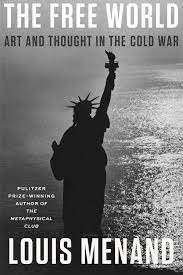
There he touches on the historical development of post secondary education and the creation of and rise in America of a distinguishable youth culture. The formation of later high school grades and post secondary college/universities were established so as to extend the market of youths who were seen as the engine of Americas economic machine and its enusing appeal to an emerging culture of individualism. Thus this formulated a culture that isolated youth from the same family systems which governed the rest of the world, the image of the “youth” becoming the new symbol of eternal life and the aged person being relegated to a burden.
A reminder that when we invest in educated societies we are investing in wisdom as a virtue, and wisdom as a virtue always leads to the betterment of the whole. That is the value of education that we find in the ancient world where art and theology and philosophy were seen as equal to and of the same mind as the maths and sciences. It is when we exchange wisdom for economic function and a need for progress that we end up with something quite different, which then tells us something about the ideologies lying underneath the systems.
 The Stories of my Life