
While certainly a primary aim of reading is the act and interest of understanding the other, be it a perspective, person, or story that is different than your own, one of the great joys of reading is also finding those stories and voices that allow you to feel seen and understood. Even better (in my experience anyways) when it arrives completely unexpected.
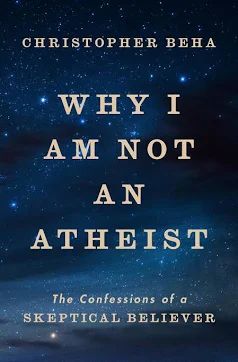
This was the case with Christopher Beha’s recent book, Why I Am Not An Atheist: The Confessions of a Skeptical Believer, a book that I am in the middle of re-reading. A book that, upon first glance, might appear to be yet another tired entry into the world of christian apologetics, rife as it is with intentional and targeted polemic. Turns out that’s not what this book is. At all.
This is, in fact, a book I wish I could put in the hands of all of my atheist friends- more than that even; all of my “friends,” as a way of saying here, if you would like to understand my own journey, my own path, read this, the basic thrust of what I am arguing for and against. A book which, in it’s introduction alone, seems to capture my journey nearly beat for beat, so much so that it left me certain now that I, with a life time of feeling like I have never truly “belonged” anywhere, exist as a type. That sounds like a negative, but trust me when I say it was a liberating revelation, if indeed I could qualify it as such. And yes, I use the word nearly with intent, as there are subtle nuances that distinguish us, certain questions I follow with more vigour than he does, and small points of departures in terms of where this shared journey lands. But I can’t remember the last time I’ve had such a mirror held up to this extent and this degree. That’s something I am deeply grateful for.
At it’s heart, the book walks through the history of continental (western) philosophical development. Not as an information dump, but as a way of mapping his particular pathway by way of his particular questions, engaging with the studied and analyzed philosophical threads. It seeks to caputre the lay of the land for what it is so that any move into the larger interests of a rational discussion about God and reality and empiricism can be held in check. Whether we recognize it or not, and whether we like it or not, modern atheist-religion debates are birthed from the same soil.
One of the things Beha captures with an especially astute voice and hand is the way these philosophical roots become the thing that ultimately sets him in express conflict with his honed and articulated atheism. It brought me tumbling back to those moments in my own life where, equipped with the thing that had promised to liberate me from religion, and in-particular Christianity, I suddenly found myself face to face with a re-molded and re-casted dogmatism closed off to inquiry. In short- I found myself face to face with angry atheists reacting against the very same thing that had supposedly energized their own weaponized empiricism- that history of philosophical development.
Why the reaction? Because those same philosophical voices, when cited back to the ones that claimed them as their own, challenged their tightly guarded positions. The real problem was, for this particular expression of atheism in this particular point in history, it would seem it became commonplace for the actual tensions and divide apparent within these philosophers, largely between materialism and dualism, to get swept under the rug in favour of expressed positions that refused to attend for either while trying to retain both in service of defeating the basic claims of relgious belief.
It’s in chapter sixteen (The Artist Forming the Work) that Beha really made this come alive for me, where he moves into Kant’s “greatest atheist disciple,” Schopenhauer, set as it is against Hegel’s great reconstruction efforts (of metaphysics).
Like Beha, Schopenhauer found me on my journey through his express interest in not just the what by the “why” of things (which he understood as “the mother of all sciences”). That is, any coherent and rational discussion about reality cannot be content to simply appeal to the commonplace rhetorical device of the “I don’t know,” but must be willing to atend for the nature and shape of knowledge itself. It is the why question that bridges any concern for the empirical with the intuition of the lived life, and it is on this level that Shopenhauer “believes that the nature of sufficient reason has been consistently misunderstood” within an incoherent appeal to how it is that we know anything at all (his exploration of the relationship between object and subject, or the notion of all things in relationship, stemming from the relation between the will and representation).
Now, not to get lost in the nuances of Schopenhauer’s particular philosophical interests and development, there are three central points that overlap with my own story of first encountering that resistance within my newly adopted atheist communities (armed as we were with the Bertland Russell’s and the famed Dawkins/Hitchens/Harris/Dennett four horsemen). The first is this:
- “(In Schopenhauer’s view), if our sense of ourselves as freely acting will is inconsistent with our picture of material reality, we should not assume that the former must yield to the latter.”
- Schopenhauer’s appeal to a world that is, in reason, not ordered nor rational, and more importantly represents “a kind of thoughtless, meaningless pulsing,” and through it’s representation, “an endless parade of suffering.”
- “For Schopenhauer (and critical to much of his thought), there can never really be an ethical “ought,” so one can’t exactly say that it’s “wrong” to take one’s own life, but one can say with certainty that it is no way to escape the problem of the will. For suicide is a preeminent act of the will (in Schopenhauer’s express definition of that term). The appropriate response to the reality of existence is instead a kind of stoic quietism. The will’s “self-elimination,” comes not by suicide but by resignation: “This is the ultimate goal, and indeed the innermost nature of all virtue and holiness, and is salvation from the world.”
It’s the last point in-particular that stands out for me and my own journey, as this is precisely the thought exercise that I landed on when asking those in my atheist communities to attend for their own indebtedness to materialism and the implications our beliefs hold for the ways in which we make sense of the lived life. My own repeated questions, “if there is rational grounds for me to kill myself, is there good reason not to,” and secondly,”If there is no good reason, why do I will not to do so?” were questions that would eventually, in my admittedly loaded term, “ex-communicate” me from these communities. But here is the irony- I got the question from Schopenhauer, one of the central voices forming the very soil out of which these modern atheist expressions would arise, including the inate tendency for modern atheism to fill in the gaps of it’s own incoherent arguments with that catch all term- “art.” Somehow it became acceptable for reasoned arguments to replace God with art while still imagining a stark empiricism rooted in materialism as the highest order. These are the things my own atheism needed to hold to the fire, and what remains baffling to me today is that it is thinkers like Schopenhauer who offer the most coherent and rational means of getting there, it’s simply that “many atheists” find the implications of his reasoning, to borrow Beha’s word, “repugnant” (hence the anger I faced).
It should be said too, this tendency isn’t isolated to Schopenhauer. What I also found way back then is that this modern atheist expression was equally as adept at ignoring the consistent appeal to god apparent within the very philosphers it was founded upon (the ones who shape the western ethos). There is an (again, ironic) express sense in which Schopenharuer actually could be considered the most truly atheistic of the bunch if we use the modern expression of that term. Part of what gets shoved under the rug is the fact that atheism today means something quite different from what it meant in the world of those philosophers. and there is a strange sense in which, in what I would argue is a modern world built on a practice of leaving such terminology largely undefined so as to make it immune from critique, the modern western world has handed us a Christianity that couldn’t be more atheistic in thought and expression and an atheism that could not be more religious. What runs underneath that sentiment for both stated positions is once again the bread and butter of modern western thought- materialism. A materialism that is both necessary to hold the western enterprise together, and yet cannot make coherent sense of the lived life.
Beha suggests that Schopenhauer’s work has a special appeal to “an artistically inclined depressive,” and the western persona holding a particular interest in the buried eastern traditions. Both of which would be true for me. The restless skeptic (or cynic) whom is not content to appeal to the sort of rationalism which is content to finding ways to keep the why questions at a distance. In many ways, what I was after as someone posing those questions above to my shared atheist communities was the sort of atheism that could be held to the fire precisely because it was honest about what it actually holds to be true and states it believes. That’s why I love the philosophers, even where I disagree. It’s not enough to be persuaded away from something, it needs to understand what one is bneing persuaded towards. Modern athiesm (and religion or Christianity- these two things are often hard to tell apart) has become good at trying to pretend as though we can get by on it’s narrowed approach to empiricism, with the less hostile versions bringing in the “I don’t know” rhetoric as a means of forging some level of a broadcasted humility. I have never found this compelling or satisfying. It doesn’t take much poking and prodding to get behind this rhetoric and find an express allegiance to that materialism that isn’t willing to contend for the implications within the lived life of what one actually believes. Much harder to get beyond the resistance towards the inherent questions it poses of itself, and into the sorts of unencumbered debate that allowed these philosophers to coexist within their impassioned disagreements. In many ways, both atheist and religious (and in-particular Christian) alike continue to be addicted to the method of modern apologetics precisely because it provides them empirical certainty about the materialism that is being held on to so tightly and so fervently. Which is why I have tended to see that as the first battle ground for getting beyond it (mostly not to much fruitfulness unfortunately).
And I do think a book like this is a welcome breath of fresh air to this end. No better way to break the modernist bubble than through an honest analysis of it’s “fathers” (and yes, the inevitable patriarchal language applies in and outside of religion to this end). Funny enough, this is the exact basis for my critique of Protestantism (or many of the tenants within it) as well- no better way to get beyond that bubble than by bringing an honest exploration of the “fathers” and their great debates to the table.
Which is also to say, looking at where my journey has brought me to, if I am going to be able to honestly assess the why of where I am and what I believe to be true, I can’t base it on my critique of modern evangelicalism or modern atheism or protestantism. Rather, for me, I need to be able to articulate why I ultimatley find Schopenhaur’s arguments less than persuasive as part of that larger development of thought. An argument for or against, to borrow Beha’s phrasing, skeptical belief, has to be able to converse with what are it’s honest and reasoned alternatives. Anything less is simply avoiding such rational critique.

