
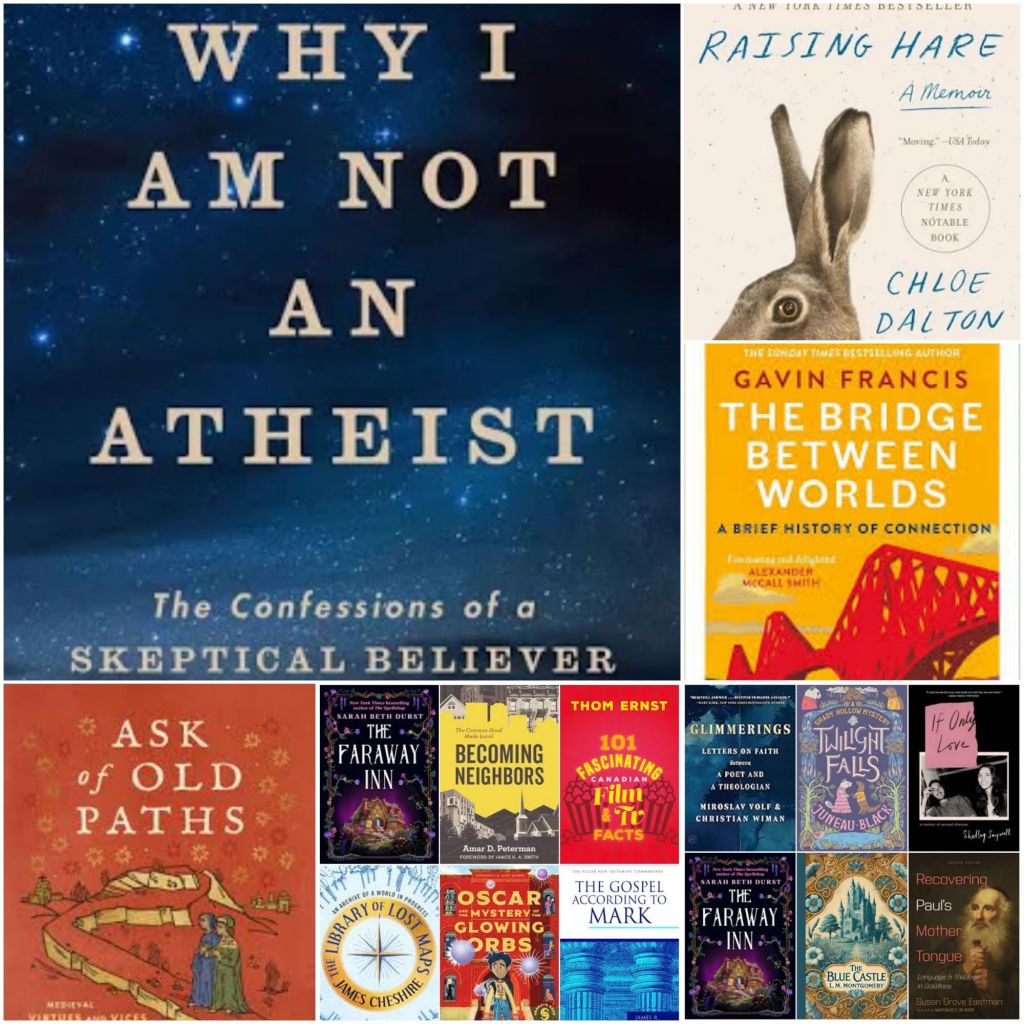
Looking back at my reading over the month of April, three things have become clear
- I have apparently adopted a new experimental approach- having multiple books on my currently reading list but reading small portions of each at a time in a given sitting. A chapter or two of four different books instead of my usual 50 pages of one fiction/50 pages of one non-fiction a day (when I look at my average). This wasn’t intentional. In fact, I think I know where the idea came from- finishing Hwang Bo-Reum’s Every Day I Read earlier this year. In it she gives each chapter (or essay) to one idea or reflection or approach that opens up the bigger questions concerning why we read. Some of the chapters speak for themselves, others are even designed to sit alongside contradictory notions, with the aim of breaking one out of “must read this way” mindsets and demands. The chapter on reading multiple books at a time is not only positioned alongside chapters that suggest doing the opposite, but speaks to the ways exploring different approaches can open up our awareness of how we encounter stories and their inspiration. Given that this approach is different from the way I usually approach reading, it has been an interesting exercise both to find myself quietly incorporating it in my subconscious (as in, waking up and wondering how I got here) and to explore it’s impact on my reading. life. I can say this- it does tend to distinguish which books have the more powerful draw (as in, which ones I can’t wait to return to) and which ones don’t, even at times distinguishing between when that draw comes (I might not be drawn to a book in the first hundred pages, but then suddenly I find myself looking to cheat by sneaking in a few more chapters). There is a second conciliary impact that I think is directly associated with this new found practice though which is even more noted, leading to my second observation
- I find myself more ready and more willing to put a book down. Which I don’t usually do, especially with purchased books. I did this most recently with Ken Follett’s Circle of Days, a most anticipated of mine, Dennis Bock’s Strangers at the Red Door, and Kate Quinn’s The Astral Library. I am presently feeling like it might happen with Caro Claire Burke’s Yesteryear. Whether this is a good thing or a bad thing, I don’t know. But if I was to entertain the positive end of this equation, there is a certain liberation with learning how to do this without regret.
- Thirdly, it would seem my year continues the trend of reading stories that pair well together. For example, I could not have imagined a more timely one-two punch than Why I Am Not An Atheist: The Confessions of a Skeptical Believer by Christopher Beha and Make Your Home in This Luminous Dark: Mysticism, Art and the Path of Unknowing by James K.A. Smith. Beha’s answer to the question of the title utlimately ends on the classic The Cloud of Unknowing, and Smith’s book makes that his starting point. Or my presently reading The Great River: The Making and Unmaking of the Mississippi by Boyce Upholt and Eddy L. Harris’ Mississippi Solo: A Memoir. No Two Persons by Erica Bauermeister blends perfectly into my currently reading of Libby Page’s This Book Made Me Think of You. The Library of Lost Maps pairs with a book I finished last month, This Way Up: When Maps Go Wrong (And Why it Matters). The Bridge Between Worlds: A Brief History of Connection, leads to my currently reading Our World in Ten Buildings: How Architecture Defines Who We Are and How We Live. Becoming Neighbors: The Common Good Made Local by Amar D. Peterman fits well with the similarly themed (on the act and power of communion) Feasting on Hope by Hannah Miller King. For whatever reason, I find this following my reading year as a visible pattern, often without realizing it until I’m a decent way into the book. It’s something I am really enjoying.
The Books
The Library of Lost Maps: An Archive of a World in Progress by James Cheshire, started things off with the real life journey of this accidental stumbling across a treasure trove of old and forgotten maps that tell the story of the unfolding of Western history by way of the map’s particular shaping of a world both with particular fixed context and in flux. As an armchair lover of maps, I always find the ways in which they shape and tell the movement of history fascinating, and the book has the look and feel of a grand old treasure hunt.
Speaking of book pairings, much of this fits well with two choices on my currently reading list- The Discovery of Britian: An Accidental History by Graham Robb, in which his own stumbling into a paradigm shifting encounter (in his case with the landscape) reshapes popularized histories and understandings of Britian, and Europe: A New History, which of course reaches more broadly into the shaping of an idea connected to this particular space.
I had a good time with The Faraway Inn by Sarah Beth Durst. It’s a breezy comfort read indicative of the type of magical realism (or low fantasy) that helps reimagine the world as a place where our struggles can meet whimsy, wonder and delight. It also delves into themes such as family, lostness, and love, following a young woman in flux as she uncovers some of the secrets and dynamics of her family’s past and discovers her place in it’s present. On a different front, and certainly geared much more towards a younger audience, Oscar and the Mystery of the Glowing Orbs by Don Everts does something similar with the motif of found family.
If those themes might be given a practical lens through which to apply them to our everyday lives, a book like Ask of Old Paths: Medieval Virtues and Vices For a Whole and Holy Life by Grace Hamman really opens up the relationship between the expectations and demands of the world and genuine transformation. One of the great insights it afforded me is considering how virtues and vices essentially belong to the same idea, operating and functioning together as a nuanced picture of the way they bring us to growth. What lies behind our sense of virtues is the equal presence of vice, and it is equally true to say that whatever we consider virtuous (or good) also, by it’s nature, causes harm. This is what the old paths can reveal, is a way beyond virtues as moralism and measure and towards the idea of practices embedded in actual transformation of self and world.
Or the even more stridently practical Becoming Neighbors: The Common Good Made Local by Amar D. Peterman, a small book with a powerful punch. I left this one saying that I know I will be returning to it, and my best advice would be to buy a copy and bring your highlighter. If you are looking for a book that gives flesh and blood to the idea of community and relationship bound together through our disagreements and, equally so, our convictions, this is essential reading.
Speaking of connection and belonging, The Bridge Between Worlds: A Brief History of Connection by Gavin Francis proved to be a bit of a mixed bag, but it’s central conceipt- that places are bound together by bridges, and those bridges can tell the stories of the different elements of our connections across place and time, is compelling enough to keep it afloat. The unfocused nature does strand it’s naming of bridges with a particular conception or idea (such as The Bridge of Immortality, or The Bridge of Home, or the Bridge of Commerce), preventing it from becoming fully realized as an idea, but it is a reminder that who we are (and what this world is) is intimately connected to our sense of place. and time.
In it’s own way, having picked up and read 101 Fascinating Canadian Film and TV Facts by Thom Ernst after attending a seminar on the history of Canadian film, it’s a reminder of how essentially every subject can be a window into world history in it’s own way (be it bridges or be it cinema). And in many ways, I am who I am and the place I occupy is what it is because of theses “facts,” which was a fun romp through the emergence of cinema and screen within our borders.
Bridges of course would denote the importance of crossing borders all the same, which is something that I found in Recovering Paul’s Mother Tongue by Susan Grove Eastman. I’ve been working on fixing a major blindspot by filling in Eastman’s work, and I’ve been loving it thus far. The father tongue, as Eastman explains, denotes the language of the dominant power within our present context shaping public discourse. It creates a gap between the subject and the self for the sole purpose of finding a cohesive and collective idea that allows us to progress a given society. The mother tongue is the art of conversation, or turning together. It is the private language that binds the intimate forms of our relationships and our communities. These two things form a coexisting marriage that allows us to understand the nature of these connnections between space and time. Not inconsequentially, it is also the only way to truly get at a proper portrait of those things that are lost in time and yet remain profoundly important (in their interpreation) to us in this present moment. One of the powerful things that emerges from this concerning Paul is the way it also helps address one of the biggest point of controvery embedded within Pauline scholarship- the relationship between Paul as Jew and his ministry to the Gentile world. Here both father and mother tongue help shed light on how and why so much of this hotly debated subject requires us to learn how it is that Paul existed with both forms and language at the same time (as we all do).
And hey, if you want a fun way to play this same idea out, New York City Coffee: A Caffeinated History by Erin Meister reflects this same idea in telling the history of New York City through it’s relationship to coffee. Here broader movements and narratives meet with the particular stories of pioneers, coffee shop owners and communities and businesses. Or the cross-cultural movement in Raising Hare: A Memoir by Chloe Dalton, where it documents the real life story of Dalton’s chance encounter with a live Hare, something that opens up a world she never knew existed, and even teachers her about her own sense of personhood and understanding of humanity.
It’s interesting to compare the weightiness of The Blue Castle by L.M. Montgomery, another blindspot I checked off my list, with the breeziness of The Faraway Inn. Both appeal to a sort of magical realism, a conceipt rooted in the existence of a particular place that opens up a world previously unseen. In The Blue Castle it is a wanted escape from reality. In The Faraway Inn it is an unexpected answer to the existential wrestlings with reality. For Montgomery’s richly sacrastic protagonist (the way she responds with such stark cynicism in the face of a dire and fatal diagnosis- the book’s premise is built around a woman whom finds out she has a year to live- I found to be deliciously irreverant), reality is the pull where the the veil is suddenly lifted on the way the world actually is leading to a life of endless expectations and motions being left to feel startingly and uncomfortably meaningless. There is a transofmation that takes place, to be sure, but in The Faraway Inn we begin with an inate awareness of that cynicism and move towards a different kind of unveiling. Both in their own way can tell a journey towards a similar place, just by way of very different paths.
I’m thinking here too of If Only Love: A Memoir of Second Chances by Shelley Staywell and This Book Made Me Think of You by Libby Page (again, unexpected pairings). Staywell’s memoir is built around encountering a set of letter’s after a devastating loss that tells a story not just about the loss and the past that now holds it under lock and key, but about her. In No Two Persons, Page is telling a story of a woman encountering an unexpected gift in the form of books in the wake of her own devastting loss that opens up the story not just of the loss and the past, but of her own self. Speaks to the ways in which everything exists in relationship.
Speaking of that skepticism and cynicism that Montgomery so wonderfully brings to life, two of my favorite reads of the year thus far came in April with Glimmerings: Letters on Faith Between a Poet and a Theologian by Miroslav Volf and Christian Wiman, a book that reminded me of why I remain so enchanted with the Inklings- the art of debate and charged discourse across diffferences as a means of forming relationship has become lost to (and on us) today where it has become synonymous with online discoourse, and it was so wonderful to come across a flesh and blood example of such a thing alive and well today. And Why I Am Not An Atheist: The Confessions of a Skeptical Believer by Christopher Beha. While I have written elsewhere about what this book means to me, in giving voice to my own story and journey, words don’t suffice. This is the sort of book that helped me to understand my own self better, precisely because it understood my journey. It asked my questions. It went through similar struggles. It found similar paths through when it comes to facing cyncism and skepticism head on and seeking a rational way forward. I am extremely grateful to it for this. As a sweeping treatment of the history and development of continental philosophy it’s also excellent. As an argument for a rational approach to belief in God that doesn’t fall into the trappings of modern, western apologetic interests, its as refreshing as it is compelling.
Lastly (but not least), is my token comfort read in Twighlight Falls (Shady Hollow #4) by Juneau Black. I’ll be sad when the series is done. Another murder, more small town drama, more exploits between the city dwelling creatures, and of course more coffee.
It’s also worth throwing The Gospel According to Mark by James R. Edwards into the mix. I’ve been working through that one since December, and finally finished it along with The Gospel of Mark itself. We do have different theological dispositions, but that should not diminish Edward’s scholarly work. Sitting within a conservative, reformed tradition, that certainly does bleed through along the way, but the attention to the history and the scholarship is equally on display, in some really exceptional portions on textual criticism as well. The biggest thing I took away- his idea of the parallel narrative threads in Mark, briging together a way of reading that sees Mark telling the story of Jesus (the passion narrative), the story of his readers (the post resurrection/new creation narrative), and the story of Israel (the cosmic narrative) all at the same time. One can read it as though it is telling the story of Jesus from his emergence to his resurrection, and one can similtaneously read it as though the opening words are telling the story of it’s readers situated within the new creation. The beginning of the Gospel, as it begins, can read equally from both fronts. Holding this together is the story of Israel, which gives it that cosmic focus. The more I have been applying this, the more it has been coming illuminated and alive.

