
Capturing this milestone in my book logging by marking the book:

The Gospel of Being Human: How Asking Better Questions of the Bible Reveals Who We Are by Marty Solomon and Reed Dent
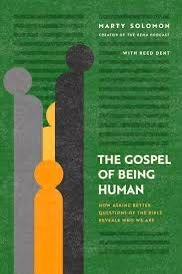
If Marty Solomon’s Asking Better Questions of the Bible: A Guide for the Wounded, Wary, and Longing for More navigated the precarious terrain of how we view the scriptures (what they are, how it should be approached, read and studied, and why they matter to the Christian life), his newest, a collaboration with his podcast and organization partner Reed Dent, probes one of the primary issues that emerges from a failure to ask better questions about the Bible: harmful understandings of who we are in in relationship to who we believe God to be. And what binds these two things together is the question of what we believe this world (or creation) to be.
This is a book also for the wounded, wary, and longing for more, but one that begins to narrow in on the root of what either allows the Christian story to make space for this or not. Indeed, often it can be the source of these things, and that root reaches into these fundamental qeustions of identity.
It’s no suprise that there would be lot of Genesis talk at play here, the necessary soil that needs to be overturned in order to plant the seeds of a better conversation. The common refrain that pushes through the whole however is simply this: the invitation to be curious. Apart from that we do not leave the space for God to speak (or to hear God speaking). And lest we think this feels overly obvious, the challenge of curiousity, for all of us, is that we have a tendency to be curious only where it reinforces our own tightly guarded appeal to our grasp on truth. It doesn’t matter which side of the common divide we are on, the tendency is the same. And here’s the thing with that tendency: if we appeal to curiousity to legitimize our rejection of one side of the equation, we are failing to be curious about the other. Curiousity is not, then, about what we believe on one side or another of our common divides, it is rather about how we posture ourselves amidst the journey that belief represents. Curiousity is not a lifelong commitment to agnosticism, nor is it a directionless appeal, rather it is simply this: if God is true, what shapes our seeking of something we can only ever know in part on our way to the hope of the transformed life and world. In this kind of posturing, we are then free to learn how to ask better questions, ones that seek holistic understandings of this relationship between God, humanity, and creation, always allowing those unsettled parts of our senses to speak into a conversation that has the power to pull us sharply to modes of certainty we then need to protect at all costs, precisely because what hangs in the balance, we perceive, is the very idea of God itself.
Solomon (and Dent) are those rare voices that speak with a weathered and tested conviction, while also demonstating what it is to be curious by nature. They have a wealth of studied and experiential justification for trusting in the Christian story, a reasoned faith if you will, and yet they model what it looks like not to be settled. This matters to them, and they see it mattering to their primary audience (the wounded, wary, and longing for more), precisely because they know the damage that can be caused by certain theological positions birthed by a failure to ask better questions. They know how difficult it is to have that stuff scrutinized and layed bare, to feel like everything that matters most hangs in the balance. And yet that’s precisely where the wounded, wary and longing for more are. Everything does hang in the balance, because those once certainties do not and cannot make sense of the lived life, the world that confronts us each and every day. Solomon and Dent are convinced there is a way forward: asking better questions. And that way forward will bring us straight to the heart of the matter: who we believe God is matters to who we believe we are, and those things matter to what we see creation to be. That’s where the real wrestling happens. If we cannot trust that we cannot be curious about it, instead opting to build our theological fortresses on either side of that vast ocean that lies inbetween or rejecting the whole thing altogether.
There’s so much great stuff here to that end, much of it facing common translations and interpretations of paradigm shaping passages head on. One of my favorites was their observations about passages that seem to suggest God repaying generations for the sins of the fathers. It’s a small but massive example of how so much can hinge on an interpretation, and the authors show what happens when we ask better questions of that passage. Suddenly, what gets unearthed is something long buried by a lengthy history of Protestant interpretations building their own questions on a certain theological foundation. Seeing those passages through the light of God’s responsisiveness, where the phrasing is an intended contrast meant to say something about God’s love, about God’s intention to continue attending to generations caught in these particular cycles. This is not a passage about God’s essential punishment in this present moment, nor about some eternal lobbying of this punishment on to subsequent generations, it is a literary design built on an equation that ancient audience would have understood, meant to communicate one thing: God will not cease or stop attending to His beloved creation. The equation rendered in the literary design is meant to befuddle any conceptions that God would or could.
it’s worth stating here too, where Solomon and Dent locate their foundation, beyond a simple conviction that God is that which they seek, in the Jewish and Rabbinic Traditions driving and underlying Christian interpretation. This is what leads them to give the scriptures an authoratative voice and what allows them the freedom to hold something like the Protestant Tradition and its specific interpretations to the fire. it’s not aimless, rather, it is taking our assumptions and consistently holding it to the fires of the world in which these texts were birthed. We are free, and indeed invited into the process of continued midrash, meaning this foundation doesn’t hand us certain theologies, but it does anchor us in something tangible: always holding our world accountable to the world of revelation that went before us. It frees us to seek precisely by giving us a means of critiquing where we are deviating from the spirit that set that movement in play. Meaning, every Tradition needs this same internal critique, and likewise this internal critique doesn’t mean that everything within a given Tradition is wrong. in fact, every “Christian” Tradition exists, if we dig deep enough, precisely because at one point in time something left the people of that time wounded, wary and longing for more, getting curious about what was unsettling them. That’s the wonder and beauty of the journey. Every Tradition, in it’s own way, needs to grapple with where we went from curious to certain as time went on. That we in the West need to hold Protestantism, or the endless varied Traditions that fall under that umbrella, to the fires is not a bad thing or something to be feared, but rather is a necessary part of the Christian journey.

