

In his book The Affections of Christ Jesus: Love at the Heart of Paul’s Theology, scholar Nijay Gupta weighs in on the significance of a Pauline corpus which, giving little to no mention of the ministry of Jesus that is the central focus of the Gospels, defines itself according to its awareness of and concern for specific, prevailing, pre-existing and predominant credal expressions of these early church communities. Of which, the Jewish conception of Love is the central driving force.
And just to underscore this crucial part of Gupta’s thesis. If we have become prone to seeing love as a “third order” idea within the Christian story, coming to recover a more robust understanding of the love that shaped the ancient readers and authors of the Judeo-Christian world means not just recovering love as central to Paul’s theological understanding, but of that love emerging from Paul’s own Judean context. And the way to do that is understanding the many different overlapping terms that work it’s way into a centralized concept, running through both feeling (emotion) and mind (rationality). This heart/head relationship in the ancient world the Judeans occupied was not importing a modern dichotomy but rather understanding the ways in which the very nature of a transcendent God is made known through the embodiment of a lived life. To love is as much attached to knowledge of God as it is an action.
Some of Gupta’s most interesting work here, which might prove to be too much for those only interested in the ideological conclusions, is the ways in which he meticulously unpacks Paul’s specific choices of words in contrast over others. This shows the complexity of the discussion, and even more so helps bring the larger converstaion Paul is having with his Greco-Roman context to light. And much of his interest is in forging a ground by which to say something about how Paul’s own interests and outlook is developing within that world in which Jesus’ ministry is also shaping this notion of love. If there is so much we simplly cannot know regarding why the ministry of Jesus in the Gospels reamains so absent in Paul’s writings, there is much we can say beyond mere speculation regarding what is present across these boundaries. And Gupta does a nice job of arguing his basic case that what informs Paul’s convictions is the same Shema we find Jesus unearthing in His own teachings. “Love… is at the core of Paul’s understanding of the experience of individuals and communities in Christ.” And as Gupta states, “What’s often missing in this debate (about Paul and Jesus) is the personal aspect of why God saves in the first place.” The credal language of the death, resurrection and ascencion of Christ looms large for Paul, and in fact is everything when it comes to his central conceipt: that “Paul’s Gospel is first and foremost about God’s love for the world.” For Gupta, he states that one of the most transformational insights he gleaned through the process of writing this book, and perhaps what might be the most difficult for people to grapple with and accept, is that “Paul believed that God has a heart, and that the gospel comes out of compassion of God that lives within that heart.” To this end, “The good news of God’s love is not new with the New Testament: Jewish scripture and tradition place love from and for God, at the heart of covenental life.” It is, in other words, about the covenental story.
He ends his book with a walk through the letter to the Ephesians. Debates on whether this belongs to the collection of accepted Pauline letters aside (either way it still reflects the singular tradition and voice), Gupta describes Ephesians as “a kind of greatest hits of (Paul’s) apostolic proclamation,” reflecting back on the entire lifespan of Paul’s ministry and asking the question, does our collective memory of this journey of trusting in the death, resurrection and ascension of Jesus give us hope in something true, or does it reveal that Gospel to be less than trustworthy when set in the scope of this history
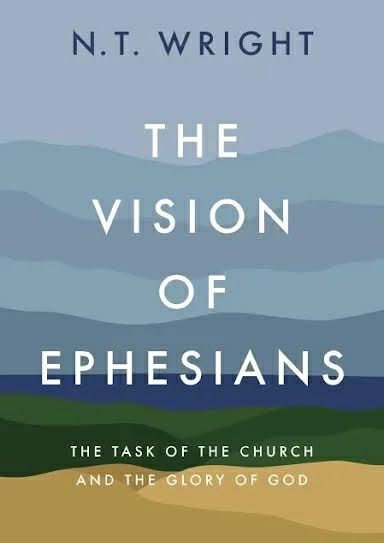
N.T Wright in his book The Vision of Ephesians describes the letter in terms of a working household analogy.
Thessalonians is like uncovering a long lost blueprint or early draft for the house, imagining the life of the community, centred around the meal, unfolding from the kitchen to all the rooms in the house.
Galatians is like the kitchen, where all the ingredients are sitting around on the table inspiring debate and discussion and yes, division.
Romans is the dining room, where the cooked meal is layed out with formal precision
He doesn’t go so far as this, but in this analogy I imagine my own personal favorite letter, Philippians, being the neighborhood coffee shop, or perhaps the front porch.
Wright echoes something similar as Gupta when he describes Ephesians as that quiet, secluded sitting room in the back with a view from the window looking out over the ocean. Reflecting on the lived life and all of the grander questions about God and the world that come along with it.
A letter that both Wright and Gupta describe as being absent of the particular concerns for a particular context in a particular community in the way all the other letters are, and instead exhibiting the signs of a circulating letter which is finding it’s life in the midst of the whole of these communities, the very thing his letter in Thessalonians first brings to our imagination and which is now a fully functional reality.
Gupta adds the observation that this letter, being defined by this circulation, is refreshingly absent of conflict. The sort of thing we step back from the chaos of the household and sit with when the world seems to be incoherent and pressing in, the sort of thing that brings us back to what the story is all about and allows us to wonder about that central and important facet of the Gospel: hope.
And if Gupta is correct, this hope centers us on one thing: love. As Gupta spends his book doing, this is an aspect of the Pauline corpus that both surprises and doesn’t at the same time, something I think he makes a strong case and argument for: it’s unusual presence when played against his theoretical relationship to the formation of the Gospels going on around him at the time, and indeed as a presence that sits in conversation with the wider world that surrounds it.
The task then for those sitting with this particular letter, gazing out at that vast and endless ocean that is the weight of this world and its many questions and struggles, becomes one of ruminating on a word that is far more expansive and nuanced than modern definitions and expressions tend to allow. To make sense of love in Paul’s letters, especially when weighing it against a historical witness and a life lived, is to dig into and confront those parallel aspects that is making a home in this world and our imagination for another. Attending to this present reality while growing our imagination for the truth of the transformed creation. Of wrestling with the complicated nature of a singular legacy, while seeing past the restraints of a singular life. Love, Gupta says, in all of its dynamic, Is the thing that moves through all of these things at once for Paul.
That was hitting me this morning. Probably because 50 is around the corner. Likely because this world feels just a little chaotic at the moment. Likely because that sitting room, that ocean view, feels wanted and needed at the best of times.

