
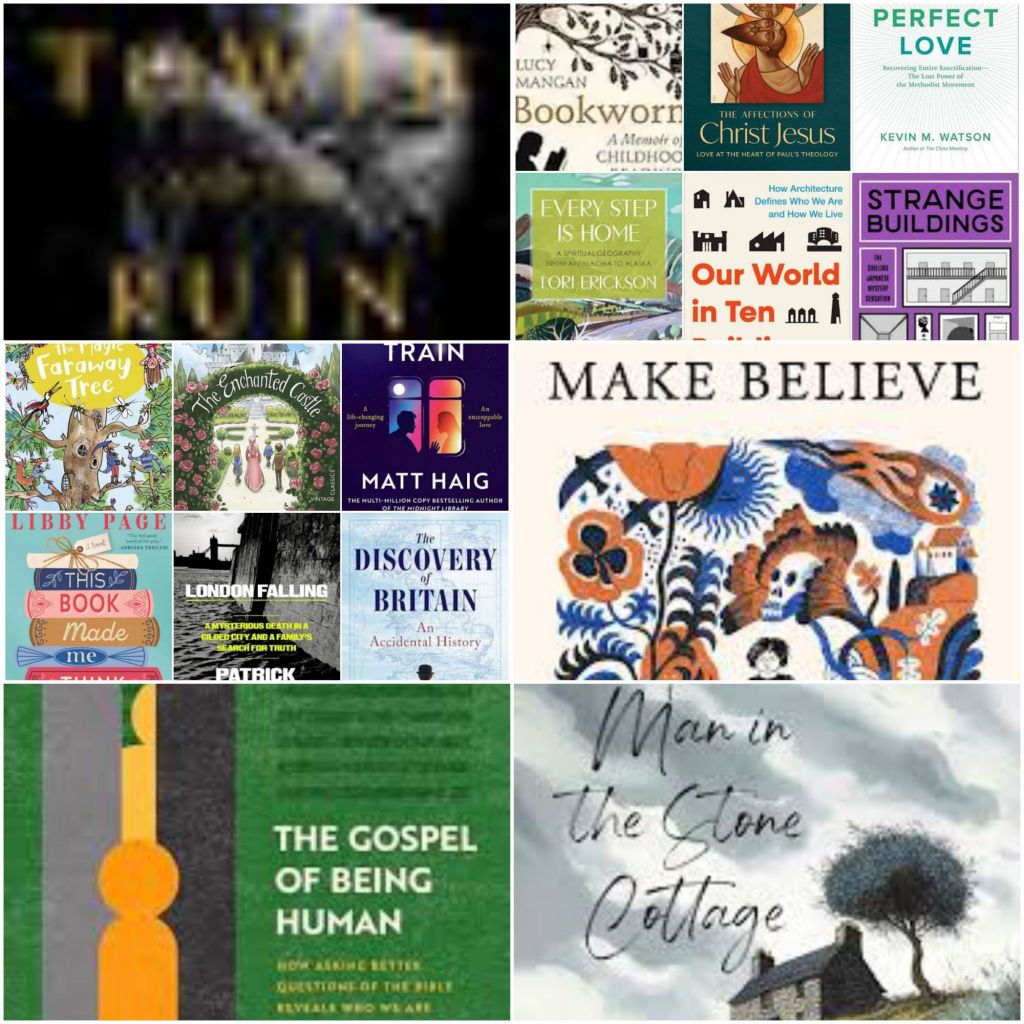
Just because I continue to enjoy connecting my books, figured I would look at my June reads through the lens of specific pairings:
The Tower and the Ruin: J.R.R. Tolkien’s Creation (Michael DC Drout) and Bookworm: A Memoir of Childhood Reading (Lucy Mangan)
In The Tower and the Ruin, Drout spends a good deal of time, using the available tools of literary/textual criticism, tackling the subject of the genre of the Lord of the Rings (and the broader interests of Tolkien’s creations). Of interest for him is how the ways in which such a stark cross section of readers with different beliefs tend to claim LOTR as their own. Thus, setting Tolkien’s creations in context and looking at the world he created it within, with it’s own sets of questions and concerns and interests, becomes a way into a necessary conversation about what this work is and why it continues to have the power that it does even still today. Rather than assuming that this work is expressing our own wordview, Drout’s approach asks us as readers of his work to allow what we can know and what we can say about Tolkien’s own intersts to critique our assumptions.
Which of course brings to mind the thorniest part of that conversation, which is the simple question of whether LOTR is theological in nature or not. In this sense, tendencies to define LOTR according to genre become ways of categorizing it and boxing it in to the fantasy works that surrounded Tolkien. The issie is, as Drout argues, such categorizations don’t make sense of what the text actually is, nor does it have a particularly strong explanatory power when it comes to making sense of the unique power it seems to hold as a text. It might feel too risky to allow the text to actually be what it is, and yet that’s our best way into understanding what the text actually is.
What’s interesting to me is reading this alongside Mangan’s Bookworm, a memoir that can’t help but find itself tip toeing around the elephant in the room seemingly on every fifth page, attempting to justify the formative place Narnia has in her childhood as someone who also sees it’s percieved blatant christian allegories as a problem. She takes the complete opposite approach of Drout, embracing a rejection of any form of book banning, but finding the corrrective in recontextualizing the works (in this case of her childhood) through the lens of her adult assumptions (in this case a strident appeal to materialism). I found this to be a deeply frustrating process in the case of Bookworm, even as I very much appreciated the spirit of the book, choosing as it does to take our childhood seriously. Who she is is because she read, and I very much share this in common. Certainly, one of the great curiosities remains over why Tolkien escapes such criticism and Lewis does not.
The Affections of Christ jesus: Love at the Heart of Paul’s Theology (Nijay Gupta) and Perfect Love: Recovering Entire Sanctification: The Lost Power of the Methodist Movement (Kevin Watson)
Love at the heart of all things. For Gupta’s captivating work, exploring the intersection of Paul, for whom scholars have often puzzled over the absence of any mention of the ministry contained in the Gospels, and the Jesus of the Gospels. For Gupta, we have to look at the foundation of love in the Shema to understand the relationship between these two sources, a study that breaks out of the narrow confines of our modern definitions of love and into the world of a formative concept rooted in both the qualities of that which informs their worship, and their participation in it. For Watson, a book I picked up out of interest in my own family heritage and roots, and as well to accompany an upcoming trip to England, Love is at the center of the Methodist conviction and theology. Love in this sense is seen through the defining theological paradim of entire sanctification, a theology that has been lost in much of the church today. Here we find love not simply as a source, but as the transformed life (and creation) itself. Watson does an excellent job of outlining what this theology is and why it matters to the Methodist Tradition, and even though it’s primary audience is Methodists, I found it to be a great source for those who aren’t as well (it’s my history, but I know very little about it). And more importantly a good window into my own family history.
The Gospel of Being Human: How Asking Better Questions of The Bible Reveals Who We Are (Marty Solomon) and Every Step is Home: A Spiritual Geography from Appalachia to Alaska (Lori Erickson)
I loved Solomon’s follow up to Asking Better Questions of the Bible, a book that essentially takes a deeper dive into one of the dominant reasons this matters (to asking better questions and a failure to do so). Which relates specifically to how we understand God, humanity and creation. What hangs in the balance is the very narrative through which we gain our beliefs about these three things. For Erickson, it could be said that her interest is in asking better questions of creation. Her particular journey is one of exploring the ways a world soaked in the presence of the Divine informs our understanding of the same three things. Hers is definitely a progressive spirituality, although I recognize that in itself is a somewhat ambigious label when not defined. I found it to be a bit too surface for my liking, but I did appreciate how she is reaching for a more expansive defintion of home here in this world, asnd how she sees the world as a stage upon which to find the Divine.
Our World in Ten Buildings: How Architecture Defines Who We Are and How We Live (Michael Murphy) and Strange Buildings (Uketsu)
Murphy does an excellent job, as one intimately connected with the profession of architecture, of outlining our connection to buildings. I have long felt this, and been fascinated by it, understanding that archicture is an outflow of who we are. We can tell so much about a society, and indeed our humanity, by the buildings we construct and the cities we design. Murphy outlines his book according to types of buildings, and each type correlates with his own story. As we move through significant moments in his life, we begin to understand the role the buildings play in it. More than this, we understand why and how it inspired him to invest in this archicecture.
If you are unfamiliar with his name, his name is behind the inspired design and construction of the memorial and exhibit in Montgomery, which functions as a climatic point in his story. But each type of building sets the stage for this inspiraiton, and I genuinely loved coming along for the ride. He has a way of holding great uncertainty alongside a willingness to see the possiblity of deeply rooted transcendent truths, never allowing the utility of the archictectural discussion to erase an equal need for greater revelation to lie behind it.
In Uketsu’s work, my introduction to this series, the spirit is much the same (seeing the spaces and buildings we create as intimately connected to who we are and how we live). But his work is fleshing out a mystery. In some ways he works in the opposite direciton, beginning with the the mystery and gradually stripping away the layers in order to find the truth of what becomes these interconnected stories on a material and physical level. It is a bit hollow to that end, but it’s definitely a very unique structure. Hard to follow at times in translation, but always interesting in the effort to try and keep up with the puzzle pieces.
The Magic Faraway Tree (Enid Blyton) and The Enchanted Castle (E Nesbit)
Two books about learning to see the world beyond the veil. The Magic Faraway Tree is definitely heavier on the allegories and symbolism, making for a rich study of characters and themes and more centered around lessons. The Enchanted Castle is the richer story, being the more singular of the two books, but also the more formative read on a narrative level. I loved them both for what they were, owing themselves both to the grand tradition of English literature and children’s storytelling.
The Midnight Train (Matt Haig) and This Book Made Me Think of You (Libby Page)
One book about a life examined looking backwards through your own eyes, another about a life examined looking backwards through the eyes of another. Very different books, Haig reaching for an inspired spiritual journey filled with existential questions and cosmic interest, Page’s book a more grounded look at grief and transformation. Loss plays into both in their owns ways, and so does hope. Both, for me, proved to be memorable, although Haig’s was the more impactful.
Make Believe: On Telling Stories to Children (Mac Barnett) and Unseen Existences: Of Heaven, Earth, and the Divine Mystery in All Things (Brian Zahnd)
Why this pairing? Because both are books about reclaiming a more robust undestanding of what this world is. Both books are looking at the shape of this world we occupy, Barnett navigating the chasm between the world of the chid and the world of the adult, lamenting and calling out the ways we modernists have come to see growing up as a rejection of childish things, Zahnd challenging the disconenect between an inadvertent sliding into forms of physicalism in a world that is defined by these unseen existences that modernists have rejected. Both books struck a chord for me in their own way, hitting at some important feelings and thoughts and convictions that have been following my life lately. If Barnett opened up a window in to my own journey of finding myself in my childhood (and those childhood stories), of learning how to allow my adult self to converse with my child self in ways that illuminate the truths of this world and this existence, then Zahnd is a reminder of why this kind of seeking matters: because there is actually Truth, or a true reality there to seek.
London Falling: A Mysterious Death in a Gilded City and a Family’s Search for Truth (Patrick Keefe) and The Discovery of Britian: An Accidental History (Graham Robb)
A kind of unlikely pairing, but for me these two books reflect this central truth: that however we normalize our day to day experiences in this world, the actual shape of the world is always this kind of crazy. Keefe’s tackling of this mystery is a peek behind the curtain off what’s actually going on in places we visit regularly regarding big money and organized interests. Robb’s book, which is uncovering it’s own mystery, in his case discovering the story of Britian from the ground level, is pulling the curtain off some commonly held narratives that simply do not reflect what the history actually is. On the largest level, this applies to the narrative of conquest and immigration. But it also plays out on other small levels. Keefe’s book is exciting, Robb’s book is unfortunately pretty dry, especially in the second half where some of his underlying (and in many ways anti-religious) motivations come to light. But both books are a good reminder that the world isn’t always as it seems.
The Man in the Stone Cottage (Stephanie Cowell)
This one pairs with books I am reading currently. It’s a complimentary fit with my upcoming literary tour of England, looking at the Bronte sisters and weaving (using the historical fiction genre as it’s tool) a speculative story rooted in certain truths about who these individuals were. I enjoyed it. I knew very little about the Bronte’s, but this filled in some gaps between some of my struggles with Wuthering Heights and Emily’s own worldview/life. Opened up the whole Yorkshire territory as well.
 The Stories of my Life