
8 days
That’s how many days I went without watching a single film. More if you include the days leading up to my departure. And technically counting.
That might not sound like a big deal, but for me it’s very much out of the ordinary.
So much so that, upon returning from my trip, I became particularly aware of the fact that this anomaly seemed to be unearthing something that ran a bit deeper. The more I thought about it, the more aware this became: I was feeling disconnected from my love of film as a whole.
And the stats seemed to bear this out. A perusing of my Letterboxd page helped solidify this simple fact, showing a 60 percent drop in the number of films watched reaching back to this same period (January-July) a year ago.

Thus I have found myself theorizing on the eve of Nolan’s latest big screen blockbuster (The Odyssey) about the reasons for this disconnect. Certainly part of this has been the larger reality of the ongoing erosion and codifying of online communities and cultures that once promised lifetime connections across different interpretations and experiences (those communities replacing the physical communities I once thought to be eternally present as well). But such a sharp drop seems to suggest something more localized to 2026.
One place to begin fleshing this out is noting the simple fact that when I left for my trip and the screens, for me, had turned mostly dark, online discourse had just transitioned from the doom and gloom of reporting on Supergirl to it’s most recent robust attack on Moana. Logging back in upon my return, the first thing that flooded my feed was the imbattled discourse leading up to the release of Nolan’s The Odyssey. And this is not even to note the plethora of smaller films that continue to be buried underneath the finely tuned rhetorical online gamemanship.
That’s when I started to wonder. I had effectively detoxed from these convos and was seeing it, however briefly, through somewhat sober eyes. The joy, for me, of going to the movies continues to be challenged by the nature of this perpetual discourse and the media headlines that fuel it. What makes this more complicated is that stepping out of online discourse doesn’t address the source of the problem: the communal nature of this unique artform being continually challenged.
That’s one part of a working theory. Another thing hit me however, this one perhaps more prevalent to my own particular circumstance and journey. This trip I had embarked on, more of an intentional pilgrimage towards rediscovering the literature that had formed me beginning in my earliest years as a veracious reader. Walking the grounds that gave these authors and their stories their inspiration. This was also a pilgrimage towards rediscovering the source of those stories. Of coming to understand better why story matters in the first place.
Beginning in London, walking in the footsteps of the likes of Dickens and Wilde, reaching as far West as the rugged Atlantic shoreline that holds the history of the Arthurian legend in it’s weathered soil and looming cliffs and as far north as the lore surrounding Bram Stoker and the Bronte sisters, ultimatley ending in the streets of Oxford where the enduring legacies of Lewis, Tolkien and, for me, my favorite living author Stephen Lawhead remain alive and well. The likes of Coleridge, Richard Adams, A.A. Milne, Roald Dahl, Shakespeare, Beatrice Potter, Agatha Christie and Virginia Wollfe, the Robin Hood lore, all dotting the space inbetween. My encountering of these voices and these spaces lingers in my spirit with an ever renewing sense of awe as I settle back into routine. These were the voices through which the idea of story gained it’s power over my life, the seedbed for what would become my equal and passionate embrace of storytelling’s visual form. Thus, in many ways this was returning me to my first love: books. Perhaps in ways I don’t yet understand, this is also the way into rediscovering the tradition of oral storytelling that precedes and informs this literature, along with my love of film, a form that would proceed from it, as well.
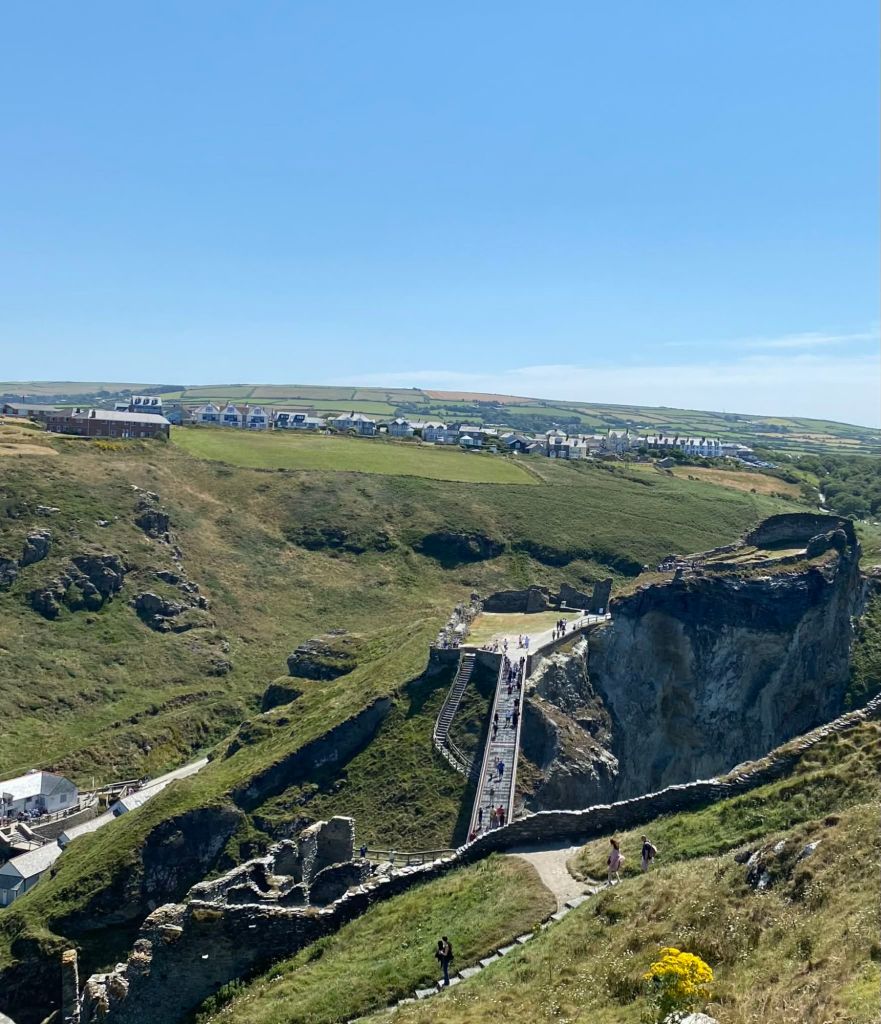

Retracing these steps in my memory as I attempt to preserve this pilgrimage within a framework of it’s own emerging narrative, I am picturing those looming cliffs stretching out over the ruins of Tintagal. Perhaps the true climatic moment of my journey, arriving as I do finally at the great expanse of the Atlantic looking out over that great divide between the old world and the new.
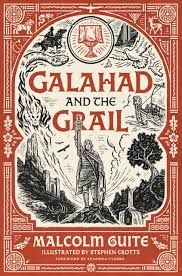
I am standing there looking out over the waters listening to Malcolm Guite’s Galahad and the Grail, letting his passionate play, as I heard it put, on “a theology of the Grai” open up a world long buried by my own modern, adult senses. I have thoughts of Drout’s majestic critical work on Tolkien’s works, The Tower and the Ruin, envoloping my awareness as well, with his capturing of Tolkien’s own impassioned image of the ruins of these castle walls on one side of me and the great expanse of the chaos of the waters pushiung in from the other holding the existing tension of those dualing forces, the Spirit of Life and the Spirit of Empire, together in a coherent narrative of that necessary euchatastrophy.

It all evokes this powerful sense of restlessness and wonder within me, moving me to consider where precisely the narrative of this journey pushes towards. The same feelings that I have found expressed in both Tolkien and Lewis as they describe their own wrestling with the erosion of their own once thought to be infinite community called the Inklings in the face of their own unique awareness of this growing tension that has come to be known as modernism. The necessary question for them: from what source does story gain it’s power. In a world that, even in Tolkien and Lewis’ day, is pushing forward towards a sharp disconnect between the evidenced power of these once enduring stories and the emergent elitism of the classicism and criticism which would come to dominate their world on both sides of this percieved break in history, this is precisely what comes to motivate someone like Tolkien, immersed as he was in the stories that informed his world, to capture and thus preserve the true source that gives these stories their life.

In Erica Stevenson’s The Odysssey Effect: How Homer’s Epic Poem Shaped the Woirld, she outlines, as a scholar in the field of the classics, how the enlightenment period reflects this movement towards elitism in a field (the art and study of the stories of the classical world) once accessible to the people of that world (and enlivened) by being both a product of and for the story tellers and hearers. Story, taking on the rhetoric of that invented term “classics,” now becoming a distinct product of the historian. A product that, for anyone taking a course in the classics or the classical world at a given reputable university/college even still in our time, gets molded and handed down to us by the select ones able to study them and thus control their translation and interpretation.
More importantly, not just handed but pre-molded in the spirit of that same enlightenment influenced modernsist lens. Soaked in the kind of intellectualism that serves to further entrench this distance between the hearer and the story. On one hand stating, as Stevenson points out, that the act of history is always an act of the imagination held captive to the interpreter, while similtaneously handing the scholar the hidden wisdom that now drives a wide, wielded sword between it’s redefined notions of myth and reality. Here story becomes bound to the very western foundations which have been built through that precise practice of “othering” the ancient world into being within this framework of thought, a practice used to justify our brand of intellectualism giving rise to the so called higher criticisms, branded as it becomes within the hiearchal systems of the Victorian age and codified by the continued reapppropriation of the Greek philosphers. This is, one might say, what we can call the modern, rhetorical framework. In this framework, ones access to the “classics,” or more importantly their meaning, not only operates as a sign of belonging to this higher criticism, the classicists then become the true bearer of their “meaning.” This becomes the means then of preserving the myth of progress that holds the enlightened world together.
As Guite insists in his introduction to his masterful book, along the way we’ve lost the language of story. We’ve lost the ability to actually be hearers of story, precisely because we’ve lost any sense of their actual source. That they have any source at all outside of our reconstituting of the classical world itself. This is what the distance brings about. Peer behind the veils of these intellectual systems and what you find is the same theoretical approaches for dealing with the diversity that we actually find within this world soaked as it was in Story. The only way to deal with the diversity in the modernist point of view is by reducing this to a single genre we now commonly call myth (in the modern sense of the word). Rather than the notion of a unifying narrative opening up a world full of stories across space and time, the creation of the classics becomes the silent indoctrination into a dominating modernist framework.
And that matters for this single reason: the modernist framework could arguably be said to be the only moment in history that, percievably, refuses to recognize it’s own operative myth. In fact, it sees itself as operating above such antiquated ways of being and seeing in this world. Which is precisely why, as Stevenson so aptly outlines in her book, classicism must function at such a distance from the people. What those like Guite, acting as they do as modern prophets of our present time, are proclaaiming through their life and works, is that when people learn to tell and hear these stories, it invites us into the greater Story to which all of thse patterns and symbols, contextualized as they are into our space and time, belong.and point towards. This is where history becomes a living, breathing entity that indeed can be framed as a pilgrimage.
It is also not suprising that the ones educated into this idea called classicism are often the same ones using the old world myths, which once functioned as a means of opening us up to a world hidden and unseen, as prooftext against the actual power of these old world myths. You can see this alive and well in the debate over this recent adaptation of The Odyssey, which underscores the two competing understandings of myth that has become so prevalent in the modern age. This could be what we might call a delicious irony. The way into attacking and/or dismissing religious or spiritual truth, for example, is to a devoted modernist to study and to come to love the Greek myths. Because, as claccisism will tell you, it’s all about categorizing these myths within a singular conception called the classical world, where we can safely draw lines between the old world and the new. And for western society, owing it’s own existence to the Greco-Roman world we have reconstituted as the great enlightenment project of our time, the true force of this movement from a world of Story to a world of the classics is a movement towards a percieved rationalism that allows the new to do away with the old altogether. Instead of finding a world filled with diverse stories by it’s very nature, the dichotomy that we find within claccisism sees it as a war between monotheism and polytheism, to which the proper modernist will claim a secularized version of the latter. In truth, this truncated version of the world only betrays what is actually true about it’s shape, which is that it’s diversity brings a shared monotheistic allegiance into conversation with a polytheistic world. This is how diversity exists. The modernist tendency to set these things at odds becomes grounds for creating this sharp dichotomy between myth and reality, giving the assumptions claccisism makes regarding creating and upholding the necessary and needed distance between the higher criticisms and the storytellers (which gets the label “rationalism”) a percieved justification.
Meanwhile, the very thing that gives these stories their power is the very thing this form of institutionalism is actively stripping away. We remain seduced by the self wielding power this kind of rationalism hands us, but only in so far as we retain some sense of control over what it is allowed to reveal (in theory). As Stevenson puts it, this justification comes from our ability to single out the particular god’s of Homer’s epics and use that as our reasoned means for purging the world of the whole of religion. Of course this isn’t historical, modernism says, therefore the whole of religion occupies this same shape. In other words: it’s all Greek, as the saying goes, a phrase that brings with it all of the assumptions of a supersessionist point of view.
Which is where it needs to be said: this is, in fact, not rational. In contrast, for the ancient (or classical) world, evidence suggests that they fully understood the power of their operative stories or myths as a window into the greater Story that holds rational and reasoned history together, a word that simply evoked that once richly experienced sense of the enduring source lying underneath all the world’s stories. Something Tolkien and Lewis were accutely aware of. Something that can actually honor and make sense of the diversity of all the world’s stories.


Back to those cliffs with the castle ruins on one side and the ocean on the other. It became powerfully aware for me, recognizing the storied layers of this landscape. This castle was built over top of a legacy lost to us but aware to the builders of it’s time. To get to the reason for the castle we have to dig further and recognize this simple fact, and that digging brings us to that perpetual question that runs through the whole act of history itself: why did they build it? What motivated them to build it?
The answer is: Story. Or their stories.

When the modern approach has weaponized our attempts to answer this question by predetermining the ancients to be lesser than our own constructed academics, designed as they are to reshape the world in our own image, there can only ever be one answer to this question: they were less educated and thus lesser than us. Thefore, to engage their stories means we must actively strip them of what makes them lesser. This becomes a mark of so much of the West when it comes to adapting these stories into our time and place. We thus mire something like Homer’s works, to come back to Nolan’s The Odyssey, in this veneer of self justifying rhetoric. To imagine a people wholly versed in the art of story and storytelling apart from this higher criticism is simply foreign, and increasingly a lost art in modern academics, and therefore we become the necessary conduits of the world we believe the classics must reveal in order for them to be allowed to say anything at all.
When it comes to this Arthurian landscape, and similarly with the legacies of Robin Hood further to the northernly, eastern part of England, we cannot dare to imagine the ones building this castle did so because they were aware of something we ourselves are not. That they were rooted in the stories that formed them precisely because they revealed something very real about the world they both experienced and understood. That they preserved the Arthurian stories because these stories were part of the larger world of Story, a reality that immersed them in the very world these stories sought to then open up. To acknowledge this would leave us feeling like our own appeal to this carefuly crafted thing called higher criticism is losing its ability to uphold our sought after sense of superiority over the past, as though we have a greater window into what is true than they did when they crafted this fortress against the harrowing forces beating up against it’s back, building their stories over the it’s source. Or perhaps betraying the fact that it never had this ability in the first place.
Yet, what this space, and the likes of Guite, are attempting to retrieve from the muddied landscape that our modern senses have obscured is our ability to allow these stories to once again unsettle in the ways they did for their original hearers. To understand how, for the ancient world, these stories were not operating as empty metaphors. They awakened them to what only the imagination could, a world in which the very patterns of our stories reveal it’s source. Where, as Guite sees it, story has the power to “set us upon the numinous shores of Faierie in all its mystery and meaning.” Where he finds the unifying relationship of the source of our stories evidenced in the whole of history.
There is a reason, as the foreward to his book says, the world would cease to be without the story of Arthur. What it means by this is not an elevating of Arthur above all other stories, but rather that in this space we find a way into all the world’s stories. We find a historical moment in which this practice was alive and well, fostering the heart of storytellings and story hearers. A way of making sense of all the world’s stories. All stories draw from the same source. This is why Story, and the stories that become our windows into a true narrative, holds power.
We can debate what this source is, but what the modern world has largely forgot, and pretended not to need, is a world that can be opened up to us in precisely this way. That what drives the stories we tell is an awarness of the source that gives them life. That a source actually exists. There is an irony to the fact that we live in a time when history is, as it was famously put, no longer a thing. We have arrived at the end of history. It cannot be buried, forgotten in the way of these old stories, and it can no longer be lost or gained, because we have surpassed it. Therefore it can never be something that needs to be discovered or imagined, nor preserved. We are no longer tellers or hearers, we are the drivers of a world now brought about by an act of our own making.
And yet, it’s not just these continued adaptations like The Odyssey that remind us of the Western world’s indebtedness to the past, it’s that we remain entirely ignorant of the ways in which these same patterns and symbols are the very things running through the life giving stories of our time. Sadly, what gets lost in this ignorance is the very diversity that awakens us to this power. A world where the classics have been reconstituted and reduced to modernist interpretations is a world built on utility, not Story. it’s a world where film gets reduced to the tehcnicalities of it’s technology. Where the modern script trades life giving metphaor for idelogy and moral “lessons.” What struck me in reencountering the narratives of my childhood afresh is how harkon back to a forgotten history of storytelling that didn’t adhere to rules, but to patterns. Patterns that reflect the lives of the storytellers and the hearers. The best of the modern voices, and indeed I would include Nolan here, tell stories that are able to open us up to the rich tapesty that is the human experience defined by life and death, order and chaos, suffering and salvation, despair and wonder. An expansive rendering of the world rather than a narrowing. The reason these are the enduring sotiries is because they reflect the enduring Story that connects us to history. We become players in the human story rather than the drivers of it.


One thought on “Arthur, Galahad and The Odyssey: How The Invention of the Classics Distances Us From the Enduring Power of Story”