
My wife (Jen) and I recently visited The Seine River Cafe for breakfast, a quiet, unassuming store front diner tucked in behind a Shell station and a Dairy Queen on Provencher, the central route winding its way through Winnipeg’s French district. It had been on my list of restaurants to visit for a while, being a celiac who is always on the lookout for new places which can accomodate the inconvenciences of this auto-immune disease.
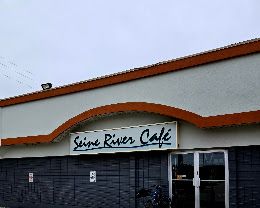
We went early on a Sunday morning, close to when it opened, arriving to an empty restaurant. As we were sat at one of the non-descript tables, the sort of tables you would expect to find at any like minded low key diner, a friendly waitress came to take our order, leading with welcome warm cups of coffee.
It would be soon after that the diner started to fill up with people, some by themselves others arriving in couples or larger groups, each sliding up to a different table in different corners with the obvious ease and aura catering to custom and routine. Both Jen and I noticed, quietly at first to ourselves, as we observed the growing activity and conversation, every single person that came through that door appeared to be a regular. The sort where the waitresses already knew their names and orders. One such table, saddled up close to the open kitchen, naturally fed into casual conversations with the the cook and (assumed) owner, as though they were simply picking up where they last left off. It became so obvious after a while that we, by all appearances, felt certain we were the only strangers in the bunch. We barely needed to verbalize what was on both of our minds in that moment, me just beginning to open my mouth to state the obvious and Jen speaking the all to familiar words of the old Cheers sitcom- “where everyone knows your name.”
What made this moment more startling was the conversation that preceded and followed this moment. With my 50th birthday coming up quick (two days away from this particular Sunday morning venture), such milestones have a way of pushing you into expected modes of reflection on the passage of time, and if you are me, the nature of life itself. Earlier that morning I found myself talking with Jen about how the passage of time has indeed reframed the ways I experience life today, caught in this space where a world, now made primarily visible through its endless online portals, just keeps going about its business even while, in my head, this particular moment for me feels monumental, as though its stopping my world in its tracks.
For me, this is the mark of something I have to similtaneously learn how to grieve and celebrate. One of the things I noted to Jen was how striking that realization actually is given my life today, thinking back on a life that was once dominated by the endless phsyical presence of a social circle, with that memory now ringing out into the uncertain space of this transition into a moment that, by all appearances and experience, now seeks to displace and forget and isolate. Where you know through your convesations with those whom have travelled this space ahead of you, that the process will require a constant process of reckoning with what will become a perpetual stream of loss. In various areas of course, but most pertiently of all the things that once made you “you.”
The notion that this phase of life is marked by the important process of learning how to more appropriately grieve in real time, but also the increased call to remember and to preserve.
These actions, as I’ve been told without the sugar coating, get harder as the years push forward, with life relegating you more and more to the sidelines. At the same time, the call to remember and preserve becomes all the more important precisely because of this reality. As someone once said, words that are lingering today, this is the hard work of aging. Something you are forced to learn in real time, leaning on all the wisdom you have forgotten, handerd down by those who went before. The most difficult thing being your ability to hold on to the simple truth that this process matters to something real and true regarding the meaning of a life.
To be honest, the only word that fit in that moment, in my conversation with Jen, was “loneliness.” A feeling of lonliness that is also marked by existing in a world that now oeprates in that online space. A world in which my closest lifelong friendships remain marked more by distance than presence, for as valuable as they remain.
Fast forward to after our breakfast, where we attended the Sunday morning service at our Church. Here we were met by a message about the importance of having those voices in your life, the ones that truly know you, which can help you through the passage of time and different phases of a life. How telling the story of a life together matters, especially to how we imagine God’s relationship to this world and our continued participation in it.
That image of the diner, defined as it was through routines built over the passage of time, where those figures knew exactly where to sit without needing direction, where their names were known and orders made before any words had yet been spoken. Such an image pushes back against the dominant image of the way it seems life must work today. A world where we are taught that life is meant to be about some gradual progression towards some non-descript and undefined point of growth. Here, in this image, I find something much richer, preserved as it is in the passage of time, not a product of it. A timely image given the question my day started with, and the message that would follow.
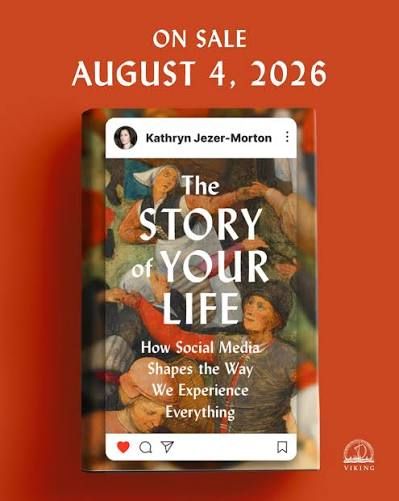
I’ve been thinking about this (now) memory as I’ve been working through the newly released book by Kathryn Jezer-Merton called The Story of Your Life: How Social Media Shapes the Way We Experience Everything. It’s a book about understanding this present moment. Which, whether we like it or not, whether we want to recognize it or not, runs straight through one of its primary driving forces- social media. A truism that holds whether you are among those deleting their facebook accounts or perhaps establishing limits and boundaries and reforming habits. “Social media” applies broadly to nearly every facet of our world and its function., far beyond the typical scapegoats. It’s written into the fabric of our econoimy, it’s the primary language of our social function in an online world, and it takes on many different forms.
I found it fascinating to journey with Merton back in time to the early adoption of social media (and I promise to connect this back to my thoughts above on turning 50). Back to the age of MySpace and Friendster and AOL. She outlines the way the early adoption of this form of communication complimented the way life worked before its reshaping. It was a mirror of that (now) lost world. Meaning, it once served as a space largely built for our relatively small physical circle of friends where we could engage in the largely experimental but active creative curation of ones story. Anyone who grew up in this era can understand that these early sites fit our lifetyles at the time, where they demanded the same sort of hours upon hours of time and attention that curating and collecting our tape and CD collections did in a largely still computer iliterate world used to (and loving) “being bored.” Building our MySpace platforms wasn’t that far removed from the practice of building our physical zines or our basement jam session hang outs, and it wasn’t abnormal to find ourselves doing it together either. We would build them, and then we would meet together to discuss and compare and chat about them. More importantly, which Merton points out, the first place we would gravitate to were the profiles.
But then came an important shift in the atmsophere. Where these connecting spaces experienced a movement from a small group of our close friends (our physical life) out into a small group of connections turned friends from outside of that physical circle. This began the gradual progression towards a world framed now through connections marked by physical distance. As this shift became the norm, those once physical spaces began to disappear, along with the once cherished practice of the curation of profiles. Facebook understood where these winds were shifting towards long before anyone else, and eventually that once world of creation curation of our physical lives turned into a world of online connection and content now replicating and chasing after itself. The world was now our collective space, and that space was now online, and every platform that followed became defined by the further implementation of “user friendly” streamlined designs, whicih is shorthand for “stripped of the need for time consuming personal curation.”
And the bigger the world became, the more these physical spaces we once occupied disappeared. Ironically, if you fast foward to some of the eventual fallout, what we eventually find is a world where carving out time for physical interaction (be it with spaces or people, the more predominant trend being towards the former) has now become an intentional trend, the necessary reprieve, the thing we build in to our lives as an antidote to the way the world now works.
A world where going off social media becomes a matter of virtue signalling for a lost world no one actually knows or understands masking the simple fact that even where we engage in such admirable practices of disciplined retreat, the world we occupy remains defined by social media. What’s also true, and maybe even more pertinent, is that this supposed reclamation of physical spaces tends to narrow our world into small, protected circles of like minded connection, not open it up. The lost world we think we are retreaving, in constrast, that was a world once necessitated by a room filled with disagreement by its nature. That’s what made it valuable. .
One of the things Merton brings to the forefront is that the thing (the social construct) that is telling the story of our lives is intimately connected to how we tell the stories of our lives. Meaning, we are always as much a product of the world as we are a product of the way the world functions. The first is the world we inherit, the second determines the paramaters of our participation in it. Within this we can note important and common human tendencies that remain universal across the shifting tides- the need to share of ourselves, the need to belong, the need to preserve. But we also have what we would call the unique dynamics of a particular moment in time, in this case our present online age. Knowing the difference is important.
She does state that this (book) is not about singling out the present online age and demonizing it. Although in some ways it is singling it out so as to understand the thing we are looking to critique (and its relevance to our lives) Mostly though, it’s about learning how to distinguish between what those inate common human needs are, and the particular shape of our present moment that distinguishes us from the rest of history, a process that is equal parts reflective and predictive.
But there’s an important aspect of our navigation to this end that needs to be recognized. In order to get to the root of the problem we have to understand where it is situated in the history of it’s emergence. For example, we can look at the ways social media changed from that era of hands on curation to the automated forms we encounter today. That begs the question, why did it take this shape? It doesn’t just come out of nowhere. It’s following a pattern. That might push us to look at the nature of the market economy this emerges within, something Morton notes as a force that naturally seeks the commodification of emotional (lived lives) capitalism, something that economy craves in this online world.
But that also doesn’t come out of nowhere. Morton notes how we can reach back to Maslow’s hierarchy of needs to locate a pivotal shift in a way of doing life in this economic reality, observing the devleopment of the myth of “personal growth” or pesonal development, something that gets applied to telling our stories according to a preconditioned allegiance to expected notions of linear progressions and sought after narratives of self improvement.
But again, this doesn’t come out of nowhere. It is the natural outcome of a particular world of its time, one that follows the myth of progress, or a narrative of societal progression that is built on scapegoating the past. A world that finds its worth in today always necessarily being better than yesterday, lest the whole enterprise show itself to be a failure. Follow that line and we find ourselves, again as an example, standing on the precipice of a new societal shift, now known as the age of the Enlightenment. Itself a product of wide-spread shifts which divided East and West according to the terms old and new, tumbling as it was into the industrial age and everything else that would follow in its footsteps.
Perhaps reaching further back yet, as far back as James Suzman’s theory in Work: A Deep History, From the Stone Age to The Age of Robots (necessary reading), which sees the first truly universal shift in the way we do life with the discovery of fire, the singular moment where activity once the sole property of the active expenditure of human energy was now being contracted out to a different energy source (handing the work we once did to something other than ourselves). Which of course begins the long and patterned road to now grappling with the realities of AI.
All such digging requires us to work our way back up then to those pivotal points that mark our present point of concern, to something closer in relevance and which we can, perhaps, actually have a degree of control over and hold greater proximity to. But we do so with those helpful patternings in mind, which make us better equipped to understand the issues we are facing now, especially for that all important task of distinguishing between the familiar and common patterns that bind history together, and the uniqueness of this present moment.
A present moment marked in a unique way by
- the commodifcation of emotional capitalism
- a globalized world shaped predominantly by this seperation between digital and physical spaces
- widespread epidemics of depression and anxiety fueled by the erosion of the attention economy
- Increasing feelings and experiences of loneliness and a loss of a guiding narrative
Morton notes another important, and I think profound, observation. At the heart of the problem sits this essential idea: what we’ve lost is the basic vocabulary for describing, and thus knowing, the world before this present shift from physical space to the new online world (and the economic machine it would bear out in its image). That’s massively important for understanding where we find ourselves in this present moment. All narrative is, after allo, predicated on language. And not just language, but a shared language.
There is a reason why this matters though for how we understand this present moment. When you look at the patterns of history, what you find is a human tendency towards forms of dualism. Dualism is simply a way of seeing a world (or a facet of reality) as being made up of two distinct, seperate parts. Platonism is perhaps one of the most famous expressions of dualistic thought, and comes in and out of fashion like the 80s and 90s (also see the obsession of the West with retrieving ancient Greek Myth and reappropriating it, along with it’s infused dualism, as our latest iteration of a modern western origins story). These same patterns emerge when we look at our now online world seeking repreieve in the physical. Rather than acting as a critique of the online world, we create these dualistic realities, such as the world of nature versus the digital world of our now functional lives (or nature versus the city). More specific to the above analyszis is the tendency to carve out spaces and sections of our lives dedicated to physical space that are effectively seperate from the world we occupy in the online space.
Debate surrounding dualism looms large, especially where it intersects with our preservation of the modern western myth of progress, but critiques have long accused it of falsely writing reality into narratives of disparate parts. Such ways of thinking not only keeps us at arms length from attending to the way reality is on a more holistic level, it actively allows us to ignore it. Such critiques see it as enabling forms of escapism, which then sacfiice our ability to hone in on what actually matters when it comes to assessing a true narrative of the world we are inhabiting. Carving out wanted repreives doesn’t pose the necessary quesitons needed to actively address the online world we still inhabit.
And subsequently, it fails to pose those same questions to the unique challenges such a world represents: the loneliness epidemic, the challenges of widespread and systemic depression and anxiety, the erosion of the attention economy, the lack of narrative.
Coming back full circle to my restaurant experience and my struggle with turning 50 in a world that increasingly feels unfamiliar, but one which also no longer speaks my language. Being of that generation, the last suriving one which has one foot in both worlds, who grew up without the internet, but came of age in the great shift towards this online existence., in some ways makes it more difficult. It’s not simply that I feel the impact of such a world, it’s that I actively know what has been lost over the years. I also know that what is lost is part of a world that no longer exists, a world that “today” doesn’t have the language for. This, I think, is part of why the process of aging in a world where change happens at a rate which is unprecedented, brings with it those ineviatble feelings of growing isolation and loneliness. Attempting to communicate these parts of oursevles in a world that neither understands you nor cares to (or perhaps is able to) only serves to underscore the predominant narrative that relegates lives to the very past the myth of progress sees as the enemy. In some ways this has been true for a good long while about the ebb and flow of generational shifts, but to understand the challenges of aging today one also needs to note its unique expression in this now online world.
In truth, I don’t know that my generation fully grasped what it was getting into. We were taking our own journey into something we did not understand, and what has come from it is a world we no longer understand. A world so reshaped that it cannot recognize its own shadow, even in proper conversation. And yet it is also our world nonetheless. We, those of us who are aged, still live in it. Still occupy it. Still have to navigate it. Which is part of the challenge of that never ending grieving process, because the more we do, the more distanced we become from our mother tongue so to spaeak. The more the memory of the world we grew up in fades and retreats with the passage of time, and the more we become convinced of that ever repeating narrative: the past exists only to assure we have rejected it. Only now it’s as if the past never existed at all. In many ways, modern history is not history at all. In the online world it cannot be lost, it cannot be buried, and it will never need to be sought or wrestled with or understood. This is part of that vast language barrier that keeps these two worlds apart.
Here’s something interesting. Today I went to visit the Dalnavert Museum, the once home of John A. Macdonald, a former Prime Minister of Canada. While I was working my way through the old home, built in the late 1800’s, one of the workers asked me how I was enjoying the displays. The first thought I had was, if you took this home, cut it down to less than a quarter of its size, and took out some of the more lofty artifacts denoting that upper class status, the whole thing reminded me of being a young child visiting my grandmothers house. So many of the artifacts were exactly the things that they had in their home, from the old style washers and tub to the kitchen stove and pots, to the wallpaper and lamps. It all tbrought me straight back to those childhood memories. But it also struck me that, here I was seperated by two generations from that life, and my world can still share that language. in my ways. Being seperated now (in some respects) by two generations on the other side (given the rate of change, two generations between my grandpaterents and me translates to about 5 between me and and my nephews children) leaves me with a world that seems to share next to nothing in common. Case in point: I was teaching a confirmation class a little while ago, and in my lesson I brought up what I thought was the single generation occupying of that room- Gen Z. Turned out the room was actually divided by two whole generations, defined as such while only being a year apart. More shocking? Both sides stated that they really didn’t understand the other. They felt like they spoke a completely different language. That really shook me up.
Back to that breakfast outing. Somehow that simple act of eating breakfast in a long standing diner surrounded by visible acts of routine and tradition reminded me that certain revelations do break through the noise from time to time. A lost art? Perhaps. A dying relic in an age where such institutions only survive by changing names every four or fives years.? There’ a good chance this is true. For me it wasn’t so much about it being some ill fated reverance for the good old days (not that this isn’t part of it I assume for anyone remembering the past), rather it was a moment when I felt known., and understood. As though this shared language had the power to remind me that the past is still a thing. That life does indeed matter. That its not just an inevitable (and often tough) dance towards the reality of being erased. Or worse yet, living in a world where one has already been erased. After all, such discussions about a life are never contained to a single story. As Morton’s title denotes, its about “our” stories. It always has been. How we grapple with the relevance of the past in the face of this new online world impacts the whole. What we find the world saying about us, is precisely what allows us to say something about the world. This is why it matters. Perhaps then, this is precisely why figuring out, in this new phase of life, how to grieve and preserve at the same time matters as well.

