
We’ve internalized what the algorithm favours.
(We’ve bought into the idea) “that we are the authors of our own lives…
Redemptive narratives have power…. Baked into the story of individual triumph and redemption is the assumption that people can and will change when things aren’t working for them. The arc of success presumes that as conditions dictate, we adapt and come out better than we started. This is part and parcel of the masternarrative of redemption, that personal growth moves in a steady upward direction. It is also rooted in the concept of the personal brand. Successful brands pivot and remain nimble, surfing life’s waves of change with deftness and flexibility.
… It is conventional wisdom that when a person fails to adapt to change this signifies a problem, one that needs to be addressed. This pressumption, that change is inherently good, is a product of a culture fully committed to the growth oriented spirit of capitalism, an economic model based on maximizing the benefits that come from constant adjusment within the market place. But does this market place logic need to apply to (a) life?
These presuppositions form the foundation of a master narrative of redemption. A good story is one in which the main character conquers obstacles and comes out stronger.” (The Story of Your Life, Kathryn Jezer Morton)
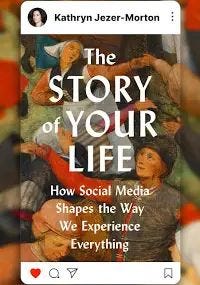
In her book, The Story of Your Life: How Social Media Shapes the Way We Experience Everything, author Kathryn Jezer Morton helps to connect studied, examined, universal human tendencies to the specific societal and culturally rooted realities of social media (and it’s use).
A key point of her argument functions on two levels, beginning with assessing the ways in which social media, for all of its particularness as a modern construction, can only truly be understood by examing its relationship to those larger, common human traits. Second, and likewise, a fruitful discussion of social media needs to move beyond reactionary trends that limiit themselves to our social media usage, and into a broader more reflective discussion of the predominant role narrative or story plays in all societies across human history. Deleting facebook accounts or intentional efforts to go off social media, however much this can bring about certain wanted outcomes in our lives, do not ultimatley change the shape of the world we are presently living in. Nor does it bring us to a greater understanding of that world. Whether we recognize it or not, the language and function of “social media” permeates nearly every facet of our modern society. It is integrated into our news sources, our communication, our jobs, our podcasts, the arts, politics, and even basic government and civic related duties and tasks. Meaning, its much larger than simply our facebook or instagram accounts.
To understand what this is, then, requires examining how it plays into one of the most crucial and necessary aspects of that human tendency mentioend above: the role of story in shaping the way we live in and make sense of and understand this world, and indeed our place in it. Not simply on an individual level, but on master/meta-narrative levels.
Such a discussion can then be a window into the particular cultural forces shaping our lives through this thing called social media. On this front, in the quote above Morton touches on something I have long felt and vocalized. Social media and its use adheres to a master narrative that stems from modern assumptions regarding how history must work in order to justify the shape this world and our lives take today. In this worldview, social media is simply the natural and necessary outflow of the world’s progress, a myth (using that word in its proper sense of those stories, or master narratives, that reveal what is true about this world and our place in it) that seeks its own justification in each subsequent generations rejection of the past. Here change isn’t just a constant, its the measure of a world’s progress. Adapt or die, as its often said. This is simply the way of things, and this is not only how humans survive, it is how we bring this world and our lives under our control. This is, to borrow from Morton, the language of the modern redemptive narrative, with the thing we are redeemed from being our enslavement to a lesser and inferior past.
How often does this basic assumption about change get brought up in chats and threads using all manners of precondiitioned rhetoric? I know I encounter it all the time. More importantly, how often does this basic assumption about what change is act as the driving force of our endless ideologies here in the West?
I’ve spent a lot of time immersed in the study of this basic idea, that the world I was born into, the reality I was handed, the culure I have been shaped by, hinges on this basic understanding about how history must work (and indeed does work). Or of how history must work in order to uphold our redemption narratives. We are who we are and we are where we are because of our accomplishments. Life is about this continued investment into who we are becoming through our efforts at (fill in the blank with a never ending list of self or societal frameworks designed to turn us into better versions of ourselves or hand us better versions of our world, all of which flow from our modern addiction to self improvement practices and into our myriad of cultural creations, from growing podcasts and youtube platforms, online business creations, to much broader realities such as scientific, technological, or space related inovations).
To be clear, neither Morton, nor myself in this space, are suggesting that these things are inherently bad. Rather, the problem is, in this narrative the concept of change is given an inherent virtue. Change means we are getting better. Change means we are better than who we were. And of course we have endless ways of measuring this in order to assure ourselves that we are in fact counted among that number. And the way the world functions, in its market laden structure, simply seems to affirm our suspicions: businesses that fail to adapt and change in this modern age die, therefore this must be the way our lives work as well.
What we aren’t good at is attending for what gets sacrificed in this incessent clamouring for forward movement (which is really a sacrificing of the whole of history), not to mention the ways in which it tells a very specific story of our lives that needs to be sctrutinized. This is in fact why the emergence of the modern world saw itself as the end of history. To see ourselves as part of history means we become the very thing we are seeking to scapegoat, holding ourselves above it.
We also aren’t good at asking the why questions, questions that concern where this forward movement is actually going or taking us precisely. We aren’t good at distinguishing between what a life is and how a redemption narrative fits into that equation. This is at least in part, I think, because our entire sense of the world and reality, and indeed our identity, has become wrapped up in upholding this myth of progress. Sure, we can speak of the failures of society (for example, the current climate crisis), but only in so far as we are able to categorize such failures in terms of “them” rather than “us.”
So again, change might be constant, but the problem emerges the minute it is assumed to be a self justifying virtue, an inherent truism regarding what a “good” or (successful or meaningful or accomplished or celebrated) life or world is. In fact, one of the things this book helps to underscore is how such a story of our lives engages in a critical error of judgment when it fails to recognize how this narrative of redemption actually defines us (or the past) according to the things that we are not. This is at the heart of what it means to assume that change is inherently good. It is anchored in that perpetual state of rejecting the past.
Once we step out of this broader perspective and these broader concerns, part of what Morton then begins to flesh out is a simple probing of the assumption that progress leads to a better world or better lives. That what comes from change is always good, or even desired or needed on a human level. That it brings greater experiences of satisfaction and happiness. All words of course that demand definition. What’s fascinating to me in the immediate though is that Morton challenges these assumptions by looking at the very human functions that social media exploits. If we are to take this seriously, we must then confront these narratives as a product of something else entirely: these underlying human tendencies. A robust examination of social media can reveal the ways in which such assumptions, which existed long before social media became a thing, actually act in accordance with what human experience appears to need, want, and desire.
If this is the case, why does this narrative have the power that it does? One answer could be that it taps into contrary parts of this same nature. Another answer, which likely can be taken together with the former suggestion, can be found in establishing visible patterns within the fabric of history itself. For example, we crave the sharing of our lives, and have always sought to shape our lives into stories that create a shared language. Here we can find the basic markers of this social exercise embedded in the interplay between persons within what we call communities. This means, long before social media was a thing we were, in different ways, analyzing these relationships in order to understand how to belong. We instinctively respond to these observations by way of projecting curated narratives while similtaneously absorbing others, always seeking measures that tell us whether we belong and are thus okay or not.
One can see how all of this fits with the modern social media framework. What makes this unique is simply the ways in which this modern technology has widened the sphere of belonging, increased the scope of the practice, and the way it has streamlined the risks and the costs of our participation in this world. We can see this in the growing body of research which suggests the line we tend to think still exists between our flesh and blood lives and our online lives no longer exists.
Further yet, we also see this in the way social media, a product of this new technological age, mimics a society in which the rate of change far surpasses any other period in our history. It’s no wonder change has taken on the mythic proportions that it is, as human function no longer has the ability to reflect on what these changes are. Similarly, social media, having far surpassed its origins as primarily a work of creatively profiling the story our lives, has taken on a life of its own, now becoming its own mirror.
Morton continues on in her assessment, defining our lives within social media as a constant act of management. We manage our brands (brands are either our own lives or the thing we have built our lives around). We manage perceptions. We manage reputation. And as we manage, we are selling the product that is our life. What’s fascinating to me about this idea is, as I fleshed out from Morton’s ideas above, all of these things, when we peer behind the curtain of social media, are inherently human traits. It’s simply the unique expression of our particular moment. In a sense we have always engaged these things. It’s how we have always come to belong somewhere (or to be excluded). But one of the unique things the modern narrative of redemption has handed us is this underlying belief in the redeemed “self,” a concept that both assumes the existence of the self made will, formulating that into the undercurrent of the larger enterprise of modernism itself, and has established necessary change or progress as the measure of it’s worth and the aim of its existence.
In case this sounds too lofty or too theorized, these thoughts have a very practical expression within the examined life. Curiously, we have become masters at comparmentalizing the different parts of our lives into seperate spaces. Our private life at home, and our social life online. Our retreat into nature and our occupational lives in the city. Our spiritual lives and our lived lives. Our professions and our leisure. In truth, these things not only can’t be compartmentalized in this way, they, in reality, are not. Such dualism, for as popular as it is, only serves to hold us at a distance from the story these lives and this world are telling. It’s little more than a convenient means of laying the blame of our frustrations and the merit of our accomplishments at the feet of whatever we chose to align ourselves with in a given moment.
One of the most common type of online personalities according to Morton is the observer, or passive surveillance. The one who doesn’t post but views. Here’s the thing though. Even this practice is an act of managment and selling. Such people are every bit as visible as the ones in the thick of the incessant shouting matches. And everything becomes a product of the judgement these actions make about us and about this world. Whether you’ve deleted your social media accounts or not, whether you post or not, in a social media age every single act is observed, and every observation weaves a story of this world and its lives in a particular way. And more to the point, it’s all still being written according to this master redemptive narrative. It simply becomes a question of where the circles get drawn.
So what does one do with all this? As with anything, recognizing the reality of things is the place to start. And it could be appropriate to adopt the posture of the cynic, something I have adhered to for a while. A cynic is simply one, if we are to see it through the lens of its long storied tradition, who rejects all social constructs as authoritative. However, what defines the cycnic is nevertheless one who also understands that they are products of this world at the same time. It is not simply that we see the absurdity of the enterprise, it’s that we know life exists within its own absurdities. This is not a contradiction for the cynic, rather it pushes us to constantly assess what is sacred and what is not. And equally, it remains aware of those inate human tendencies that persist underneath our constructs.
This is all well and good of course, until those inate human tendencies begin to grapple with things like lonliness, depression and anxiety, which social media has turned into an epidemic. We know that we are being observed and judged by the world every step of the way, and this is not something we can escape. It has tangible outcomes in the scope of our lives, bleeding through those now non-existent lines between our online and our private lives. We would do well then to also face these things head on, even as we keep a cynical eye on the absurdities that give these real and valid and very human experiences life.
Lastly, we can reclaim the idea of a master or meta-narrative, something the modern world has largely taught us to reject and/or ignore/demonize. We can do things that help deal with the epidemics, for example, but the real concern will always remain the story. Apart from that we cannot rationally and objectively attend for the problem. The greatest obstacle to this end? The fact that reclaiming a mastd\er or meta-narrative is the single greatest thing that challenges our illusions of control. Worse yet, it challenges the very story that tells us we are better than (fill the blank) for as long as we are changing. And that reaches into something long embedded in our human experience as well as a trigger. There’s a two-fold reality at play there though. We know we crave this control, but we also know the toll this takes on us at the same time. We know it’s not what we actually desire, and in our most vulnerable moments we tend to be willing to finally question the narrative. But the world still turns, and questioning the narrative in a world designed to avoid such questions (after all, the new world finally arrived at the answer to what plagued the old one and thus surpassed it and its superstitions, as the story goes) often only serves to perpetuate the very issues social media creates.
But we are still human after all, and that humanity also seems to be the greatest antitode. Thats the real beauty of the conversation Morton is having regarding one of the most recognizable facets of our own modern cultural landscape.

