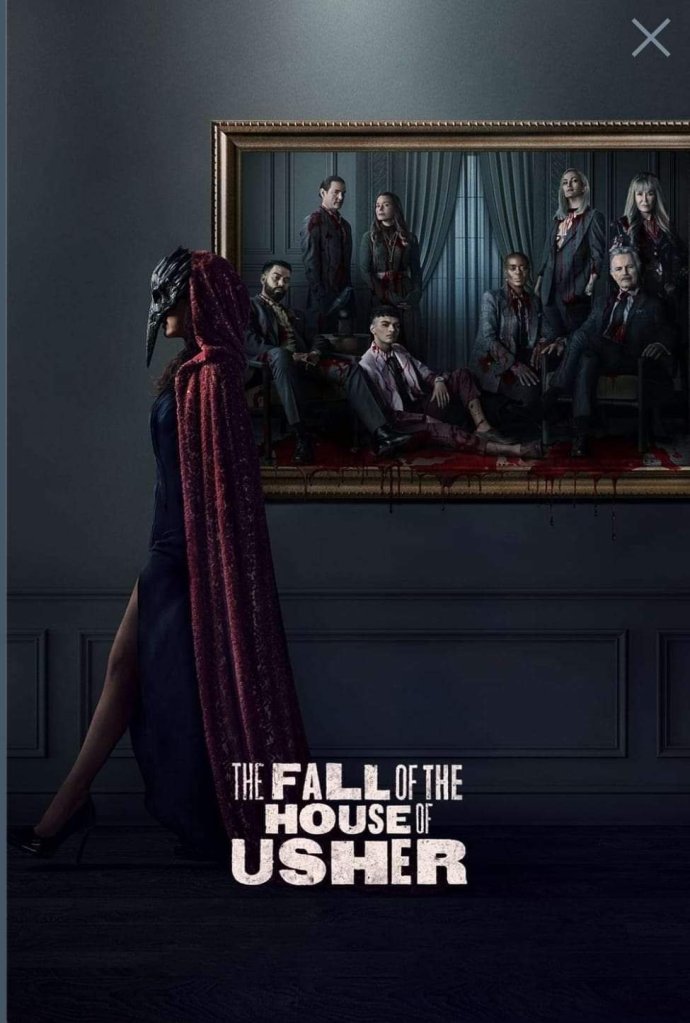
Film Journal 2023: The Fall of the House of Usher Directed by Mike Flanagan
Flanqan’s stark and rapid fall from favor in my eyes might be the far more interesting story than this take on an Edgar Allen Poe adaptation. My love for Dr. Sleep met with my general disinterest in the rather tepid and benign haunting of hillhouse and my outright disdain for Midnight Mass, a show I found to be in bad faith and more than a bit deceptive.
The Fall of the House of Usher leans more towards the generally benign in terms of motivation, but also reaches for bland and uninspired. At the very least hill house had some visual intrigue. In Usher, not only is the storyline broadcast from the beginning, a massive cast keeps it steadily bound to its pefucantory and drawn out dialogue. For a cast this big, there are very few to no interesting characters to actually fill out the space and carry the load of that static story. Just to reiterate, this is about the house of Usher and its inevitable fall. And once we know who the house of Usher is, something that is made clear from episode one, every possible allegory and metaphor, which for Flanigan unsurprisingly comes from the relgious imagery, becomes obvious and clear.
It also doesn’t help that this is 8 episodes. Maybe this would have worked as a three parter? Even then, the blandness of the story would likely hamper this. But the experience of being dragged through 5 episodes of drawn out filler might have felt like less of an affront.
I hate to say it, but I’m almost out on this guy. Which saddens me, because I thought Doctor Sleep was flat out inspired.
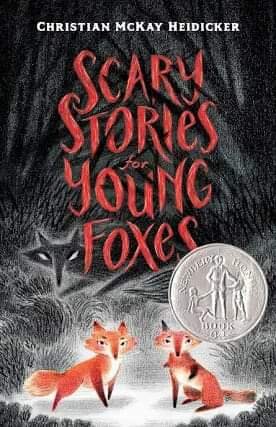
Reading Journal 2023: Scary Stories For Young Foxes Author: Christian McKay Heidicker
I loved the premise- a group of young foxes (kits) want to hear a scary story. They are cautioned by their mother about someone called the “storyteller”. The storyteller tells the scariest stories of all. Which of course makes the young kits all the more curious. So they visit the storyteller, who proceeds to tell them a story.
I also really like the set up- the kits want to be scared. The storyteller offers them this- “All scary stories have two sides,” the storyteller said. “Like the bright and dark of the moon. If you’re brave enough to stay to the end, the stories can shine a light ion the good in the world. They can guide your muzzles. They can help you survive.”
Which becomes an invitation to hear what the story is about. One of the best parts about the scary stories is the way the book roots the fear in the world these foxes know. Facing the fears that haunt the night are also a way for them to understand themselves. The book is wonderfully grounded in this way, exploring the tension that exists between the dueling sides of the natural world.
If I had one small critique it would be that the ending does try to sum things up into a singular moral lesson that I found to be slightly unsatisfying. The story brings together all the working threads in a nice, poetic fashion, but it sort of gets reduced to a platitude which I don’t think works as a way to address our fears. That’s a very small critique though of a book that is otherwise really strong with memorable characters, an engaging adventure, and a good dose of heart.
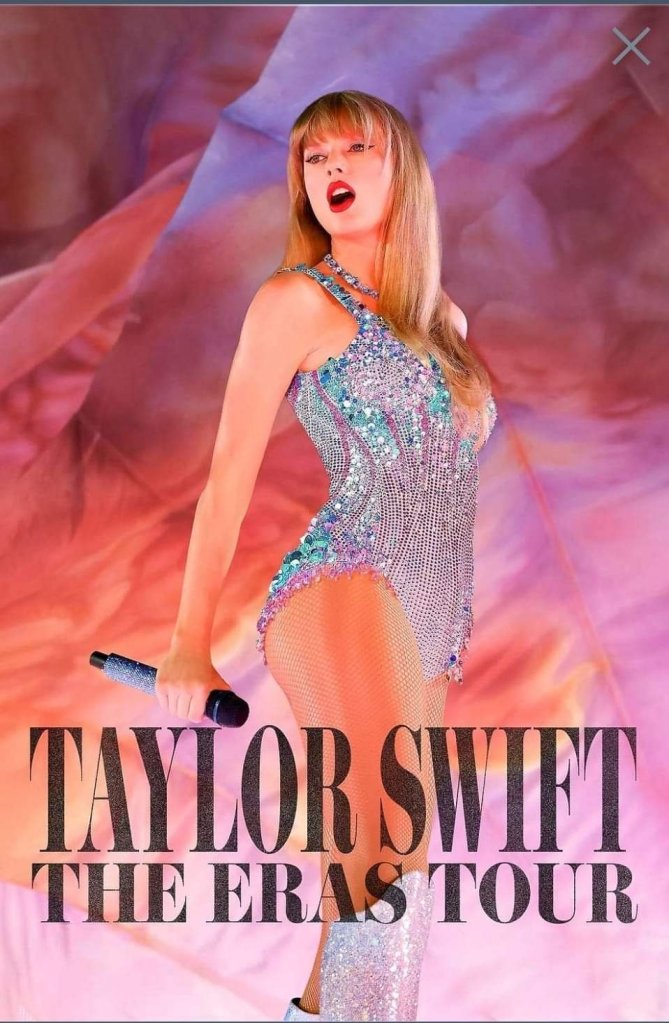
Film Journal 2023: Taylor Swift: The Eras Tour Directed by Sam Wrench
If you are not a fan of Taylor and swifties drive you nuts, probably not something you want to invest in. For fans without the means and opportunity to see this tour live, this is a great way to experience it.
I’d say from the comfort of your seats, but a decent portion of my sold out screening filled the floor between the seats and the screen. The energy and excitement was undeniable.
I’m not sure if this is a sttength or a weakness of this on screen format. It’s a long haul, to be sure, and it runs the full sweep of Taylor Swifts albums. More importantly, the eras span different iterations of Swifts music. Given the diversity of my crowd when it came to age,.lengthy stretches of folklore and evermore don’t exactly inspire the same fervor for tween enthusiasts as Red and 1989. For some of us older ones, they were the highlights. The show is not structured chronologically, so that allowed her to arrange the eras in a way that interpersersed the crowd pleasers, but even then the younger ones in my showing were certainly stretched to their limits. That last hour stretch was an exercise in stamina for me.
As I often say though, it would seem strange to say that too much concert is ever a bad thing. Too much of a bad concert is a bad thing, and the Eras tour is nothing less than a spectacle. The stage production was truly awe inspiring. The number of costume changes maybe even more so. I think it’s also great that my theater showing did a preamble that helped set the stage for how to experience the show. Without that I feel like there could have been some uncertainty and frustration, and the theater gave full permission to sing along, to occupy the floor space and have our phones out. Or as they summarized it- have some fun. And this was definitely a big part of what makes this on screen experience work.
Reading Journal 2023: Fear Not: A Christian Appreciation of Horror Movies Author: Josh Larsen
I hold a deep appreciation for Larsen’s work as a Chicago film critic. He’s known as one of the hosts and critics at filmspotting, and also for his work at Think Christian. And I appreciate him on two levels.
First, his approach to film criticism blends his wealth of knowledge of the craft and his keen eye for the form with equal attention given to his personal experience. His reviews are never mere data points about the craft, they always anchor his opinions in an in depth analysis of why the film did or did not work for him personally on an experiential level. To this end he never shuts out other opinions, but rather invites them in to the conversation as equally valid viewpoints. And if that conversation is able to lead to a discussion about the objective nature of the craft and form, all the better.
Second, I really like how he approaches film as a Christian, building the mantra of Think Christian around the idea that there “is no such thing as secular”. His book Movies Are Prayers, released a number of years ago, was an intimate look at what informs his love of movies and film criticism, walking through how he bridges this intersection of faith and culture as a formative practice. He never demands a film to be anything, rather he engages all art from within his particular worldview.
His latest release, a book he wrote to tackle what might be one of the more precarious genres to engage within christendom, at least traditionally, takes a different approach than Prayers. Prayers seemed to be targeted at fellow film lovers, and more specifically fellow film lovers who are also people of faith, simply as a way to use his own approach to enrich our appreciation of film as a formative experience. Its very much designed to function as a liturgy. In Fear Not he appears to be reaching more for a kind of apologetic, simply one being targeted at Christians who might see the horror genre as being off limits for a christian film goer. And as he states in one of his earlier chapters, he is not so much encouraging christians to embrace horror as offering a window into why some Christians appreciate horror as a genre, encouraging each person to employ discernment in their own life while also calling them to consider not lobbying their own sensitivities on to others. He wants to make clear why the horror genre holds value for him, and how it plays a significant role in his appreciation of the form as a Christian.
Which brings me a slight critique of the books structure. While this appears to be his aim, the vast majority of the book, which is structured around different kinds of horror films (zombies, creature features, ghost stories, religious horror, psychological horror for example), is given to analyzing different films from a theological perspective, just to show how it is one can approach them as being something of value for both our faith and our understanding of personhood and the world. I feel like the missed opportunity here would be a chance to spend the earlier portions of the book building his case at the beginning, as it seems to me like his target audience will be unlikely to embrace his argument for horror given that they already hold a disposition that prevents them from watching the films he is discussing. Further, those with an aversion to horror on christian principle who do push through are likely to miss much of that application without the benefit of seeing those films. Had it layed out the case in the earlier chapters, and then used a series of analysis in the back half as an invitation to watch and see the films while putting some of the tools of film criticism and experience to practice, I think that could have been more effective.
That said, the work is there interspersed with the different kinds of horror films he is talking about. He touches on important considerations, such as an understanding of the horror genre helping to make us better readers of the horror genre present in scripture. Or helping understand the relationship between faith and fear, with the call to fear not being the foundation for the book. Or the ways horror can broaden our understanding of reality, or connect us more deeply to the reality of our physical bodies and minds. As he writes on body horror,
“Christ did not assume our flesh once, only to abandon it after his death. Rather, through his bodily resurrection he both affirms the goodness of the original creation, including our bodies, and points to a future in which we enjoy the goodness of embodied life as God intended it.”20 Conversely, a biblical view holds that the breakdown of the body—via illness, desecration, death—goes against God’s design. Decay and death are both the first enemy, in Genesis 3, and the last, as described in 1 Corinthians 15:26. And so our fear of mortality—of “this mortal coil,” as Hamlet would describe it—is both a physical and a spiritual one.”
Or his reapplication of Philippians 8 is particularly insightful “(Paul’s) citation of the qualities in Philippians 4:8—“whatever is true, whatever is noble, whatever is right, whatever is pure, whatever is lovely, whatever is admirable”—is not meant to chastise his audience because they had been pursuing other, “unholy” things, but to encourage them to overcome the fear they held by seeking such qualities. Horror films encompass both the fear and the admiration. Not only do these movies honestly acknowledge that which terrifies us, but the most redemptive of them—the ones explored in this book—do so with an artistry that is true, noble, and admirable. Some of them even take us to the other side of our fears, to a lovely place of grace.”
As he suggests, “One of the reasons the Bible remains a vital document, thousands of years on, is because it encompasses the entirety of our human experience, both the lovely moments and the ghastly ones. The world, after all, is a frightening place, in ways big and small, existential and intimate.”
And if this is the case, then, as he reflects, “If method is as much a part of the art form as meaning, then few genres are as fertile a playground for playing with film form as horror.” This should open up the horror genre as a place in which to find God, find ourselves, and indeed find one another. Which is a wonderful sentiment to hold on to for anyone perhaps wondering about its worth.
I will also add this. There are definite points of departure between Larsen and myself when it cones to him speaking from a Reformed perspecrive. Perhaps the most noted point of delarpture is where he begins with the concept of total depravity as his fundamental starting point (Monster Movies: Fear of Our Own Capacity For Sin). This frames the rest of the books theological joruney as one bent on individual redemption anchored in a larger promise for bringing us in to the new creation. For me, i find theological reonsnance in looking at a world enslaved to Sin and Death first, and allowing that to define the central problem that we face and fear.
That said, i don’t think theological differences should be a thing that prevents us from coexisting in fellowship, here as reader and author, and to be sure, I feel like Larsen brings an even headed and open minded approach to the table as a Reformed Christian. And certainly, as a fellow Christian I very much respect and have learned from his love and analysis of film, and I think he can bring some valuable observations to the table regarding the intersection of faith and fear. As a horror lover, I might not be the target audience for this book, but as a horror lover i gained a lot from the film analysis, and even came away with some touchpoints i can use with others who might find a love of horror to be irreconcilable with being a person of faith.
This is an interesting article on Japanese philosophy
A few years back I did a new years resolution thing and travelled my way around the world through book and film. For each country I would watch a bunch of their films and read a mix of fiction and non-fiction (history, philosophy, culture, religion). There were some common througlines, especially relating to colonization, and I tried to emphasize in my studies and experiences the development of their local film industries. Common to each country was of course their relationship to the american film industry, given how it became a primary tool of modern colonization.
I found Japan to be a bit unique and hard to narrow down in that regard. This article touches on some of those quirks and particularities regarding Japanese philosophy, especially as it relates to cultural influence. In some sense, on the surface it appears that Japan just became western by way of political powers and influences. This of course becomes most obvious in the way that japanese culture and philosophy becomes westernized. And yet in some very real ways its identity remained shaped by its relationship to the East. You can see this in the development of its film industry. There are many aspects of its culture and philosophy that simply do not cater to the west and actually act as guards against western infiltration.
Much of this article gives voice to how that gives shape to a discussion about japanese philosophy and culture, wondering about whether its resistance to the trappings of western philosophy is not the absence of a japanese philosophy but the very basis for describing and defining its philosophy.
As I remember it said in one book, japanese filmmakers seemed perfectly okay with Americans retaining superficial and westernized readings of their philosophy, as they had learned how to use the infiltration of american film and culture to set themselves apart from the larger East.
In any case, brings back memories of those travels.
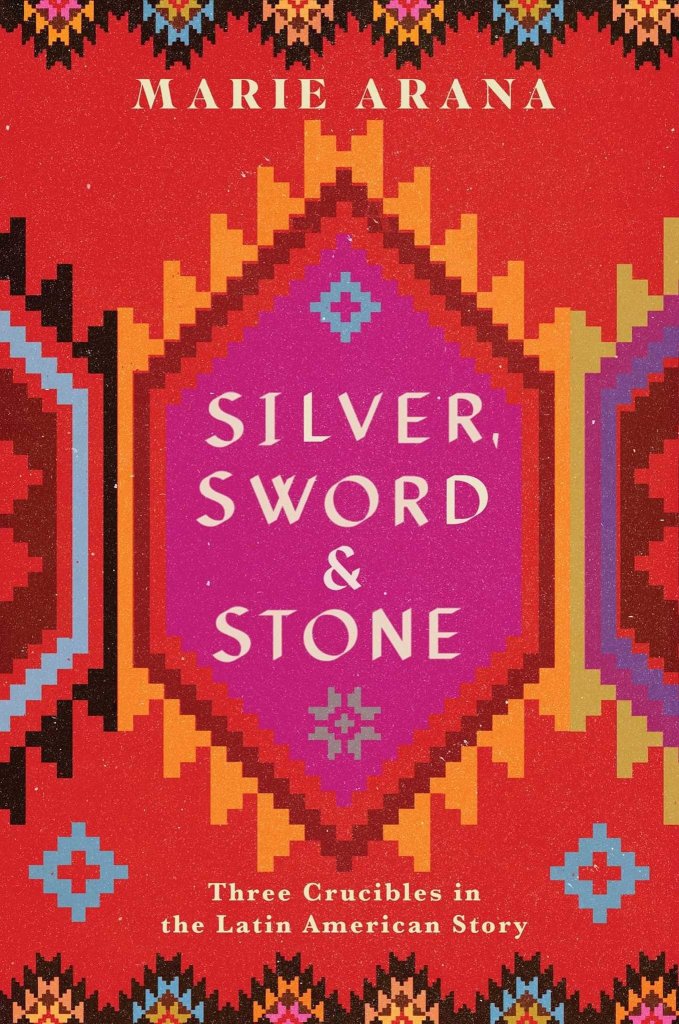
Reading Journal 2023: Silver, Sword and Stone: Three Crucibles in the Latin American Story Author: Marie Arana
When one hears the term “America”, generally speaking there is a singular conception that comes to mind, one that centralizes the story of America geographically. This basic truism lies at the heart of Marie Arana’s harrowing history of “Latin America”, cutting through the clutter of our marginalized terminology- north, south, central- in an effort to locate a cohesive and binding narrative for “Latin” America. What emerges from this is a harrowing anid often brutal mix of history mixed with modern journalism.
She settles on three defining ideas- sliver, sword, and stone. Silver equals money, Sword equals violence, and Stone equals religion. With each of these things there is an evolution. For example, mining turns to farming turns to drugs. Or the sword transforms from colonization and conquest to dictatorship and gangs. Religious interests go from the Sun God to Catholicism to Evangelicalism/Pentecostalism. Threading through each of these things is the undercurrent of war, international politics and power.
Here its worth mentioning a small critique of the book’s structure and focus. It is sweeping, both in the amount of geogprahy it wants to bring into a singular narrative, and in the amount of time it wants to cover. Given that Arana is not interested in giving us a straight up history of the lands and people- she aims for an interpretive story and includes the voices of 3 present day Latin Americans who can give this interpretation a practical grounding and shape- Silver, Sword and Stone is meant to immerse us in the particulars of a segment of the world lost in the shadows of its marginalized appeal to the “Americas’, rather than offering a didactic, linear information dump. This does get a bit much at points, jumping in time and from place to place, often at risk of repeating some of those universal traits. But it is also clearly designed to be an entertaining read all the same, showing how the three pronged descriptive is an integrative process of struggle. It remains true though that it could have told the same story from the perspective of a more narrowed time frame and narrowed geographical focus.
Lest it be thought this is all dark- and most of this is, to be sure- I wouldn’t say its completely without hope and inspiration. I don’t know that I ever felt like this historical treatment was detached from a love of the people and the place, and for as much as it seems like each of these three entities are defined by each other- the religion being inherently political, the politics being inherently religious, the money being the source of these two powers, both on the inside and for the destructive forces coming in from the outside- each of these three aspects retain their own individual beauty. This would be true for the earliest evidences of silver being seen less as a commodity and more as a representation of their worship. This would even be true of some of the spirited revival that one can see in the growing evangelical presence melding with local religious customs, however muddled that is by an ingrained sense of craving prosperity. Stories of more holistic democracies and even healthy societies within dictatorship linger in the backrop of the complicated realities of the people and the land.
But this sentiment nevertheless rings loud and true; “Then and now, there is a sameness at work, a dogged consistency, a stubborn mind-set in occupier an occupied alike.” (pg 128)
If Arana is right, and there exists a very real obstaacle to Latin America history in the notion that “chroniclers of old have accustomed us to see history from the eye of the invader, from the perspective of the conquest” (pg 362), then “we imagine Latin America… with a conquistador at its start. A Hispanic tale. The rest scatters into the haze, into the wings of history, into oblivion.” Sadly, this is what the “other America” has been reduced to in the collective consciousness. Arana wants to help readers to understan the “ands” that formulate the cultural landscape that the conquests conquered. The other side of the coin. “Until we understand the “ands” of history- the ghosts in the machinery, the victims of our collective amnesia- we cannot hope to understand the region as it is now. Nor will we ever understand the chracter of its people.”
I came across this through an interview with Rick Steves. His interest was in exploring the intricacies of travel to the area and how we can find some more meaningful ways to engage the story of a foreign land and people to “americans”. Part of that of course turns the lens back on the traveler, no matter where one is coming from. This book is also meant to provide a liberating word to Latin Americans, or the Americans of the South. The book insists it is equally true that understaning the role of these three crucibles in telling the story of their people and their culture is necessary for understanding who they are.
Reading Journal 2023: The Night House Author: Jo Nesbo
From the famed voice of the Harry Hole series comes a decidely different kind of story, one that at least protends to delve into straight up horror, albiet with his typical allegiance to crime and mystery/thriller.
The book is written in three parts, each part bringing its own twist to the story. Part 1 is where we get the straight up horror vibes. Given where part 2 and 3 take the story, I do think mileage will vary. In truth, I didn’t expect the story to go where it does, and it does aim for something far more ambitious than the title and synoposis might suggest.
But much of that ambition is tied to thematic concern, and I am someone who is big on theme. If a story wants to give its horor a grand metaphor or an allegorical force, I’m typically all in. And to be clear, what Nesbo does with the story isn’t overly complicated. It could, in fact, be that straightforward simplicity that turns people off. It could be interpreted as something of a betrayal. For me though, I felt like affording the story the freedom to go where it wants to go is precisely what my expectation should be. It would be a different thing if I didn’t care about the characters or the themes or the tension. Given the fact that I did, goiing in a direction I did not expect was part of the enjoyment. I would even go so far as to say it was a genuine page turner. There was another degree of investment for me too once I reached part 2, because once I understood what Nesbo was willing to do with the story, I was all in on trying to guess where he might go next. The mark of a good storyteller.
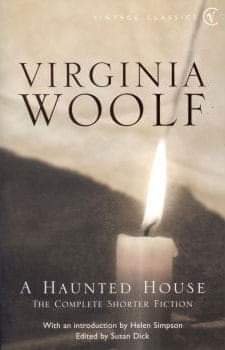
Reading Journal 2023: A Haunted House And Other Stories Author: Virginia Woolf
It certainly can get a bit frustrating, especially when you get a few stories in to this collection, for Virginia Woolf’s prose to be as ambiguous and hard to narrow down as it is. There are moments where I wanted, or perhaps needed, some points of clarity, something concrete to attach myself to, be it a clearly formed character, thematic resonance or narrative interest. These moments are far and few between.
This certiainly leaves plenty of room for poetic resonance and lyrical presence. And as I have learnt through some time spent with the life of the author, her interest in bucking tradition and convention while playing with familiar genres and forms is very real.
Lets look at the most famed short, a take on the haunted house story that finds its way into the traditional horror of the piece by using it to create an uncertain space. “Whatever hour you woke there was a door shutting. From room to room, they went, hand in hand, lifting here, opening there, making sure- a ghostly couple.”
Is this a ghost? Is the ghost the thing to be afraid of? The opening of doors? What we discover is that the ones awake hearing these doors opening and shutting are in their bed “reading”.
They go on to say, “But it wasn’t that you woke us.” Rather, its that “they’re looking for it”. And “now they’ve found it.”
They put down their book to “rise and see for oneself”. Curiosity? Uncertainty? “What did I come in here for. What did I want to find?” is the question that rings forth from the empty hallways.
What they found is contrasted with the invisbility, figures cloaked by the window panes and shadows. An open door. “My hands were empty”. The pulse of the house beat soflty with the words “safe, safe, safe”. Is this a question? A reassuring statement? A proclomation? A discovery?
And yet the buried treasure, the discovery awaits in the moment that the lights suddenly fade. “But the trees spun darkness for a wandering beam of sun.” coming through the window. “Death was the glass; death was between us.”
Now we gain a single point of clarity- one of the ghostly couple is called a woman, and she died hundreds of years ago. There is also a him, Woolf bringing into the portrait a point of context- he left her, they left the house in darkness. And return to it in the cloak of this darkness.
“The candle burns stiff and still” in the darkness. Is it a dead flame burning still with the silence of their continued “wandering through the house, opening windows, whispering not to wake us”? We now know what they were searching for. “Their joy”. Did they find it? Will they find it? What is its source? Woolf has them finding their memories as she returns to the waking.
“Our eyes darken; we hear no steps beside us; we see no lady spread her ghostly cloak” as the ghostly couple finds them “sound asleep, love upon their lips”. The “faces that search the sleepers and seek their hidden joy” lift “the lids upon” the eyes of the sleepers, reuttering the words “safe, safe, safe” with the pulse of the house.
The sleeping couple awake with a cry, “is this your buried treasure? The light in the heart.”
Was it a dream. Was it reality? Were they ever awake? What is this joy? Where is the haunting? All of this is left lingering in the waking. And yet Woolf has similtaneously created an atmospheric setting using language to both obscure and reveal, tapping into the untold fears and joys that frame the tension of the story. All using the genre of the haunted house story as a means of playing with the basic conventions.
Or consider The Mark on the Wall, where a singular individual finds themselves fascinated by this seemingly mundane mark on the wall they had not noticed before. “How readily our thoughts swarm upon a new object”, it reads, “lifting it a little way, as ants carry a blade of straw so feverishly, and then leave it.” This basic conception is used to explore some basic ruminations of existential crisis, particuarly where it relates to our relationship to nature, or the physical reality we occupy. “Here is nature” the indiviual surmises, “once more at her old game of self-preservation.” This pushes back against our tendency to rely on learnedness and intellectualism and knowledge. “I understand Nature’s game” they say, and it leaves the living wanting.
And yet, in these moments of uncertainty we, meaning humanity, tend to attach ourselves to the tangible, to the lived, breathed, felt realities that shape that which we can percieve. We “worship the chest of drawers, worship solidity, worship reality, worship the impersonal world which is a proof of some existence other than ours.” The mark on the wall becomes our fascination. And yet this sits in tension with the greater realities of this world, such as the war that informs this characters context, forcing us time and time again to seek after that which is not concrete, the mystery. As she asks in the final story of the collection, A Summing Up, “which view is the right one?”
These same patterns and intentions and sensibilies run straight through all of her stories, interconnecting threads and characters as she goes. All of them find their own genres and conventions to play with, using it to broach the ambiguity of the basic questions and concerns she chased after over her life and career. One in which “the most extraordinary doubts possessed (her)” (Solid Objects). And yet she refuses to “give it up”. Her stories are equally defined by when “they go” and when they “find” (The New Dress). Part of the beauty of the Unwritten Novel, where she writes “wherever I go, mysterious figures, I see you…”
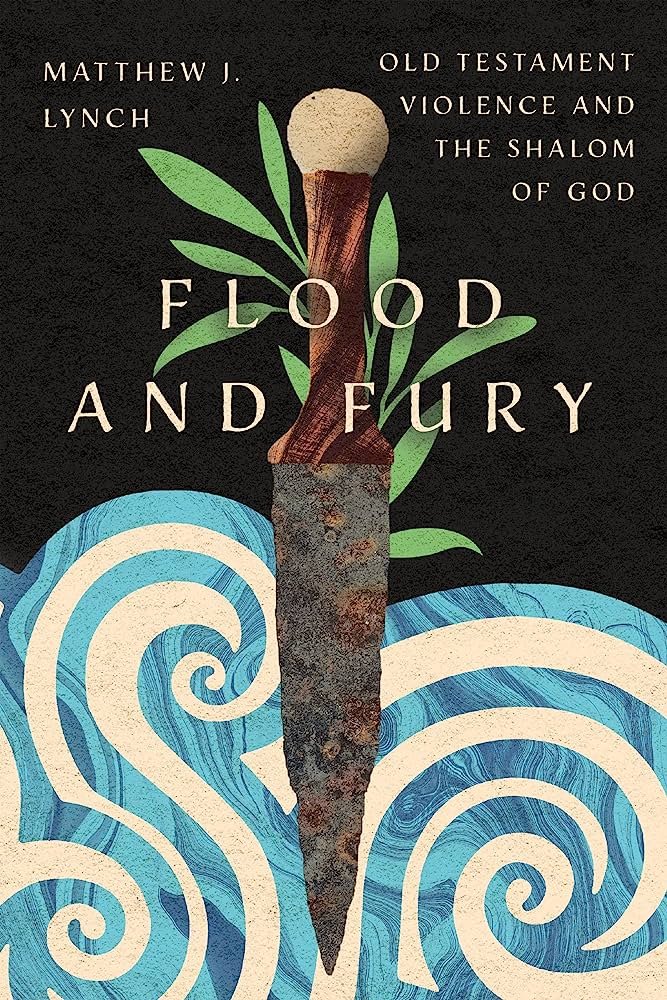
Book Journal 2023: Flood and Fury: Old Testament Violence and The Shalom of God Author: Matthew Lynch
The tagline on the back cover poses the question “what do we do with a God who enacts and condones violence”. Narrowing in on two of the most essential narratives in the Bible associated with violence- the flood story and the Canannite conquest- he works to transform that question into one more in tune with how scripture itself functions as both a sacred and literary work. If the above question is relevant to many of us today attempting to engage this work as a cross cultural movement into an unfamiliar language and worldview, learning the questions the authors and readers of scripture were asking in their world can be helpful in navigating the “challenge of violence in scripture”.
There is a good deal in Lynch’s analysis of these two central narratives that was familiar to me in terms of approach and information, albeit being one of the most concise and accessible treatments of these approaches and ideas that I have come across in a good while. And then there were some wonderful surprises. Some truly paradigm shifting surprises that left me wishing I could put this in the hands of as many people as possible. This was especially true when it came to the conquest narratives. I’ve spent a whole lot less time there than I have with the flood narrative, so that’s where I was most fully engaged.
A quick and cursory summation: central to his claims about these texts is the basic concession that part of the challenge of engaging the text is the existence of contrasting views inherent within the text operating in dialogue. This is of course the result of differing points of perspective being contained and retained and preserved with intention on the part of the Biblical editors. One of the central concerns that emerges from this process is, if God indeed spoke into and acted within history, how does this shape, and indeed reshape their understanding of their present circumstance when it comes to knowing who God is by the way God acts in and for the world.
This becomes especially complex once we begin to contrast shifting points in Israel’s own formation, locating within their story majority-minority points of view. This becomes a stepping point for navigating an important facet of scripture for us reading from our own vantage point as foreigners “into” the culture and language of their day; the role of internal critique. This becomes hugely important for engaging scripture from the outside looking in, as so often the tendency is to assume our role as judge and jury of the other, and such an act of othering, of which assumptions of our being “more” evolved and civilized and them more archaic belongs, is the best way for us to ensure that we miss and misappropriate what the text is doing in its world. A crucial point of perspective is to remember the movement present in the biblical narrative- enslavement, liberation, exile- and to understand that someone looking at this story from the point of exile is to going to be asking particular questions that a liberated or enslaved peope are not. When it comes to being good readers of scripture, and when it comes to learning how to allow these stories to shape us from our present vantage point this side of Jesus’ resurrection, we have to allow these different realities to exist in conversation.
One example when it comes to being good readers of Joshua. Noting how it speaks from the perspective of having arrived in the land and having been unsettled from the land, and how this perspective writes, using an intentional literary design, the “conquest” story in the light of the Exodus narrative, can help bind us to the bigger picture of a people contending with both promise and failure. This only becomes more apparent when connecting the conquest with the flood narrative, illuminating how it was that the ancient readers and authors saw a world to be in contention with the enslaving “spiritual powers”. This plays the connection between Joshua and the Exodus in direct relationship to the true conflict. It also gives us a way of teasing out how it is that we make sense of seeming points of contention when it comes to violent acts commanded by and attributed to the hand of God and a voice that witnesses to the character of God pointing to a different and opposing way of acting in and for the world, including the Canannites. If God did indeed speak into and act within the world in a revelatory fashion (as their convictions held to be), the question that follows, in line with the flood story (itself connecting us back to Geneis 1-5), is how does this character shape the way we live together in our present context. This is what we find in careful readings of the ever changing rules that follow an established people being prepared to take residence in the land within a world filled with violence. As readers of scripture it might feel puzzling at first glance to imagine a seemingly violent text being opposed to such violence, and yet as careful readers such a vision can come alive in transformative ways when we become attune to the larger narrative at play. Not least of which is reckoning the “”liturgical” presence of Joshua, a liturgy bent not on the story of displacing a people but in displacing the idols that hold the world in the grip of violence. Joshua on this front becomes a story of the completed Exodus, one that leads straight into the reality of exile on the basis of these same idols shadowing the greater vision of a liberated creation. Which of course leads to a new Joshua (Jesus), which careful readers can note is told through a Gospel story patterned after the Exodus and the Exile, the very thing that translates it as a “new covenant” story. A completion of both stories brought up together in God’s liberating work for the whole of creation.
A brilliant book, which blends important scholarly interest with pastoral intent. Especially formative for those who struggle to reconcile the sacredness of scripture with pertinent and important questions about the problem of its seeming violent depiction of God. It appeals to a narrative approach mixed with literary and historical criticism, but in a way that upholds the central conviction in the revelatory act of God in and for the world. It holds scripture as sacred, and is intently interested in the question of who God is based on how God acts in and for the world. The character of God should be at the forefront of the narrative, and when we allow the text to speak on its own terms it should draw us closer to knowledge of who this God is. Books like this are an extremely helpful resource then for learning how to become better readers and more faithful adherents to the story contained within in.
Reading Journal 2023: The Color Purple Author: Alice Walker
My feelings about this classic are complex. Real, but complex. Alice Walker’s exploration of the lives of African American women is both stark and raw in its appraoch. Nothing is buried here, and the book glides through many an uncomfortable reality without censorship. If that does leave the emotional experience a bit at arms length, I feel like this is intentional. It felt to me like Walker wanted to ensure that such human experiences also retained their context and their distinctiveness. She shapes a language both familiar and foreign all at the same time.
I wouldn’t doubt that readers experiences of this book will be shaped by the narrative approach as well. Walker tells the story of two sisters, tCelie and Nettie, seperated by birth and hanging on the hope that they will one day be reuinited. The primary perspective is that of Celie’s and we gain this perspective not through prose but through a collection of letters, first between Celie and God, and secondly, in the back half of the book, between Celie and Nettie. This singular perspective keeps the book intimate in both scale and depiction. Thus the depiction of domestic and sexual abuse is left largely without outside commentary. The experiences of Celie and Nettie speak for themselves, unsettling us all the more as we hear Celie processing these dynamics in particular and almost normalizing ways.
That intimacy and lack of commentary though does not mean a lack of a genuine arc. Who these characters are in the beginning of the story is not who they are at the end. The world isn’t reshaped or hidden away in light of this essential transfromation, it simply becomes part of how these characters learn to see the spirit and reconcile things like love and joy within such a world. Its engrossing. Its also quite powerful in its own, uncensored an unfiltered way.
Part of my challenge was that I was reading this book at the same time as I was reading another one (The Lost Year). I was so taken with The Lost Year, in a fresh addition to my all-timers list kind of way, that it kept stealing me away from The Color Purple. Thus, when I finished The Lost Year and came back to The Color Purple, I knew I was reading something powerful and profound, and was legitimately hearing and feeling that truth as I went, but I found myself relegating it to a cerebral experience rather than an emotional one, Which admittedly is more on me than the book, but it does speak to the books overall approach. Saying that, there is little doubt that this book is a classic in the truest sense of the word, and a must read, especially as a cultural touchpoint.


 The Stories of my Life